487 Followers
192 Following
156 Posts

McMillan Chair of Russian Studies, Institute of European, Russian and Eurasian Studies (EURUS), Carleton University

Project Director, Russian Media Observation and Reporting (RuMOR)

Editor-in-Chief, Communist and Post-Communist Studies

Faculty Profilehttps://carleton.ca/eurus/people/j-paul-goode/
Communist and Post-Communist Studieshttps://online.ucpress.edu/cpcs

🚨 New for 2024: Communist and Post-Communist Studies now allows Open Access publishing! 🚨

This is perhaps the single most requested publishing option and we are pleased to make it available for the journal's current and future authors. This is BIG NEWS for anyone with funding that requires OA publishing. Many thanks to University of California Press for making it happen!

For details: https://online.ucpress.edu/cpcs/pages/open_access
Working on your Spring syllabus, article, lit review, or seminar paper?

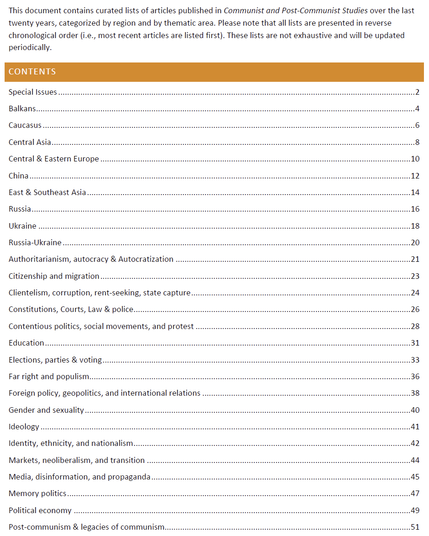
We've got you covered with the Communist and Post-Communist Studies Reading Lists, updated for January 2024!

With links to special issues and key articles from the last decade, categorized by region and subject:

https://drive.google.com/file/d/1KVF2TVIxEKaKL4tIpEro6Z5zUpeFxpva/view?usp=sharing

CPCS Reading Lists January 2024.pdf

Google Docs

Thrilled to see that my article with David Stroup, "On the Outside Looking In: Ethnography and Authoritarianism," is now officially published in Perspectives on Politics--and as the lead article in a fantastic themed section on "Methods, Ethics, Motivations: Connecting the How and Why of Political Science"!

It's open access so read away:
https://doi.org/10.1017/S1537592722004182

On the Outside Looking In: Ethnography and Authoritarianism | Perspectives on Politics | Cambridge Core

On the Outside Looking In: Ethnography and Authoritarianism - Volume 21 Issue 4

Cambridge Core

The December issue of Communist and Post-Communist Studies is online! Featuring a themed section on Political Participation in Post-Communist Europe During the COVID-19 Pandemic, guest edited by Sergiu Gherghina, Joakim Ekman, and Olena Podolian.

https://online.ucpress.edu/cpcs/issue/56/4

Communist and Post-Communist Studies

University of California Press

Before Oct 7, Russian TV struggled to talk about war in Ukraine while keeping viewers disengaged. The Israel-Hamas war gives it a chance to talk about war and liberation and to give viewers a comforting moral vantage point...while Ukraine smoulders off camera.

More to come!
8/

Note the drop in mentions of nationalist enemies in the previous slide?

Or the sudden rise in mentions of refugees and liberation since October, while mentions of the SMO and patriotism remain relatively unchanged?

Yeah, that's not about Ukraine.

It's about Israel-Hamas.

7/

Mentions of schemes against Russia and mentions of occupied territories have plummeted, though mentions of the SMO remain relatively stable.

At first glance, it appears to be a return to the geopolitical narratives that Russia peddled in advance of the war. BUT...
6/

War was mentioned on and off in 2022 until becoming a permanent fixture by mid-January.

Nationalists were mentioned throughout 2022-2023 until October.

If we zoom in on depictions of Russia's enemies, the shift is pretty stark: these days, it's all America, all of the time.
5/

So, what topics are consistently mentioned more often than the weather?

🔵 Year 1: Nationalists, Putin, Security, Special Military Operation, Ukraine, USA

🔵 Year 2: Putin, Security, Special Military Operation, Ukraine, USA, War

Did you spot the difference?
4/

To avoid artificially depressing the relative measures, we've dropped several narratives from our tracking:

✅Genocide & info warfare ceased to be salient just 2 wks into the war;

✅Denazification & demilitarization, official justifications for war, also faded quickly;

✅Remember threats of chemical-biological weapons and rumors of biolabs? Both ceased to be salient after about 1 mo.;

✅Humanitarian corridors & human shields faded in June 2022, shortly after the occupation of Mariupol.
3/