
Joshua Lake

45 Followers
58 Following
24 Posts
Husband. Father to two boys. White-collar defense attorney in Houston. Former AFPD. All opinions are my own only.
Biohttps://khalil.law/about-joshua

Court Watch #15 is out. Our weekly roundup of the most interesting court records in the federal dockets. In this issue, we talk about right/left wing energy threats, a nationwide human trafficking network, a popular rapper under investigation for living his lyrics, an spoofed bank, and Instagram weed, to name a few.

https://seamushughes.substack.com/p/court-watch-15-dont-do-it-for-the

Court Watch #15: Don't Do It for the Gram

Plus Energy Threats, Antisemites, Spoofed Banks, Human Trafficking, and Apartment Leases

Court Watch
In white-collar federal cases, a defendant's sentence is typically based on their crime's "intended loss," rather than the actual loss they caused. But that rule may be changing. My colleague and I wrote about the shifting landscape: https://khalil.law/february-2023
White-Collar Federal Sentencing: Is "Intended Loss" Irrelevant? — Khalil Law PLLC

White-collar federal sentences are typically driven by the amount of loss caused by a crime. To most people’s surprise, however,

Khalil Law PLLC

Super excited to be able to publish @kathryntewson's first Techdirt guest post... You do not want to miss this one.

"The World’s First Robot Lawyer Isn’t A Lawyer, And I’m Not Sure It’s Even A Robot"

https://www.techdirt.com/2023/01/24/the-worlds-first-robot-lawyer-isnt-a-lawyer-and-im-not-sure-its-even-a-robot/

The World’s First Robot Lawyer Isn’t A Lawyer, And I’m Not Sure It’s Even A Robot

Note: This post is an adaptation of what started initially as a Twitter thread. I’ve been going pretty hard on DoNotPay and its founder/CEO Joshua Browder for the past couple of days, and I&#…

Techdirt
On Tuesday, the en banc Fifth Circuit will hear oral argument to decide how much deference courts should give to commentary for the federal Sentencing Guidelines. That case, Vargas, could have major implications for federal criminal defendants. Here's a summary of the case by Jackson Walker: https://www.jw.com/news/sentencing-guidelines-fifth-circuit/
Major Case Alert: Is the Fifth Circuit About to Transform How Courts Apply Sentencing Guidelines? – Jackson Walker

On January 24, 2023, the Fifth Circuit Court of Appeals will sit en banc to decide how much deference courts should give commentary to the U.S. Sentencing Guidelines. The full Court will do so in the much-anticipated case of United States v. Vargas, 21-20140. Specifically, the Court will decide whether the Supreme Court’s decision in Kisor v. Wilkie, which limited judicial deference to agency interpretations, extends to the Guidelines. By Jennifer Freel & Michael Murtha

Jackson Walker
Public Defenders Are at a Breaking Point

For decades, public defenders have been told to “tough it out” in the face of trauma. That’s finally starting to change.

Slate

I've been struck by this Greg Jaffe article about one of the January 6 defendants and how hard it is to decide what sentence would be fair. Each defendant is far more than the one terrible event bringing them into court, but how do you balance everything?

The article is really about two defendants, with both cases involving a mix of crime, grace, and mercy. No matter your view of either crime, it's a beautiful picture of how hard criminal #sentencing is in every case.

https://www.washingtonpost.com/national-security/2023/01/05/jan-6-rioter-prison-or-mercy/

Prison or mercy? A Jan. 6 rioter weighs his sins and confronts his fate.

Eight years before he stormed the Capitol, Jake Peart acted with ‘unfathomable’ grace toward a woman who had killed his sister. A judge must decide if it matters.

The Washington Post

The Third Circuit is going en banc to decide whether it is constitutional to prohibit people with certain non-violent felony convictions from possessing firearms. Oral argument is set for February 15.

https://www2.ca3.uscourts.gov/opinarch/212835po.pdf

@doncruse The few stories I've found about this are light on details. I share that concern as well as a worry about the ethical issues of a non-lawyer (and non-person, at that) dispensing legal advice.

This is fascinating. New Scientist reports that next month, at a court hearing for a speeding ticket, a defendant will be advised by an AI "legal assistant" communicating through an earpiece.

https://www.newscientist.com/article/2351893-ai-legal-assistant-will-help-defendant-fight-a-speeding-case-in-court/

AI legal assistant will help defendant fight a speeding case in court

In February, an AI from DoNotPay is set to tell a defendant exactly what to say and when during an entire court case. It is likely to be the first ever case defended by an artificial intelligence

New Scientist

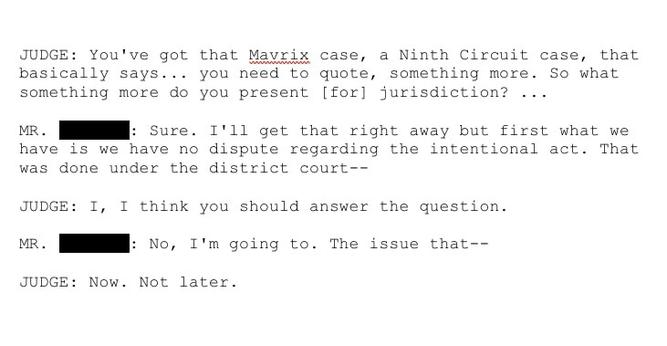
#Appellate Nibs No. 4: Oral argument is a listening exercise.

You’re writing a brief. How amazing would it be to magically peek inside your judges’ minds and learn what they really think of your arguments? To know which issues they see as problematic? To learn where they’re already persuaded, so you can focus on what matters?

You can! …at the podium. That’s why, at argument, it's so important to listen. To inquire. To treat it as a conversation. And to never say, “I’ll get there, but first…”