Jonathan Stray

@jonathanstray
760 Followers
139 Following
139 Posts
Working on better personalized news and information at
@CHAI_Berkeley. Previously computational journalism @columbiajourn. Editor, @better_conflict. More at jonathanstray.com.
Aside from the science we're doing, one of the great lessons here has been how hard it has been to arrange collaboration between external platforms and platform teams. There's a lot of distrust! But I don't see any other way of solving these problems.
3/3

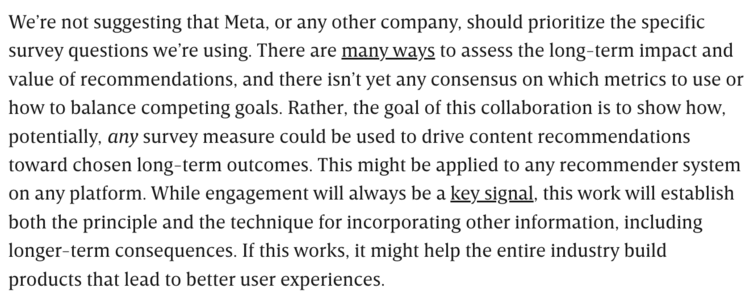
We're asking participating users (consenting, and paid) to answer a weekly survey for three months -- a version of the Online Social Support scale. And use their answers to adjust feed ranking.

If this works, it will demonstrate a method that might be used by any platform.

2/3

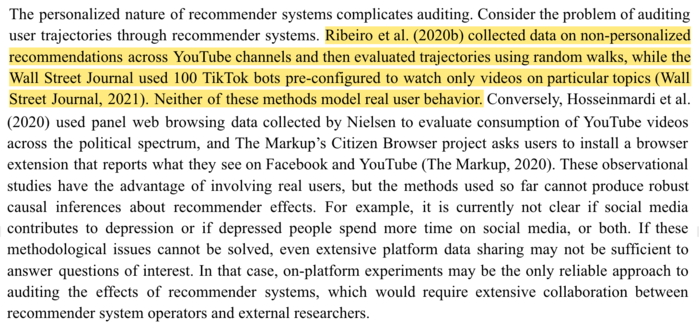
The lesson is this: don't believe any platform "audit" that doesn't carefully simulate what real users actually do.

So far, pretty much every study has used either random clicks or bots programmed to have monomaniacal interest in something bad.

So what will work instead? On-platform experiments. We covered this in our big recommender paper last year. http://arxiv.org/abs/2207.10192
2/2

Building Human Values into Recommender Systems: An Interdisciplinary Synthesis

Recommender systems are the algorithms which select, filter, and personalize content across many of the worlds largest platforms and apps. As such, their positive and negative effects on individuals and on societies have been extensively theorized and studied. Our overarching question is how to ensure that recommender systems enact the values of the individuals and societies that they serve. Addressing this question in a principled fashion requires technical knowledge of recommender design and operation, and also critically depends on insights from diverse fields including social science, ethics, economics, psychology, policy and law. This paper is a multidisciplinary effort to synthesize theory and practice from different perspectives, with the goal of providing a shared language, articulating current design approaches, and identifying open problems. It is not a comprehensive survey of this large space, but a set of highlights identified by our diverse author cohort. We collect a set of values that seem most relevant to recommender systems operating across different domains, then examine them from the perspectives of current industry practice, measurement, product design, and policy approaches. Important open problems include multi-stakeholder processes for defining values and resolving trade-offs, better values-driven measurements, recommender controls that people use, non-behavioral algorithmic feedback, optimization for long-term outcomes, causal inference of recommender effects, academic-industry research collaborations, and interdisciplinary policy-making.

arXiv.org

This tweet claims there were two specific bugs which were restricting distribution on Musk's account.
https://twitter.com/elonmusk/status/1624660886572126209

I had previously guessed that the story about him firing an engineer in a fit of petty narcissism was incorrect. It had a "too good to be true" vibe and there was no mention of a recording of the actual events. https://mastodon.social/@jonathanstray/109838184931064293

We are all more likely to believe stories which make people we dislike look stupid.
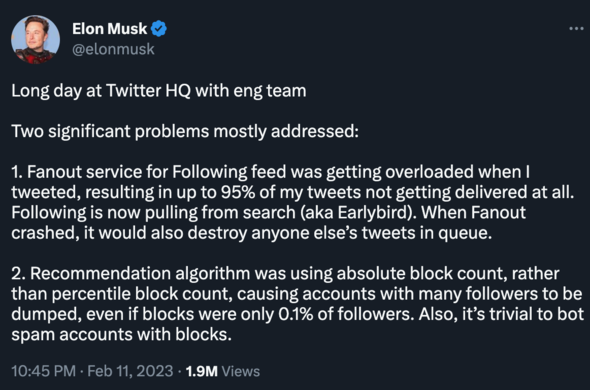
Elon Musk (@elonmusk) on X

Long day at Twitter HQ with eng team Two significant problems mostly addressed: 1. Fanout service for Following feed was getting overloaded when I tweeted, resulting in up to 95% of my tweets not getting delivered at all. Following is now pulling from search (aka Earlybird).
X (formerly Twitter)

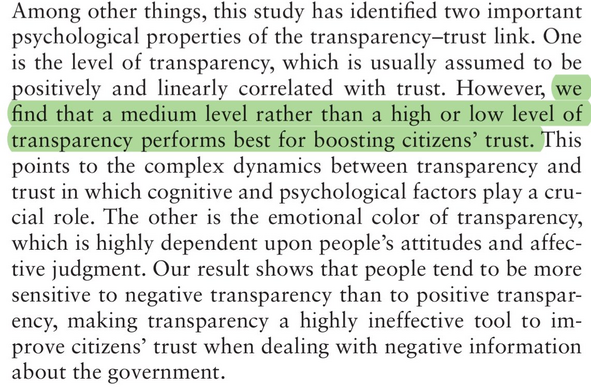
"Our experiment’s failure provides one example of a more general conclusion: transparency does not a-priori improve legitimacy."

And this is true! This finding has robust external support!
https://academic.oup.com/jpart/advance-article-abstract/doi/10.1093/jopart/muac040/6712384?login=false

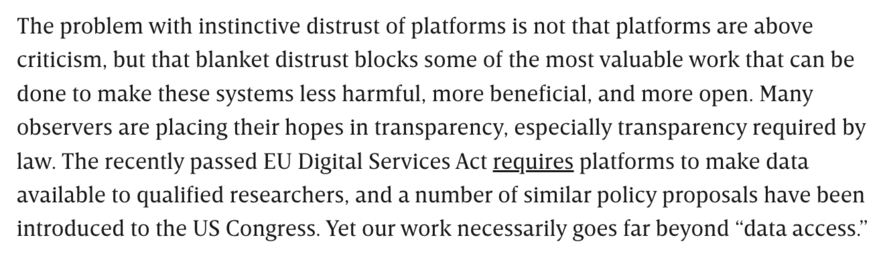
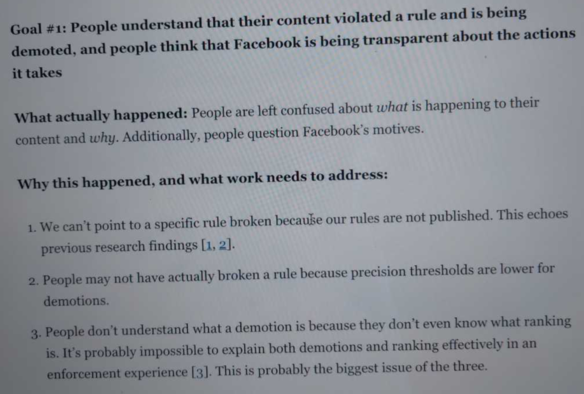
Twitter is showing view counts in an attempt to increase transparency around content demotions, so people don't feel "shadow banned." Will this also increase legitimacy? Internal Facebook research suggests this is not a sure thing.
https://t.co/72Zf9frC9e
DocumentCloud

Touching grass today.
Never Not Repost "So You Want To Reform Democracy" by @josh. A stone-cold classic. https://medium.com/civic-tech-thoughts-from-joshdata/so-you-want-to-reform-democracy-7f3b1ef10597
So you want to reform democracy

Hello. You probably just wrote me an email that went something like this…

Medium

This is an especially vivid demonstration of the difference between voting and democracy. It’s why social choice theory doesn’t solve politics.

Which is also why blockchain and decentralization isn’t “democracy” 🔥