John Gramlich

303 Followers
85 Following
33 Posts
I'm an associate director at the Pew Research Center in Washington, DC.
Verified byhttps://fedified.com
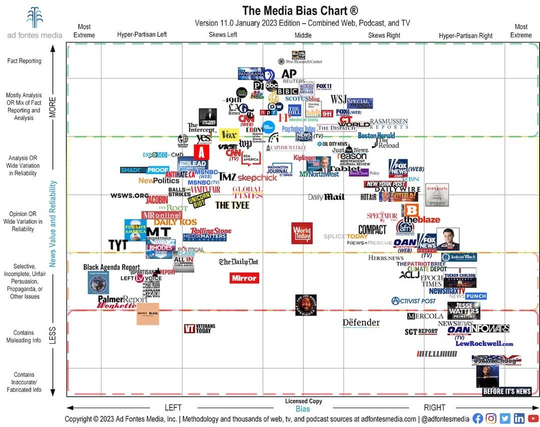
Nice to see Pew Research Center at the top (most fact-based) and center (least ideological) of this chart about media bias. For more about the chart and what considerations go into it, here's some background info from the person who developed it: https://www.poynter.org/reporting-editing/2023/why-i-decided-to-rate-the-news/
Why I decided to rate the news - Poynter

To cut through the vitriol and have productive debate, we need to understand the political leanings of our information sources

Poynter

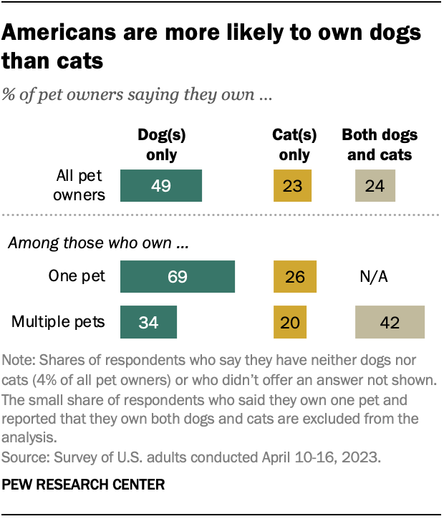
62% of Americans own a pet, and nearly all of these folks see their pet as a member of their family, according to a new Pew Research Center survey.

So which is more popular, dogs or cats? It's a controversial question, but the data's clear: Among U.S. pet owners, more than twice as many own a dog as own a cat (49% vs. 23%), though a fair number own both (24%).

Full analysis available here: https://pewrsr.ch/3JPtwoR

About half of U.S. pet owners say their pets are as much a part of their family as a human member

Most Americans (62%) own a pet, including 35% who have more than one. And nearly all U.S. pet owners (97%) say their pets are part of their family.

Pew Research Center
A quarter of 40-year-olds in the United States have never been married. That's a record high. https://pewrsr.ch/3NQ9MDX
A record-high share of 40-year-olds in the U.S. have never been married

As of 2021, 25% of 40-year-olds in the United States had never been married, a significant increase from 20% in 2010.

Pew Research Center
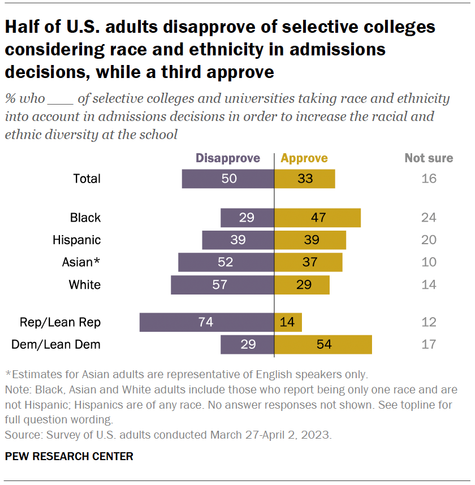
With the Supreme Court set to decide a major case on the consideration of race and ethnicity in college admissions, how does the American public feel about it? In a new Pew Research Center survey, 50% of Americans disapprove of this type of race-conscious admissions policy, while 33% approve and 16% aren't sure. Full survey here: https://pewrsr.ch/3X3rOG0
More Americans Disapprove Than Approve of Colleges Considering Race, Ethnicity in Admissions Decisions

Half of U.S. adults say they disapprove of selective colleges and universities taking prospective students’ racial and ethnic backgrounds into account when making admissions decisions. 33% approve of colleges considering race and ethnicity to increase diversity at the schools, while 16% are not sure.

Pew Research Center - U.S. Politics & Policy

Lots of news stories and research articles look at America and Americans through the lens of generation – Gen Z, Millennials, Gen X, Baby Boomers and so on. But do these labels and groupings have any real meaning, or are they just clickbait?

This new Pew Research Center piece looks at some important considerations that are worth keeping in mind anytime you encounter a news story or piece of research about generations: https://pewrsr.ch/3MLHQRg

5 things to keep in mind when you hear about Gen Z, Millennials, Boomers and other generations

It can be useful to talk about generations, but generational categories are not scientifically defined and labels can lead to stereotypes and oversimplification.

Pew Research Center

Gun deaths among US kids under the age of 18 rose 50% in the first two years of the pandemic, according to a new Pew Research Center analysis of the latest mortality statistics from the CDC.

Black kids were five times as likely as White kids to die from gun-related injuries in 2021, and the causes differed widely by race, too: Homicides were by far the leading type of gun death among Black kids that year, while suicides were the leading cause among White kids.

More: https://pewrsr.ch/413hy18

Gun deaths among U.S. children and teens rose 50% in two years

In 2021, there were 2,590 gun deaths among U.S. children and teens under the age of 18, up from 1,732 in 2019.

Pew Research Center
American airstrikes hit Baghdad 20 years ago today, officially beginning the war in Iraq. A new Pew Research Center data essay looks back at American public opinion before, during and after the war, from "weapons of mass destruction" to "mission accomplished" and, years later, to the withdrawal of U.S. troops. Link here: https://www.pewresearch.org/politics/2023/03/14/a-look-back-at-how-fear-and-false-beliefs-bolstered-u-s-public-support-for-war-in-iraq/
A Look Back at How Fear and False Beliefs Bolstered U.S. Public Support for War in Iraq

Twenty years ago this month, the U.S. launched a major invasion of Iraq. President George W. Bush and his administration at first drew broad public support for the use of military force. Yet the campaign soon left Americans deeply divided, and by 2019, 62% said the Iraq War was not worth fighting.

Pew Research Center
Russia began its war on Ukraine a year ago today. Since then, international attitudes about Vladimir Putin and Russia have turned much more negative, while views of NATO have become more positive. In the US, Republicans have become less likely to see the conflict as a major threat to American interests and more likely to say the United States is providing too much aid to Ukraine. Here's a look back at these and other shifts in public opinion in the first year of the war: https://pewrsr.ch/3kkUZp5
What public opinion surveys found in the first year of the war in Ukraine

Attitudes toward Russia and Vladimir Putin turned much more negative, while opinions of NATO grew more positive.

Pew Research Center

It's almost Super Bowl Sunday. Here's the percentage of US adults who say they have bet money on sports in some way in the past year:

All US adults: 19%

Men: 24%
Women: 15%

Black adults: 27%
Hispanic adults: 24%
White adults: 18%
Asian adults: 10%

Upper-income adults: 22%
Middle-income adults: 19%
Lower-income adults: 19%

Complete findings here: https://pewrsr.ch/3qDMmoY

As more states legalize the practice, 19% of U.S. adults say they have bet money on sports in the past year

Despite the growth of commercial sports betting, the most common way that Americans bet on sports is with friends or family.

Pew Research Center
Differences between Republicans and Democrats are common, but sometimes there are big differences *within* each party, too. Consider this chart from a new Pew Research Center survey. It shows that Black and Hispanic Democrats differ from White Democrats on key policy priorities. For example, around two-thirds of Black and Hispanic Democrats say reducing crime should be a top priority for Joe Biden and Congress this year, but only a third of White Democrats say the same. https://pewrsr.ch/3l7IPjf
Economy Remains the Public’s Top Policy Priority; COVID-19 Concerns Decline Again

Americans now see reducing the budget deficit as a higher priority for the president and Congress to address than in recent years. But strengthening the economy continues to be the public’s top policy priority.

Pew Research Center - U.S. Politics & Policy