
Julian Jaursch

@jjaursch
319 Followers
314 Following
401 Posts
Platform regulation: Policy approaches and enforcement. Formerly at interface think tank but now private account.
Former work at interface think tankhttps://www.interface-eu.org/persons/dr-julian-jaursch
Webhttps://jaursch.com
Bluesky bridgehttps://bsky.app/profile/jjaursch.mastodon.social.ap.brid.gy

Vom "Ringen um Definitionen und Sanktionen", von "pauschaler Breitseite" gegen EU", Diskussion um Pressefreiheit: Es ging im Digitalausschuss des Bundestags um Transparenz bei politischer Werbung.

Zusammenfassung hier von @roofjoke: https://netzpolitik.org/2026/politische-online-werbung-bundestag-soll-schutz-der-pressefreiheit-sicherstellen/

Politische Online-Werbung: Bundestag soll Schutz der Pressefreiheit sicherstellen

Deutschland muss EU-Vorgaben zum Schutz vor digitalen Manipulationskampagnen umsetzen. Bei einer Anhörung im Bundestag kritisierten Sachverständige zu weite Definitionen und warnten vor Folgen für die Pressefreiheit. Der Bundesverband der Zeitungsverleger und die AfD wollen die Regeln am liebsten ganz abschaffen.
netzpolitik.org

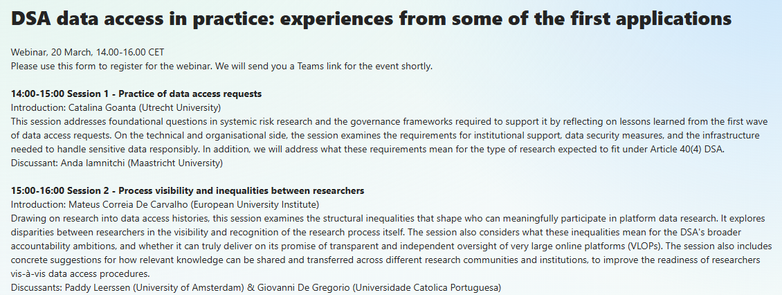
The researchers offer a webinar on the Article 40 process: "DSA data access in practice: experiences from some of the first applications"

https://forms.cloud.microsoft/Pages/ResponsePage.aspx?id=oFgn10akD06gqkv5WkoQ5311laz6z2tOoWxRAsObH1VUODM1MVlCRzQwWEREWE1TQTdLQ08xVVVaOS4u

March 20, 14.00-16.00 CET

Very good to see a reflection on a completed (albeit rejected) data access process under the DSA.

The four takeaways from @goanta and Anda Iamnitchi were interesting to read @dsaobservatory: https://dsa-observatory.eu/2026/03/12/if-at-first-you-dont-succeed-reflections-on-a-rejected-art-40-dsa-data-access-request/

If at first you don’t succeed: Reflections on a rejected Art. 40 DSA data access request - DSA Observatory

By Catalina Goanta & Anda Iamnitchi Article 40 of the Digital Services Act was hailed as a breakthrough for platform research. But what does the the procedure look like in practice? Drawing on their own rejected data access request, the authors reflect candidly on early lessons for the first wave of Article 40 applications, and what researchers should know before applying for access to platform data. Readers are also invited to contribute to an ongoing researcher survey and join a webinar on 20 March to unpack more lessons learned with DSA data access.

DSA Observatory - a hub of expertise on the DSA package.

Important initiative: "Tech researchers sue Trump over visa bans" >> https://www.npr.org/2026/03/09/nx-s1-5741213/trump-censorship-visas-deportation-lawsuit

"The suit accuses the administration of violating the First Amendment with an official policy to deny visas to or deport noncitizens who work on or study social media platforms, fact-checking or other activities the government deems "censorship" of Americans' speech. It argues that amounts to unconstitutional viewpoint discrimination."

Additional info + full complaint here: https://knightcolumbia.org/content/technology-researchers-challenge-trump-policy-threatening-deportation-for-work-on-social-media-platforms-and-online-harms

Researchers won a legal case to access X's public data under the DSA.

From those involved in the case (@Freiheitsrechte and DRI @Meyer_Resende) ➡️

What the Berlin ruling changes for researchers
1. Access to platform data is a subjective right of researchers
2. Who counts as a “researcher”?
3. Setting the data protection benchmark
4. Systemic risks: the ruling confirms a broad and inclusive interpretation

https://www.techpolicy.press/how-researchers-won-a-legal-fight-to-access-xs-data-under-the-dsa/

How Researchers Won a Legal Fight to Access X's Data Under the DSA

A Berlin court has delivered a consequential ruling, ordering X to grant Democracy Reporting International access to its publicly available data.

Tech Policy Press

Dazu: Einer der Autoren ist bald im Gespräch mit HateAid-Co-Chefin Josephine Ballon.

Geht auch darum, was unsachliche Kritik am DSA für drastische Auswirkungen für die Zivilgesellschaft haben kann (ohne in irgendeiner Weise Verbesserungen für Verbraucher:innen zu erzielen).

Online, 18.03., 15-16 Uhr:
https://www.hiig.de/events/under-pressure-the-dsa-as-source-of-transatlantic-tensions-and-their-effects-on-digital-human-rights-defenders-and-experts/

Unter Druck: Der DSA als Quelle transatlantischer Spannungen – HIIG

Wir untersuchen die transatlantischen Spannungen rund um den Digital Services Act der EU und blicken auf die Zukunft dessen Implementierung.

HIIG

"Overblocking", Risikoberichte, "trusted flagger": Immer wieder werden diese Themen aus dem DSA als mögliche Gefahren für die Meinungsfreiheit aufgeführt.

Und immer wieder gibt es gute Texte, die diese Kritik einordnen und teils entkräften.

Zuletzt von M. Kettemann und W. Schulz in der FAZ: https://www.faz.net/aktuell/feuilleton/medien-und-film/medienpolitik/digital-services-act-schutz-der-meinungsfreiheit-statt-zensur-110847167.html

(Deutlich umfangreichere Version hier: https://leibniz-hbi.de/hbi-publications/meinungsaeusserungsfreiheit/)

Geht (beabsichtigt oder nicht) auf so gut wie alle Punkte aus diesem Text ein: https://www.welt.de/debatte/article699d8291d2efdf1bd0d30a72/digital-services-act-so-gefaehrdet-die-eu-die-meinungsfreiheit.html

Digital Services Act: Schutz der Meinungsfreiheit statt Zensur

Das Digitalgesetz der EU, der „Digital Services Act“, greifen manche Kritiker als vermeintliches Instrument der Zensur an. Von Zensur zu sprechen, ist aber Unsinn. Das Gesetz sichert die Meinungsfreiheit.

Frankfurter Allgemeine Zeitung

Looking at Meta and TikTok, this report compares US litigation and EU-level risk assessments (from the DSA) regarding potential risks posed by platforms.

https://kgi.georgetown.edu/research-and-commentary/measuring-risk-what-eu-risk-assessments-and-us-litigation-reveal-about-meta-and-tiktok/

Part of the conclusion:
- US litigation surfaces novel/unknown documents but is reactive/late
- DSA risk assessments are proactive/early but mostly state platform policies

Summarized at Tech Policy Press: https://www.techpolicy.press/what-us-lawsuits-reveal-about-platform-design-that-dsa-reports-dont/

Measuring Risk: What EU Risk Assessments and US Litigation Reveal About Meta and TikTok – Knight-Georgetown Institute

Knight-Georgetown Institute

Some great insights/summary of US efforts to badmouth and unduly pressure NGOs, thus undermining DSA enforcement (because DSA enforcement relies in part on the important research fron outside of bureaucracies).

@fantafanta and @harmbotje at @FTM_nl: https://www.ftm.eu/articles/trump-allies-fight-target-europe-battle-big-tech

Trump allies target European NGOs in battle over Big Tech rules

Trump allies have waged an aggressive campaign against civil society and academics in the United States. Now, they’re setting their sights across the Atlantic, threatening Europe’s efforts to rein in Big Tech.

Follow the Money - Platform for investigative journalism

"Laws like the the DSA apply to all online platforms, regardless of where they are based"

"The strong reactions to the Digital Services Act demonstrate the law’s power incurbing Big Tech andit shows the need for rapid enforcement."

--> @bitsoffreedom via @edri: https://edri.org/our-work/us-pressure-on-the-digital-services-act-in-the-netherlands/

US pressure on the Digital Services Act in the Netherlands - European Digital Rights (EDRi)

On 3 February 2026, the United States House Committee on the Judiciary launched a report in which EDRi member Bits of Freedom and Justice for Prosperity, among others, are called "censorous NGOs".

European Digital Rights (EDRi)