Jascha Sohl-Dickstein

1.2K Followers
140 Following
27 Posts
Senior staff research scientist, Google Brain. Inventor of diffusion models. Machine learning $\otimes$ physics $\otimes$ neuroscience.
Bloghttps://sohl-dickstein.github.io/
Websitehttps://sohldickstein.com

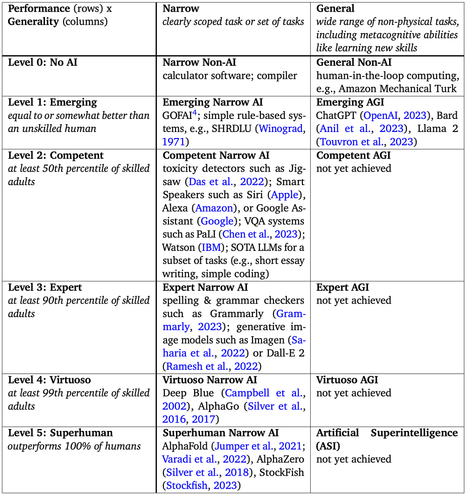
These Levels of AGI provide a rough framework to quantify the performance, generality, and autonomy of AGI models and their precursors. We hope they help compare models, assess risk, and measure progress along the path to AGI.

(AlphaGo is a Level 4 "Virtuouso" Narrow AI)

Levels of AGI: Operationalizing Progress on the Path to AGI

Levels of Autonomous Driving are extremely useful, for communicating capabilities, setting regulation, and defining goals in self driving.

We propose analogous Levels of *AGI*.

(ChatGPT is a Level 1 "Emerging" AGI)
Living creatures, human organizations, and machine learning models are all judged to become more of a hot mess (less coherent) as they grow more intelligent. This suggests that AI failing to pursue a consistent goal is more likely than AI pursuing a misaligned goal.
Most work on AI misalignment risk is based on an assumption that more intelligent AI will also be more coherent. This is an assumption we can test! I collected subjective judgements of intelligence and coherence from colleagues in machine learning and neuroscience.

The hot mess theory of AI misalignment (+ an experiment!)
https://sohl-dickstein.github.io/2023/03/09/coherence.html

There are two ways an AI could be misaligned. It could monomaniacally pursue the wrong goal (supercoherence), or it could act in ways that don't pursue any consistent goal (hot mess).

The hot mess theory of AI misalignment: More intelligent agents behave less coherently

This blog is intended to be a place to share ideas and results that are too weird, incomplete, or off-topic to turn into an academic paper, but that I think may be important. Let me know what you think! Contact links to the left.

Jascha’s blog

And huge thank you also to the other collaborators on this project -- Daniel Freeman, Amil Merchant, @lb @jekbradbury , Naman Agarwal, Ben Poole, Igor Mordatch, and Adam Roberts.

(and if any of you are on Mastodon, but I missed looking up your username -- very sorry, and please reply and claim credit!)

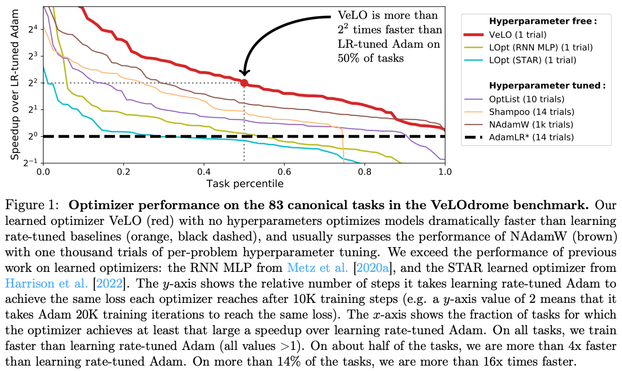
Meta-training learned optimizers is HARD. Each meta-training datapoint is an entire optimization task, so building a large meta-training dataset is HARD. Each of N meta-training steps can contain N training steps applying the learned optimizer -- so compute is also extreme (N^2).

If you are training models with < 5e8 parameters, for < 2e5 training steps, then with high probability this LEARNED OPTIMIZER will beat or match the tuned optimizer you are currently using, out of the box, with no hyperparameter tuning (!).

https://velo-code.github.io
https://arxiv.org/abs/2211.09760

Redirecting to https://github.com/google/learned_optimization/tree/main/learned_optimization/research/general_lopt

If there is one thing the deep learning revolution has taught us, it's that neural nets will outperform hand-designed heuristics, given enough compute and data.

But we still use hand-designed heuristics to train our models. Let's replace our optimizers with trained neural nets!