Cory Whitney

@human_ecologist
2 Followers
4 Following
8 Posts
Migrant academic, ultra runner, research/ experiential teaching #decisionanalysis, #humanecology #agrobiodiversity, editor @ EBL & HER, he/him
human ecologyagroecology
agroforestrybayesian
decision analysisultra marathon
runningdecision analysis

Studying the cultural importance of plant species helps us understand human ecology. Plants have played crucial roles in the development and traditions of communities around the world, and by learning about them we can both preserve cultural heritage and gain insight into sustainable ways of living.

#plants #culture #sustainability

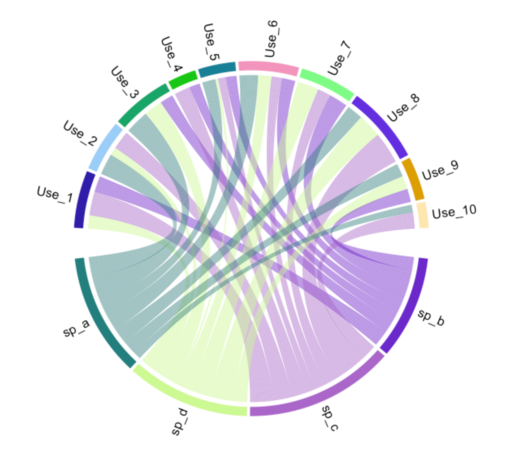
A friendly vignette from ethnobotanyR 0.1.9

tinyurl.com/47yyhmty
@nrennie @ERDonnachie I am here in Germany and can attest to the lack of doctors. I would not be surprised if the number has dropped and the gap between UK and Germany grown since 2018.

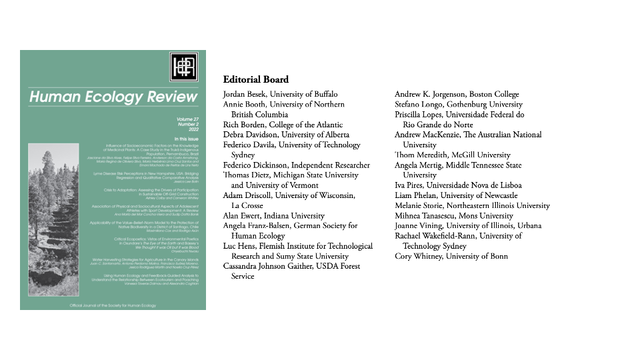
Human Ecology Review 27:2 is out with a range of human ecology topics from environmental-ecopoetics to water-harvesting and conservation; cases from Brazil to Nigeria.

Thanks to @dyball_rob @ANU_Press @OurANU

http://doi.org/10.22459/HER.27.02.2022

Human Ecology Review: Volume 27, Number 2

Human Ecology Review 27(2) features contributions from researchers from around the world, including Brazil, the United States, Mexico, Chile, Australia, Uruguay, Spain, and Nigeria.

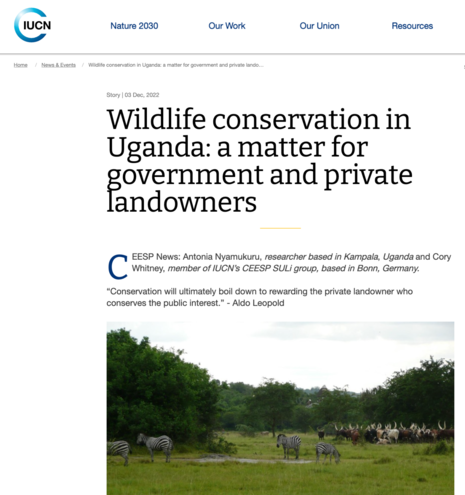
Ecology and agriculture do not have to be at odds. Our @IUCN_CEESP piece on involving private landowners in wildlife conservation to protect wild animals when they are outside of Uganda's parks

https://iucn.org/story/202212/wildlife-conservation-uganda-matter-government-and-private-landowners

@UniBonn @Makerere @wcs_uganda @ugwildlife

Wildlife conservation in Uganda: a matter for government and private landowners

CEESP News: Antonia Nyamukuru, researcher based in Kampala, Uganda and Cory Whitney, member of IUCN’s CEESP SULi group, based in Bonn, Germany.    “Conservation will ultimately boil down to rewarding the private landowner who conserves the public interest.” - Aldo Leopold

IUCN

Human values influence the prioritization and management of woody species - Read more in this case study in Awach Sub-county, Gulu District, Uganda

https://doi.org/10.1007/s10745-022-00360-2

@UniBonn

@ZEFbonn

@HumanEcology


#ethnobotany #humanecology

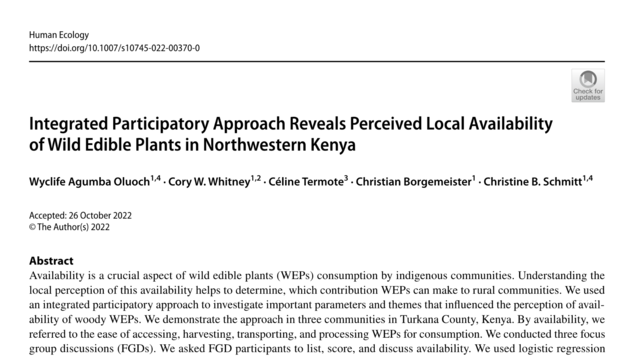
Read about participatory approaches and ethnobotany for assessing the perception of wild edible plants - implications are for sustainable management, conservation and human nutrition

https://doi.org/10.1007/s10745-022-00370-0

@UniBonn

@ZEFbonn

@HumanEcology

#ethnobotany #humanecology

Integrated Participatory Approach Reveals Perceived Local Availability of Wild Edible Plants in Northwestern Kenya - Human Ecology

Availability is a crucial aspect of wild edible plants (WEPs) consumption by indigenous communities. Understanding the local perception of this availability helps to determine, which contribution WEPs can make to rural communities. We used an integrated participatory approach to investigate important parameters and themes that influenced the perception of availability of woody WEPs. We demonstrate the approach in three communities in Turkana County, Kenya. By availability, we referred to the ease of accessing, harvesting, transporting, and processing WEPs for consumption. We conducted three focus group discussions (FGDs). We asked FGD participants to list, score, and discuss availability. We used logistic regression and mixed-content analysis to identify important parameters and themes, respectively. The most important WEPs were the toothbrush tree (Salvadora persica L.), Indian jujube (Ziziphus mauritiana Lam.), and mbamba ngoma (Balanites rotundifolia (Tiegh.) Blatt.). Distance, seasonality, price, and adequacy of harvested WEPs for household consumption were important parameters. Culture and tradition, distribution of WEPs, seasonality, and climate change emerged as important themes. We showed the importance of using an integrated participatory approach when assessing the perception of WEPs’ availability by local communities and could be used in comparable arid and semi-arid areas with semi-nomadic pastoralists across Africa.

SpringerLink

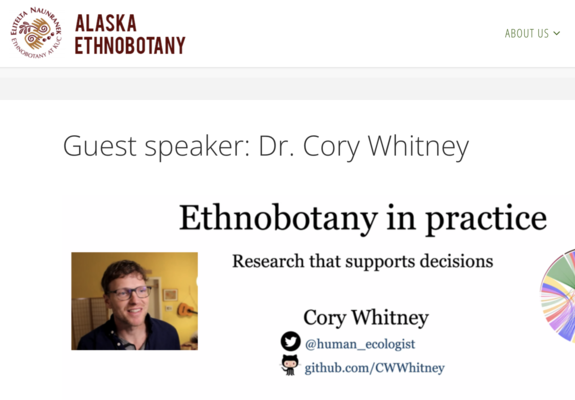
Was an honor to work with the students at the Alaska Ethnobotany Program (EBOT). 'Elitelta naunranek' – Let’s learn about plants!

https://alaskaethnobotany.community.uaf.edu/guest-speaker-dr-cory-whitney/

Guest speaker: Dr. Cory Whitney – Alaska Ethnobotany