Me, reading master 2 students internship reports before their defense 😂

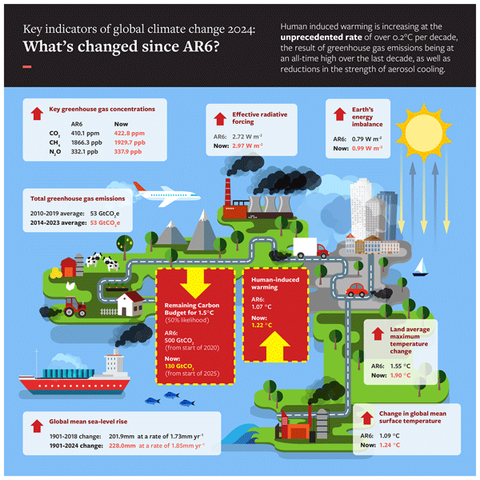
Abstract. In a rapidly changing climate, evidence-based decision-making benefits from up-to-date and timely information. Here we compile monitoring datasets (published at https://doi.org/10.5281/zenodo.15639576; Smith et al., 2025a) to produce updated estimates for key indicators of the state of the climate system: net emissions of greenhouse gases and short-lived climate forcers, greenhouse gas concentrations, radiative forcing, the Earth's energy imbalance, surface temperature changes, warming attributed to human activities, the remaining carbon budget, and estimates of global temperature extremes. This year, we additionally include indicators for sea-level rise and land precipitation change. We follow methods as closely as possible to those used in the IPCC Sixth Assessment Report (AR6) Working Group One report. The indicators show that human activities are increasing the Earth's energy imbalance and driving faster sea-level rise compared to the AR6 assessment. For the 2015–2024 decade average, observed warming relative to 1850–1900 was 1.24 [1.11 to 1.35] °C, of which 1.22 [1.0 to 1.5] °C was human-induced. The 2024-observed best estimate of global surface temperature (1.52 °C) is well above the best estimate of human-caused warming (1.36 °C). However, the 2024 observed warming can still be regarded as a typical year, considering the human-induced warming level and the state of internal variability associated with the phase of El Niño and Atlantic variability. Human-induced warming has been increasing at a rate that is unprecedented in the instrumental record, reaching 0.27 [0.2–0.4] °C per decade over 2015–2024. This high rate of warming is caused by a combination of greenhouse gas emissions being at an all-time high of 53.6±5.2 Gt CO2e yr−1 over the last decade (2014–2023), as well as reductions in the strength of aerosol cooling. Despite this, there is evidence that the rate of increase in CO2 emissions over the last decade has slowed compared to the 2000s, and depending on societal choices, a continued series of these annual updates over the critical 2020s decade could track decreases or increases in the rate of the climatic changes presented here.
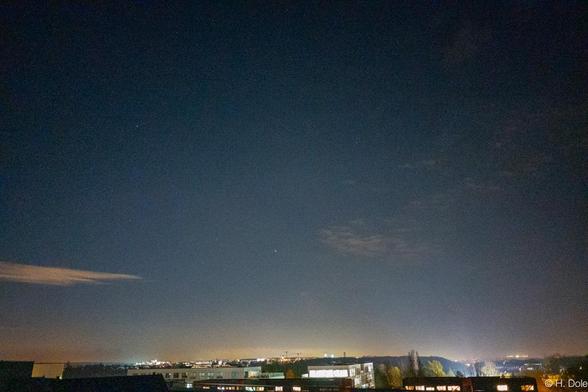
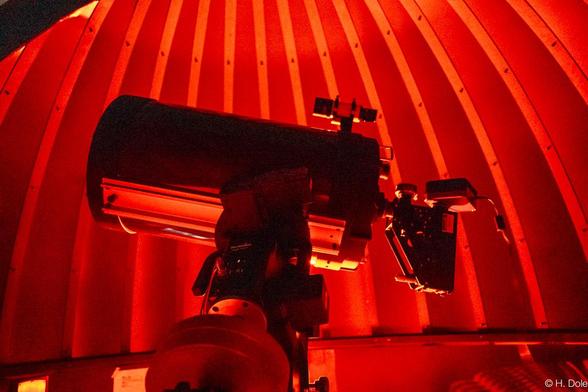
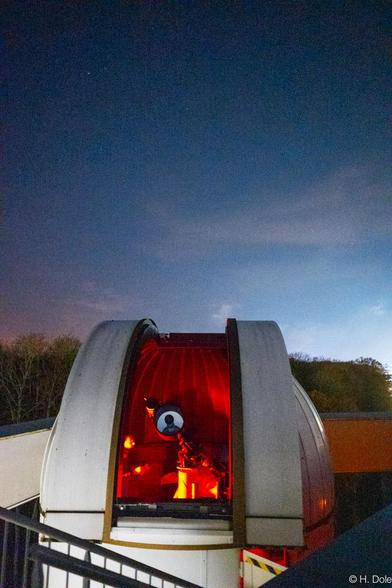
TP d'observation astrophysique ce soir avec nos étudiants de M1: spectroscopie des atmosphères de Jupiter et Saturne. Fun !
Tonight: observing in spectroscopy Jupiter & Saturn atmospheres w/ Master's students.

Hervé Dole est astrophysicien à l'Université Paris-Saclay. A l'aune de son propre parcours et de son expérience en tant que vice-président de l'université Parus-Sud, il dévoile quelques clés qui peuve
La battle des télescopes spatiaux Euclid et JWST ?
Quels liens entre une marmotte, Euclid, une montagne, une galaxie et le JWST ? :-)
Vous saurez tout dans mon dernier article sur TheConversationFrance:
https://theconversation.com/euclid-vs-james-webb-le-match-des-telescopes-spatiaux-230240
Lycéennes, lycéens: interessés par l'astrophysique ?
Mais vous ne savez pas quel métier ni formation #Parcousup choisir ?
Jetez un oeil à mon court article gratuit: https://theconversation.com/comment-devenir-astrophysicien-118563
Ainsi qu'à la vidéo: https://youtu.be/KFJU7q3D2P8
En gros: plein de choix ! bon courage!
La battle des télescopes spatiaux Euclid et JWST ?
Quels liens entre une marmotte, Euclid, une montagne, une galaxie et le JWST ? :-)
Vous saurez tout dans mon dernier article sur TheConversationFrance:
https://theconversation.com/euclid-vs-james-webb-le-match-des-telescopes-spatiaux-230240
Notre école d'été d'astrophysique pour étudiants de L3 & M1 Paris-Saclay OHP fait l'honneur du site de l'IHES :-)
https://www.ihes.fr/hugo-duminil-copin-ecole-ete-ohp/
Avec de belles observations et un soupçon d'Euclid et de maths dedans 🙂

- Du 15 au 20 juillet 2024, Hugo Duminil-Copin, s’est rendu à l’Observatoire de Haute-Provence (OHP) pour participer à l’école d’été annuelle en astrophysique de l’Université Paris-Saclay.

