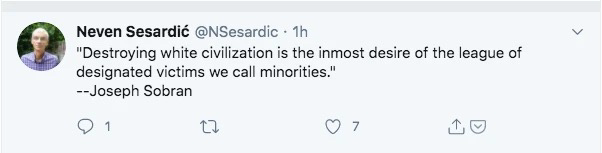
And if you need just a taste of where Cofnas got his approach, his PhD advisor Neven Sesardic consistently denigrates minorities with abandon, while attempting to provide philosophical justification of race concepts. Recently he's become explicitly white supremacist.
Sifting through Animal Behavior Society newsletters and came across a castigation of the field made by Dutch ethologist Adriaan Kortlandt in 1990. He states, "Ethology is supposed to be the study of behaviour, but the behaviour has become invisible." He also used to fight goats during lectures.
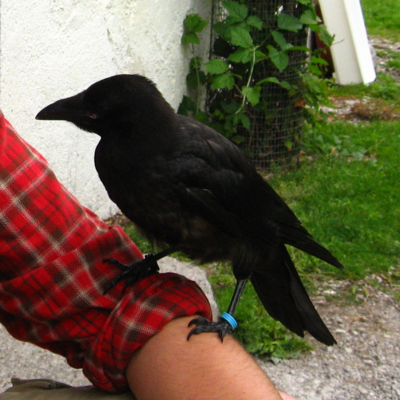
Some staff at my university feed crows from the back of their golf carts. As a result a group of three individuals prowls the parking lots looking for golf carts and consequently have become very confiding.
A Southern Two-striped Walkingstick in the lab this morning. My favorite insect in Florida.
The problem is that innateness is not a neutral concept. It hinders our understanding of ontogeny by posing as a developmental explanation when it is not. Showing that a behavior is predictable across space and time is informative, but it does not reveal how it developed.
But studying development prospectively is grueling and time-consuming. It's rooted in natural history, and fell outside the emphasis on Popperian falsifiable hypothesis testing. This left an opportunity for sociobiology to overlook past critiques and reintroduce innateness into animal behavior.
To truly understand the development of behavior, we have to observe the processes from the beginning. There is no way to predict what retroactive experiences might be causal. So we need to map out the details of the ontogenetic niches that capture a species' typical ontogenetic processes first.
Non-obvious factors guide development. Their existence challenged the retroactive view of development. This view posits that the presence of seemingly non-learned yet prepared responses to the environment is itself evidence of unobserved innate origins.
In particular, they showed that all organisms are constantly interacting and learning from (in the broad sense) their environment. "Innate" behavior that emerges in the first few seconds after hatching still has a long developmental history. Experience is etched into the organism at conception.
At the same time, developmental psychobiologists showed that development is a radically non-linear, dynamic, and constructive process. This process depended on a network of reciprocal interactions between genes, the organism, and the environment, without prioritizing any of them.