Gernot Heiser

310 Followers
4 Following
122 Posts
Physicist by training, computer engineer by passion.
Gernot Heiser FACM FIEEE FTSE FRSN ML is Scientia (distinguished) Professor and John Lions Chair of Operating Systems at UNSW Sydney. He is also the founding Chairman of the seL4 Foundation.

Hi @jamey,
You mentioned our Termite work and ask what happened to it.
Termite had three issues:
1. the (initially very fruitful) collaboration with Intel died before we could get our hands on real device implementations to generate correct specs
2. the synthesis wasn't really the way to go to create good drivers (was attempted to mitigate with the developer-guided synthesis, but only to a limit)
3. it never managed to deal with DMA (that one's bbviously the real killer)

We re-started the driver verification work a few years ago, and now have solutions to all this:
1. we've got a process (which is being further automated) for extracting provably-correct specs from the Verilog source, see https://trustworthy.systems/projects/deviceformalisation/. We've successfully applied it to open-source I2C and (almost complete) SPI controllers, and are targeting a commercial Ethernet controller next
2. we've created for seL4 a driver model that makes it far easier to write correct and performant drivers manually (like Termite making use of the learnings from Dingo), see https://trustworthy.systems/projects/drivers
3. we now have a verification approach that can deal with DMA (and are close to completing verification for a high-performance Ethernet driver)
Device formalisation | TS

Benchmarking Crimes Meet Formal Verification

There are multiple instances of authors comparing verification efforts of systems projects by looking at the ratio of proof to code size. I demonstrate why this is nonsense and constitutes a benchmarking crime.

http://microkerneldude.org/2025/04/27/benchmarking-crimes-meet-formal-verification/

Benchmarking Crimes Meet Formal Verification

There are multiple instances of authors comparing verification efforts of systems projects by looking at the ratio of proof to code size. I demonstrate why this is nonsense and constitutes a benchm…

microkerneldude
Hello Fedoverse,
I joined here when Twitter was going feral in late'22, hoping for a new home.
Unfortunately, this doesn't seem to have taken off, I don't remember when I last saw anything technical in @discuss.systems. Maybe I'm using it incorrectly, but whatever it is, it doesn't seem to work for me.
So I've set up on Bluesky and will be posting there from now on: https://bsky.app/profile/microkerneldude.bsky.social
microkerneldude.bsky.social

Bluesky Social
@sel4 welcome Cyberagentur and thanks for your support!
German cybersecurity funding agency Cyberagentur joins the seL4 Foundation.
Announced that the launch of their ÖvIT program – ecosystem for verified IT – which funds two projects that advance seL4 and its ecosystem: One by Foundation members Kry10 and Proofcraft, the other (PISTIs-V) by Foundation member UNSW Sydney and parters.
https://sel4.systems/news/#member-cyberagentur
https://www.cyberagentur.de/presse/ein-meilenstein-fuer-it-sicherheit-in-deutschland/
News about seL4 and the seL4 Foundation | seL4

A new version of application spam:

"Dear Professor Scientia Professor Gernot Heiser,

"I hope this email finds you well. My name is [Your Full Name], and I have recently completed my ...'

Presentation videos and slides from the seL4 #Summit are now available:
* videos on our YouTube channel: https://www.youtube.com/@seL4
* slides are linked from the Summit program: https://sel4.systems/Foundation/Summit/2024/program
Before you continue to YouTube

"seL4 co-habitating the hardware" with untrustworthy firmware: Roman from ETH at the #seL4Summit about real-world hardware
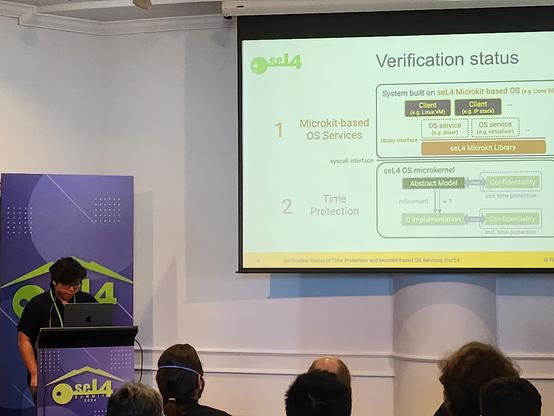
Rob from Trustworthy Systems at the #seL4Summit talks about TS verification work aiming for whole system security
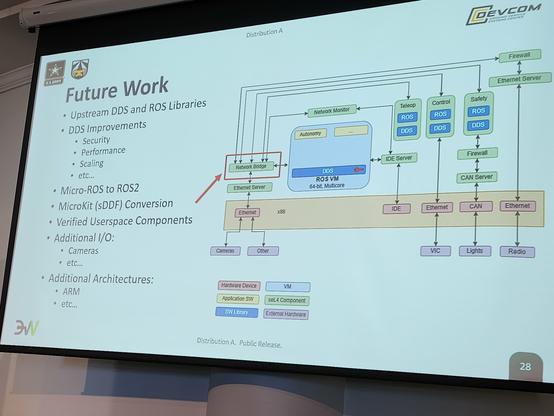
Incremental cyber retrofit at work: Nathan from DornerWorks talks at the #seL4Summit about running ROS on seL4