Gergely Orosz

14.8K Followers
82 Following
195 Posts
Writing https://pragmaticengineer.com the #1 technology newsletter on Substack. Advisor at https://mobile.dev. Uber & Skype alum. Career opportunities for software engineers & EMs: https://pragmaticurl.com/talent
The Pragmatic Engineerhttps://pragmaticengineer.com/
Talent Collectivehttps://pragmaticurl.com/talent
My bookshttps://blog.pragmaticengineer.com/books/
Contact mehttps://blog.pragmaticengineer.com/scoop

Early in my career, I had a mental "ranking" of which companies I imagined were the best in the world. Back then, Google was my #1 spot.

As I gained more experience and met more people, I realized that this type of thinking misses how your team is as important as the company.

And people come and go between companies. The Google of today consists of people who worked at thousands of other companies just a few years before.

A curious thing I noticed: it's so rare for an engineering manager or Staff+ engineer to have a *direct* chat with a business stakeholder. Most rely on PMs to do this, and do the "translation."

And yet, talking with the business directly is such a high-leverage activity for engineering.

I have yet to see pushback from the business: almost always it's the opposite, as they usually *want* to get more attention from engineering, and not less.

I remember how, around 2000, people I knew started to become fulltime online poker players, making thousands in steady income/month.

Then in 2006 the US banned online poker. The same ppl could no longer make a living.

I think of this as the US inches closer to banning crypto exchanges.

These friends of friends back then claimed that making a living as an online poker player was effectively down to skill.

Turned the reason they could do so was b/c casual players in the US funded all this.

An interesting thing to consider on what "senior engineer "means: incentives.

Take developer agencies that bill people out. Their interest will be to bill out senior engineers for higher rates and thus will be lenient in applying this title.

It's in their business interest!

Whereas if we're talking about a company with internal levels - and no "billing pressure" - then this incentive does not exist.

Great post from @gergelyorosz on critical thinking for SWEs:
https://blog.pragmaticengineer.com/critical-thinking/
Is Critical Thinking the Most Important Skill for Software Engineers?

Critical thinking will only become more important as AI tools spread more. How can you get better at this, and why should you reject jargon and "thought leaders?"

The Pragmatic Engineer

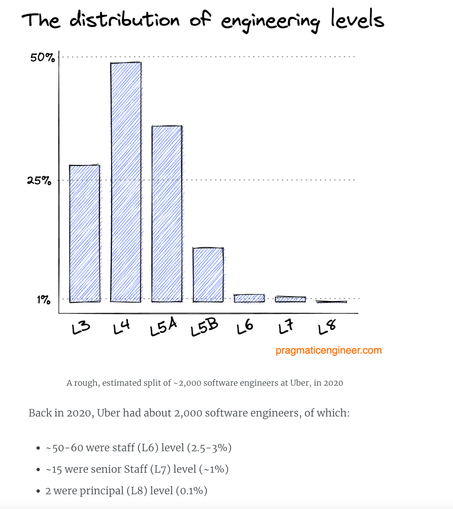
"How hard could it be to get to Staff Engineer at Uber?"

Well, in 2020, about 2-3% of all engineers were at Staff (L6) or above levels. Here's how the distribution looked like, roughly:

Uber has since updated levels. More details in today's The Pragmatic Engineer issue at: https://blog.pragmaticengineer.com/uber-engineering-levels/

Uber’s engineering level changes

Uber revamped its engineering levels in 2022. How did the levels evolve over time, why was it time to change, and what were they? I’ve collected details.

The Pragmatic Engineer

The skill I urge everyone to strengthen is critical thinking.

Whenever you don’t fully understand something: ask “why?” and “how?” and get those answers. Dig deep if need to.

When you think critically, you might not follow the masses at all times. And when you do: you know why.

Sadly, much of social media encourages people to not think for themselves, but take the thoughts of “thought leaders” and “influencers” at face value. Resist the temptation and you’ll be better for it.

How is "senior engineer" defined at your company & what are the expectations at that level?

I'm collecting examples of how this definition differs across different places. I you can share the definition example at yours, I'd be grateful (I will summarize, not share as-is).

You can share over here: https://blog.pragmaticengineer.com/scoop or in DMs.

I'll share the summary doc as well with those sharing details.

Definitions in the public:

Dropbox: https://dropbox.github.io/dbx-career-framework/ic4_software_engineer.html

Sourcegraph: https://handbook.sourcegraph.com/departments/engineering/dev/career-development/framework/

Contact me

👋 This is Gergely, author of The Pragmatic Engineer Newsletter. * Follow me * Message me * Send me scoop * Send me investor updates Follow me You can follow me on the following sites: * My newsletter: The Pragmatic Engineer * On Bluesky: gergely.pragmaticengineer.com * On LinkedIn: Gergely Orosz * On Twitter: @GergelyOrosz * On Mastodon: gergelyorosz@

The Pragmatic Engineer

An uncomfortable question startups need to ask themselves: is our existence & valuation a zero interest rate phenomenon or do we have a business model where we will generate profits, and eventually get to an ARR of ~1/5th of our last valuation?

The answer will be “no” to plenty.

While interest rates were zero, investors funded businesses with unclear business models, and no clear paths to profits. In a high interest world, they will no longer do so.

This was what took Dollar Shave Club’s site down. Not having in-house expertise any more to recover kept them down for 8 days:

https://newsletter.pragmaticengineer.com/p/the-scoop-42

The Scoop #42: Is there a drop in software engineer job openings, globally?

Also: Amazon’s job cuts deepen; pay transparency changes in the US; and the answer on why Dollar Shave Club was down for 8 days straight.

The Pragmatic Engineer