Ferme d’Ambel et roc de Toulau. ❤️ Vercors
“Multiscale Modeling of Physical Properties of Nanoporous Frameworks: Predicting Mechanical, Thermal, and Adsorption Behavior”, with Arthur Hardiagon, now in Acc. Chem. Res.
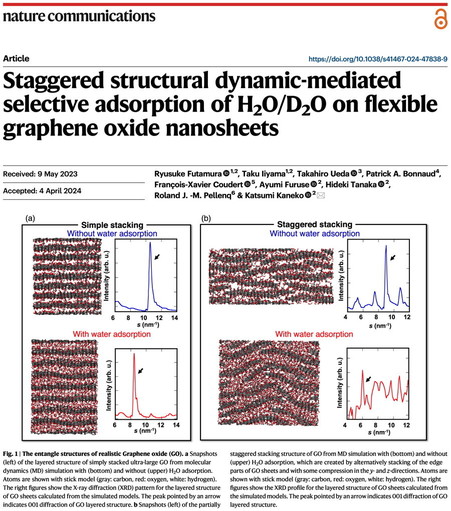
https://pubs.acs.org/doi/10.1021/acs.accounts.4c00161Selective adsorption of H₂O vs. D₂O on flexible graphene oxide nanosheets, large collaborative work lead by Katsumi Kaneko (Shinshu University), now published in Nature Communications
https://www.nature.com/articles/s41467-024-47838-9
Staggered structural dynamic-mediated selective adsorption of H2O/D2O on flexible graphene oxide nanosheets - Nature Communications
Graphene oxide is a promising material for molecular separation technologies. Here, the authors propose a realistic staggered stacking structure that plays a crucial role in H/D recognition in water adsorption, as well as high mobilities of water.
📢 The 2024 Database of MOF Reviews is now online!
https://www.nanoporous.net/3️⃣7️⃣1️⃣7️⃣ entries 📃
A searchable index of all review papers on MOFs, COFs, and porous coordination polymers.
nanoporous.net
François-Xavier Coudert, researcher at CNRS & Chimie ParisTech, molecular simulation of nanoporous materials
“Plagiarism is accepted up to 30% of content” is an interesting journal policy
“Data will be sent upon reasonable request, encoded through steganography into a picture of the Eiffel tower, printed on paper and mailed, provided that international postage fees are paid in advance and in Venezuelan bolívar 12½ céntimos coins”
Always one step ahead, Elsevier has started published papers for year 2025.
“Prediction of Diffusion Coefficient Through Machine Learning Based on Transition State Theory Descriptors”, by Emmanuel Ren, is our group's latest preprint!
https://doi.org/10.26434/chemrxiv-2024-h98mf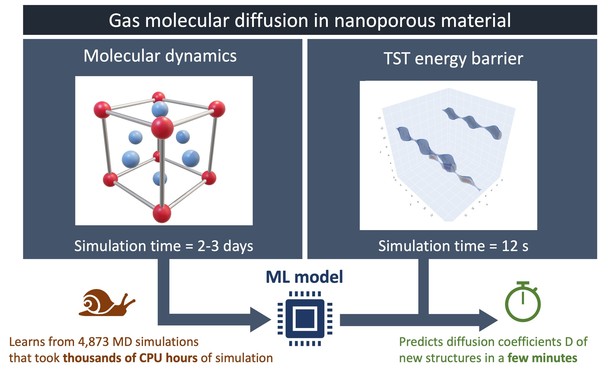

Prediction of Diffusion Coefficient Through Machine Learning Based on Transition State Theory Descriptors
Nanoporous materials serve as very effective media for storing or separating small molecules. To design the best materials for a given application based on adsorption, one usually assesses the equilibrium performance by using key thermodynamic quantities such as Henry constants or adsorption loading values. To go beyond standard methodologies, we probe here the transport effects occurring in the material by studying the self-diffusion coefficients of xenon inside the nanopores of framework materials. We find good correlations between the diffusion coefficients and the pore aperture size, as well as other geometrical and energetic descriptors. We used extensive molecular dynamics simulations to calculate the diffusion coefficient of xenon in 4,873 MOFs from the CoREMOF 2019 database, the first large-scale database of transport properties published at this scale. Based on this data, we present a tool to quickly evaluate the diffusion energy barrier that proved to be very correlated to the diffusion rate. This descriptor, alongside other geometrical characterizations, were then used to build a machine learning model that can predict the xenon diffusion coefficients in MOFs. The final trained model is quite accurate and shows a root mean square error (RMSE) on the log_{10} of the diffusion coefficient equal to 0.25.
Soupçons d’inconduite scientifique pour un couple de chercheurs de l’Institut d’électronique, de microélectronique et de nanotechnologie à Lille.
https://www.lemonde.fr/sciences/article/2023/12/19/soupcons-d-inconduite-scientifique-pour-un-couple-de-chercheurs_6206696_1650684.html
Soupçons d’inconduite scientifique pour un couple de chercheurs
Le CNRS et l’université de Lille ont commencé fin novembre une instruction concernant plus de soixante articles d’un couple de chercheurs de l’Institut d’électronique, de microélectronique et de nanotechnologie à Lille.
Glad to publish our latest work: “Predictive Thermodynamic Model for Intrusion of Electrolyte Aqueous Solutions in Nanoporous Materials”, out in Chem. Mater. Sometimes you don't need fancy simulations 💻, just a nice analytical thermodynamic model 🧮
https://pubs.acs.org/doi/10.1021/acs.chemmater.3c02230