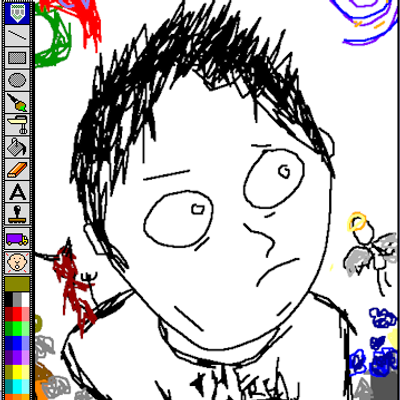
these ducks have more innate catching skill than most pups i know
so now we've restarted Breath of the Wild in Master Mode.
my son, who's two years old, refuses to play Tears of the Kingdom with me. he says the game has a sloppy aesthetic, the building mechanics feel like fan-mod stuff, the sense of exploration from BotW is just not there, and he misses the bombs. he did have positive things to say about Link's new hair, however. these are not my opinions, they're his. he's very articulate for his age. says it has nothing to do the sheer terror he experiences when seeing a Like-Like or one of those awful hand things.
but the problem here is that, technically, using a semicolon there wouldn't be grammatically incorrect, so you may be tempted to use one there, and that would be fine, i guess. my main problem is not so much the grammar but the fact that the semicolon exists in the first place, which adds a layer of additional complexity to my writing flow that i don't appreciate because i get hung up on it. perhaps i prefer simplicity.
take for example, this passage:
"When he’d get really mad, his eyes would go dark red, he’d sprout feathery black wings, and he’d shoot lasers out of a third eye on his forehead. To an edgy twelve-year-old, there's nothing cooler than that."
you could easily use a semicolon after "forehead," but do you really need to? to me, it makes just as much sense with a period. one intuitively understands that that "that" (ew) at the end of the second sentence is referring to Jin Kazama.
i'm still on an em-dash sabbatical, for a few reasons that i don't want to get into right now. but i've found that em-dash statements do have some real utility, so writing without them has been interesting to say the least, but also a learning experience, like "how do i make this supplemental information flow in a non-confusing way without using an em-dash statement here?" and this has inspired me to get very creative. imposing rules on oneself can lead to amazing creative innovation.
the second usage is the catalyst for my sabbatical: joining two similar independent clauses with a semicolon because they would otherwise be confusing or misunderstood without one is very weird to me. i've not found many examples in my own writing where a semicolon works better than a comma or simply a period. you get into this trap where you think all vaguely related clauses should be joined by a semicolon, and this quickly runs wild. so i think i'm going to stick with the first usage only.
i just recently returned from an almost year-long semicolon sabbatical, starting when i replaced all semicolons in a story with commas and it made just as much sense and flowed better, and now, upon my return, i'm quickly realizing why i stopped using them to begin with: they're simply confusing. the two main rules for usage being, one, separating grammatically complex lists, and two, connecting closely related clauses whose meaning might be interpreted differently without that connection.
the first usage is the most intuitive, and has some practical utility. although, it's easy to confuse a complex list of things with a series of linear actions, like "John ran to the car; he jumped into the front seat; he started the engine; &c," when you could just use conjunctions instead. so, when considering the semicolon, you have to have the stylistic judgement to determine if conjunctions are more appropriate. don't get me wrong, i like having options, but i'm kind of stupid, so.