 Vegetable Gremlin ⍼👻
i reckon there are people who left mastodon because bsky is the true twitter successor and people who return to mastodon because bsky is the true twitter successor

Ely Strömberg
@elystromberg
- 110 Followers
- 103 Following
- 72 Posts
PhD candidate, University of Amsterdam. Interested in open science, mobility, and Critical theory. Previously Research assistant at @swedish Institute for Social Research. they/them.
Can run many regressions
https://elystromberg.github.io/About/
 Jens Rydgren
My new book (edited with Michael Samers) on Migration and Nationalism will soon be in print.
It is a little bit pricey, to say the least. But if you have the chance, please ask your library to buy a copy.
Contributors include: Ilke Adam, Marco Antonsich, Hans-Georg Betz, Lenka Bustikova, Gabriella Elgenius, Anastasia Gorodzeisky, Petra Guasti, Naoto Higuchi, Christian Joppke, Theodora Lam, Inna Leykin, Jens Rydgren, Michael Samers, Catherine Xhardez, Brenda S.A. Yeoh
https://www.e-elgar.com/shop/gbp/migration-and-nationalism-9781839100758.html

Migration and Nationalism
‘We cannot separate immigration from nationalism. This book offers fresh insights into this understudied relationship. It helps us understand how populism, right-wing politics, and neoliberalism affect migration policies. To me it shows why the dream of free movement for all seems so distant today.’ – Harald Bauder, Toronto Metropolitan University, Canada
 httpster
En minimalistisk webbserver som drivs av solenergi
Allt sedan jag läste Kris De Deckers ursprungliga bloggpost på Low-tech magazine om deras soldrivna webbserver har jag haft en idé om att bygga en själv.
Och nu har jag gjort det!
https://www.turist.blog/2023-09-01-en-minimalistisk-webbserver-som-drivs-av-solenergi/
 Daniel S. Katz
From Sheeba Samuel and @EvoMRI
"Computational reproducibility of Jupyter notebooks from biomedical publications"
https://arxiv.org/abs/2308.07333
Found 27271 notebooks in 2660 GitHub repositories associated with 3467 articles
22578 notebooks were in Python, including 15817 that had dependencies declared in requirement files
For 10388, all declared dependencies could be installed successfully
1203 notebooks ran through without any errors
879 produced the original results

Computational reproducibility of Jupyter notebooks from biomedical publications
Jupyter notebooks facilitate the bundling of executable code with its documentation and output in one interactive environment, and they represent a popular mechanism to document and share computational workflows. The reproducibility of computational aspects of research is a key component of scientific reproducibility but has not yet been assessed at scale for Jupyter notebooks associated with biomedical publications. We address computational reproducibility at two levels: First, using fully automated workflows, we analyzed the computational reproducibility of Jupyter notebooks related to publications indexed in PubMed Central. We identified such notebooks by mining the articles full text, locating them on GitHub and re-running them in an environment as close to the original as possible. We documented reproduction success and exceptions and explored relationships between notebook reproducibility and variables related to the notebooks or publications. Second, this study represents a reproducibility attempt in and of itself, using essentially the same methodology twice on PubMed Central over two years. Out of 27271 notebooks from 2660 GitHub repositories associated with 3467 articles, 22578 notebooks were written in Python, including 15817 that had their dependencies declared in standard requirement files and that we attempted to re-run automatically. For 10388 of these, all declared dependencies could be installed successfully, and we re-ran them to assess reproducibility. Of these, 1203 notebooks ran through without any errors, including 879 that produced results identical to those reported in the original notebook and 324 for which our results differed from the originally reported ones. Running the other notebooks resulted in exceptions. We zoom in on common problems, highlight trends and discuss potential improvements to Jupyter-related workflows associated with biomedical publications.
@X9Sunny that’s the definition of machine learning right?
@X9Sunny has joined mastodon, Sanni is a PhD student at Stockholm University doing cool computer stuff like learning machines to do tricks
 Alex Wild
If you're new to Mastodon, know that you don't get your tusks until one of the longtime locals scolds you for not putting your stuff behind a content warning, and your response sets off an old-school flame war that defederates at least three instances.
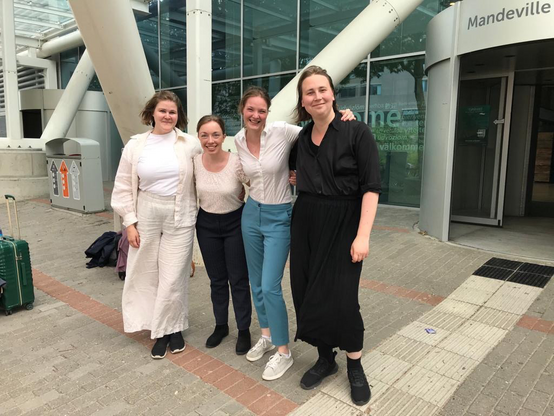
Spent the last two weeks at a Summer Institute in Computational Social Science organised by ODISSEI working on machine learning with dutch registry data. Great experience and great people, especially this fantastic team! #SICSS #ODISSEI
 Netherlands eScience Center
We had a fantastic time at the #ODISSEI summer school #SICSS in Rotterdam! Our #MachineLearning workflows were put to the test on a social dataset focused on fertility. Thanks to everyone who participated and made it a memorable two days in the summer school!


 claudiakincaid
PhD position in Digital Sociology:
https://www.digsum.org/digsum-feed/phd-position-in-digital-sociology
https://www.digsum.org/digsum-feed/phd-position-in-digital-sociology

PhD position in Digital Sociology — DIGSUM
DIGSUM's Digital Sociology group is looking for a new PhD candidate. The position is fully funded and salaried for four years. The research will be in the area of public opinion dynamics, broadly defined. This includes the study of disinformation and misinformation, and also related phenomena such