
24 Followers
39 Following
23 Posts
Research Fellow @ U.C. Berkeley Center for Long-Term Cybersecurity
Substackhttps://else.how
CLTChttps://cltc.berkeley.edu/people/nick-merrill/
Daylight Labhttps://daylight.berkeley.edu/
I found this article fascinating. The 'middle' of the Internet isn't full of robust competition. It is become centralized and, of concern, more opaque. Regulators should think about this. https://scholarship.law.duke.edu/dlj_online/101/
"Inside the Internet" by Nick Merrill and Tejas N. Narechania

Conventional wisdom—particularly in the legal literatures—suggests that competition reigns the inside of the internet. This common understanding has shaped regulatory approaches to questions of network security and competition policy among service providers. But the original research presented here undermines that long-held assumption. Where the markets for internet traffic exchange (and related services) have long been thought to be characterized by robust competition among various network services providers, our findings suggest that these markets have consolidated. These trends raise a host of concerns for network reliability, online speech, and consumer choice, among other matters. Indeed, some recent high-profile internet outages reflect some of these concerns. And so we consider how the internet’s regulatory infrastructure might respond to these new revelations about the internet’s interior network infrastructure. Specifically, we call for regulation to enhance visibility of the internet’s interior and to assure a regime of fair carriage for all the internet’s users.

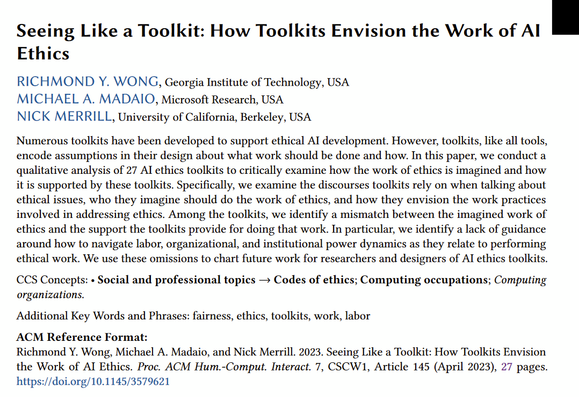
In the paper, we identify a mismatch between the imagined work of ethics and the support the toolkits provide for doing that work. In particular, we identify a lack of guidance around how to navigate labor, organizational, and institutional power dynamics as they relate to performing ethical work. We use these omissions to chart future work for researchers and designers of AI ethics toolkits!

https://dl.acm.org/doi/10.1145/3579621
#CSCW

Seeing Like a Toolkit: How Toolkits Envision the Work of AI Ethics | Proceedings of the ACM on Human-Computer Interaction

Numerous toolkits have been developed to support ethical AI development. However, toolkits, like all tools, encode assumptions in their design about what work should be done and how. In this paper, we conduct a qualitative analysis of 27 AI ethics ...

Proceedings of the ACM on Human-Computer Interaction

Sharing a new (open access!) #CSCW paper co-authored with Michael Madaio & Nick Merrill:

"Seeing Like a Toolkit: How Toolkits Envision the Work of AI Ethics" https://dl.acm.org/doi/10.1145/3579621

We analyze a set of AI ethics toolkits to understand how they imagine the *work* of doing ethics. (Who's doing it? When and how? How should a worker justify doing ethics work?). Broadly there's a lack of guidance about org & institutional power dynamics.

(I'll be at #CHI2023 if you want to chat more!)

Seeing Like a Toolkit: How Toolkits Envision the Work of AI Ethics | Proceedings of the ACM on Human-Computer Interaction

Numerous toolkits have been developed to support ethical AI development. However, toolkits, like all tools, encode assumptions in their design about what work should be done and how. In this paper, we conduct a qualitative analysis of 27 AI ethics ...

Proceedings of the ACM on Human-Computer Interaction
RT @josephfcox
New: here is the contract showing the FBI bought access to mass internet data. Netflow can show which server communicated with another, used to trace activity through virtual private networks, etc https://www.vice.com/en/article/dy3z9a/fbi-bought-netflow-data-team-cymru-contract
Here is the FBI’s Contract to Buy Mass Internet Data

The FBI previously purchased access to "netflow" data, which a company called Team Cymru obtains from ISPs. Team Cymru then sells it to the government.

We have massive privacy issues in this country, including sales of sensitive personal data to whomever wants to buy it (including China!), but everyone is hellbent on banning tiktok?

Give me a break.

We've been getting lots of questions about Twitter's imminent SMS 2FA changes at @tallpoppy, so we broke it down for you 📲🔐💕 https://www.tallpoppy.com/blog/much-ado-about-twitter-whats-going-on-with-2fa
Much ado about Twitter: What’s going on with 2FA?

Let’s break down Twitter’s changes to two-factor authentication and what you should do about it.

Truth.

I made my first-ever YouTube video.

The idea is: "Bug of the Week." Exploring the technical intricacies of real-life bugs behind major recent cyberattacks in a concise, informative format.

This first attempt is an objectively bad YouTube video. What do you think of the concept? Is this interesting? Should I work on my technique and keep making videos like this one? Any suggestions, tips, or tricks are *very welcome*.

https://www.youtube.com/watch?v=EI59J1BawsU

Plex Puncture: The Simple Bug That Breached LastPass - Bug of the Week

YouTube
NEW: Every year, governments use algorithms to flag people receiving welfare benefits as "high risk" of committing fraud. Today, for the first time, a joint investigation by Lighthouse Reports and WIRED can reveal how one of these algorithms works. We obtained the full algorithm code and the training data and recreated the system. What we found was discrimination based on gender and ethnicity. Part 1 is here: https://www.wired.com/story/welfare-state-algorithms/
Inside the Suspicion Machine

Obscure government algorithms are making life-changing decisions about millions of people around the world. Here, for the first time, we reveal how one of these systems works.

WIRED
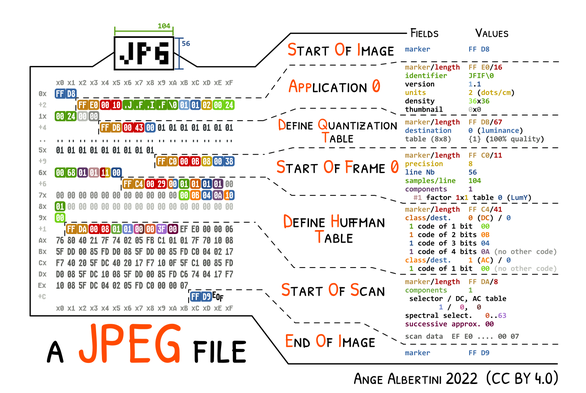
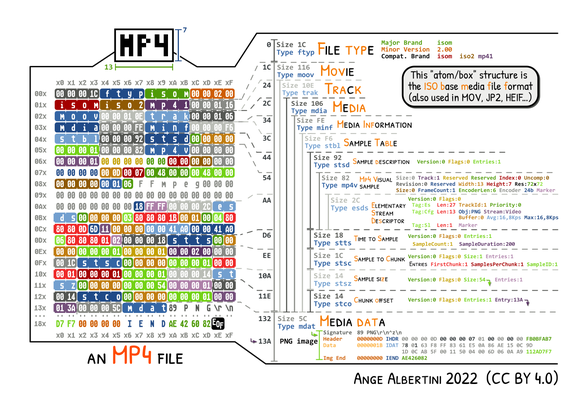
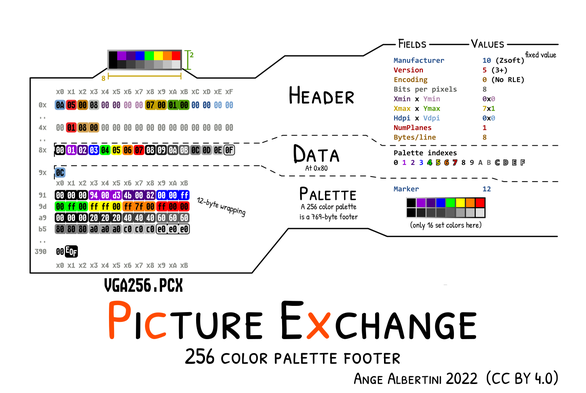
pics/binary/README.md at master · corkami/pics

File formats dissections and more... Contribute to corkami/pics development by creating an account on GitHub.

GitHub