Healthcare costs remain a catastrophic drag on both individuals and businesses. The US spends more per capita on healthcare than any developed nation, yet outcomes lag behind peers in life expectancy, maternal mortality, and chronic disease management. This is an economic failure as much as a public health one.

Ellen C. Roggers
@ellenroggers
- 1 Followers
- 12 Following
- 27 Posts
Policy commentator | Healthcare, inequality & economic reform | Believing facts shouldn’t be partisan | New to Mastodon, not to these fights. An Independent market analyst/Trader ™️| investor And a Digital Trainer 📈📉
Income and wealth inequality in America has reached Gilded Age levels. The top 1% holds more wealth than the entire bottom 90% combined. This isn’t just a moral problem, it’s an economic one. Concentrated wealth reduces consumer spending breadth, distorts political incentives, and breeds social instability.
Housing affordability is in crisis. Home ownership once the cornerstone of the American Dream is increasingly out of reach for younger generations. Rising mortgage rates combined with limited housing supply have created a market where the wealthy accumulate assets while millennials and Gen Z are locked out entirely.
Inflation, while cooling from its 2022 peaks, has permanently eroded the purchasing power of working and middle-class Americans. Grocery bills, rent, and insurance costs remain stubbornly elevated. A strong stock market means little to the 50% of Americans who own little to no equities.
But let’s not get too comfortable. The national debt has surpassed $34 trillion, a number so large it has become almost meaningless to the average American. Interest payments alone are now consuming a frightening portion of the federal budget, crowding out investments in infrastructure, education, and healthcare.
Wall Street continues to lead global capital markets. The S&P 500 and NASDAQ remain the benchmarks by which all other markets are measured. American companies. Apple, Microsoft, Nvidia, Google, are not just businesses, they are civilizational forces reshaping how humanity works, communicates, and creates.
The US labor market has shown remarkable resilience over the past few years. Unemployment has remained historically low, and job creation across sectors like technology, healthcare, and clean energy has been nothing short of impressive. American workers, when given opportunity, are among the most productive in the world.
To repeat one of my favorite economic mistakes: income distribution in one year is not lifetime income distribution. Almost all are in bottom half and top half at some point in lifecycle. Like 1/3rd of US households hit 250k at some point.
Information is a difference that makes a difference.This quip fundamentally altered my relation with philosophy. Don't know why it doesn't have the same effect on many philosophers.
Making a distinction is not something inherently profound, it has to be a means to an end.
Making a distinction is not something inherently profound, it has to be a means to an end.
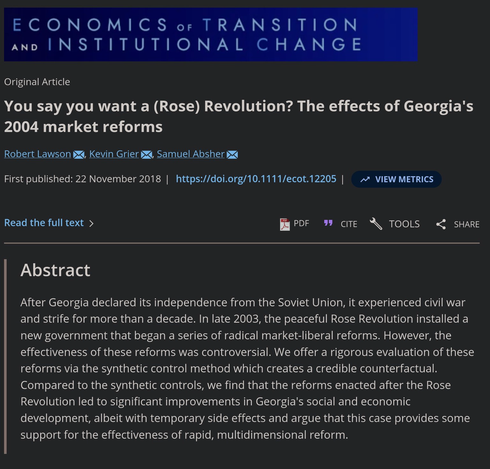
Georgia’s Rose Revolution wasn’t just political, it was an economic turning point.
Lawson, Grier & Absher (2018) use synthetic control methods to show that the 2004 market-liberal reforms led to significant improvements in social and economic development.
Rapid, multidimensional reform works. 🌹🇬🇪
#EconomicReform #Georgia #PolicyResearch #DevelopmentEconomics”
Lawson, Grier & Absher (2018) use synthetic control methods to show that the 2004 market-liberal reforms led to significant improvements in social and economic development.
Rapid, multidimensional reform works. 🌹🇬🇪
#EconomicReform #Georgia #PolicyResearch #DevelopmentEconomics”