Edward J. Stembler

@ejstembler
21 Followers
90 Following
96 Posts
Designer of the Kit programming language. Software Engineering, Machine Learning, Data Science, Clojure, Crystal, Elixir, Go, Kit, Nim, Ruby, Python, Zig, Raspberry Pi, Arduino, Robotics.
Bloghttps://ejstembler.com
Kit 2026.5.8 focuses on keeping builds fast and making release checks catch build-time regressions earlier. The release improves Kit build performance, adds build speed guardrails, and includes a release preflight build benchmark so performance-sensitive changes are visible before shipping. It also hardens self-updater release verification so update checks can validate release metadata more reliably. https://kit-lang.org/blog/2026-05-08-kit-updated.html
Kit Updated: 2026.5.8 - Kit Programming Language

Kit 2026.5.8 improves build performance, adds build speed guardrails and release preflight benchmarking, tracks runtime ABI in the partition entry cache, and hardens self-updater release verification.

Kit 2026.5.6 is a compiler, incremental compilation, and build hardening release. It adds partial per-module incremental recompilation for the interpreter, adds a manifest file for per-module fragment caches, and preserves global origin paths for imported bindings without global values. https://kit-lang.org/blog/2026-05-06-kit-updated.html
Kit Updated: 2026.5.6 - Kit Programming Language

Kit 2026.5.6 adds partial per-module incremental recompilation for the interpreter, fixes codegen artifact invalidation, hardens Zig release CI, shows Zig download progress, and fixes installed stdlib sync.

Kit 2026.5.3 is a package release and release-tooling hardening update. It syncs package releases and badges, validates package release tags from manifests, narrows GitLab metadata sync by package, and adds the Kit badge to package metadata sync. https://kit-lang.org/blog/2026-05-03-kit-updated.html
Kit Updated: 2026.5.3 - Kit Programming Language

Kit 2026.5.3 syncs package releases and badges, strengthens release validation, expands package dev sweeps, and fixes examples and import drift.

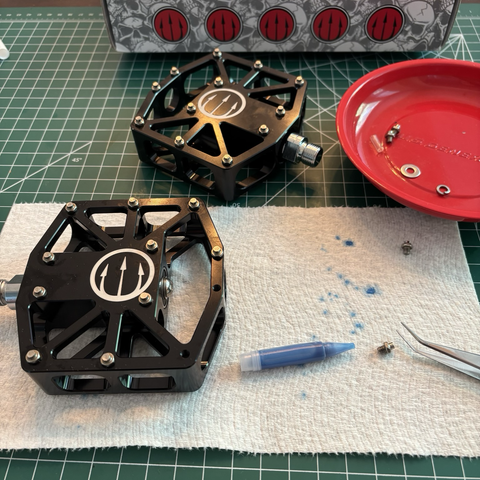
Upgrading the pedals on my 26” bmx. Some assembly required. 😅
Kit 2026.5.2 is a compiler, build, and package-tooling release. It fixes implicit kit build output reuse, scoped import globals in codegen, native package link flag duplication, reusable global initialization, and library discovery. https://kit-lang.org/blog/2026-05-02-kit-updated.html
Kit Updated: 2026.5.2 - Kit Programming Language

Kit 2026.5.2 fixes build output reuse, scoped import globals, native package link flags, reusable global initialization, and library discovery.

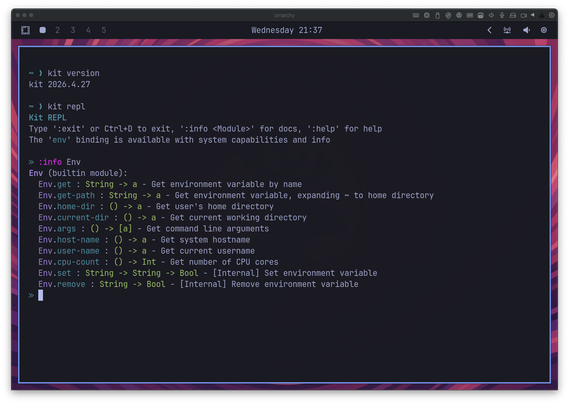
Kit running on Omarchy (Arch Linux)

Kit 2026.4.27 is a workflow, codegen, and build-system release. It tightens kit dev example validation, makes workflow diagnostics easier to scan, preserves partitioned package globals in codegen, and carries the release path through the Zig 0.16.0 migration.

https://kit-lang.org/blog/2026-04-27-kit-updated.html

Kit Updated: 2026.4.27 - Kit Programming Language

Kit 2026.4.27 improves kit dev workflow validation and diagnostics, preserves partitioned package globals, and completes the Zig 0.16.0 migration.

Kit 2026.4.24 is a package and codegen hardening release.

https://kit-lang.org/blog/2026-04-24-kit-updated.html

Kit Updated: 2026.4.24 - Kit Programming Language

Kit 2026.4.24 fixes partitioned package codegen, cached metadata, Map and CBOR runtime edges, compression docs, release tooling, and CI build reliability.

A community proposal for advanced Kit syntax that surfaced on GitHub, covering decimal literals, error propagation, computation expressions, units of measure, and more. The proposal identifies real problems—float precision, monadic nesting, unit safety, and crypto primitives

https://kit-lang.org/blog/2026-04-23-kit-syntax-proposal-analysis.html

Kit Syntax Proposal Analysis - Kit Programming Language

An analysis of the Kit Lang Advanced Syntax Design proposal against Kit's existing features, including error handling, pattern matching, traits, refinement types, and FFI.

How one programmer's pet project changed how we think about software

YouTube