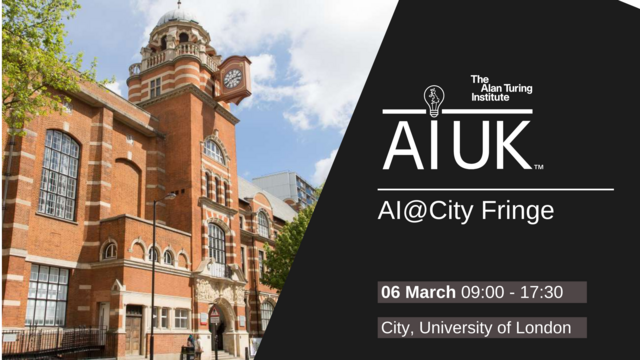

We are pleased to announce that our AI@City has been accepted as one of the #AI UK Fringe events.
Agenda and registration details:
https://github.com/city-artificial-intelligence/ai-uk-fringe-event-2024
🗓️March 6, 2024
🏫City, University of London
Organisers: @ArturGarcez , @ejimenez_ruiz, Eduardo Alonso
AI UK Fringe Event on AI research at City, University of London - GitHub - city-artificial-intelligence/ai-uk-fringe-event-2024: AI UK Fringe Event on AI research at City, University of London
We are pleased to announce that our AI@City has been accepted as one of the #AI UK Fringe events.
Agenda and registration details:
https://github.com/city-artificial-intelligence/ai-uk-fringe-event-2024
🗓️March 6, 2024
🏫City, University of London
Organisers: @ArturGarcez , @ejimenez_ruiz, Eduardo Alonso
AI UK Fringe Event on AI research at City, University of London - GitHub - city-artificial-intelligence/ai-uk-fringe-event-2024: AI UK Fringe Event on AI research at City, University of London
Tonight live on our #costDKG YouTube channel:
https://www.youtube.com/@costdkg4356/streams
Next talk in the online talk series [1]
of the COST Action on Distributed Knowledge Graphs (DKG) [2], in
collaboration with the Semantic Web Science Association (SWSA) [3].
January 31, 18:00 CET / 12:00 EST,
Mayank Kejriwal (University of Southern California) will talk about:
Neurosymbolic Approaches for Robust Domain-Specific Semantic Search: Current Progress and Future Opportunities
[1] https://cost-dkg.eu/talks
[2] https://cost-dkg.eu/
[3] https://swsa.semanticweb.org
If you are thinking about learning Artificial Intelligence, this master's may be what you are looking for.
A peek into our programme https://www.flipsnack.com/C5E97B77C6F/msc-artificial-intelligence/full-view.html
To have a chat with the director f2f on Feb 7 from 5 to 7 at City, please register here https://www.city.ac.uk/news-and-events/events/2024/february/postgraduate-open-evening
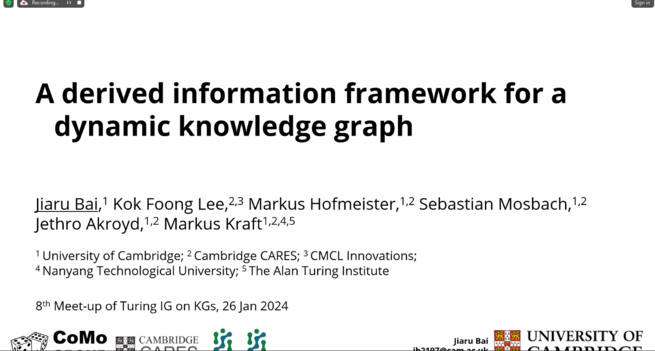
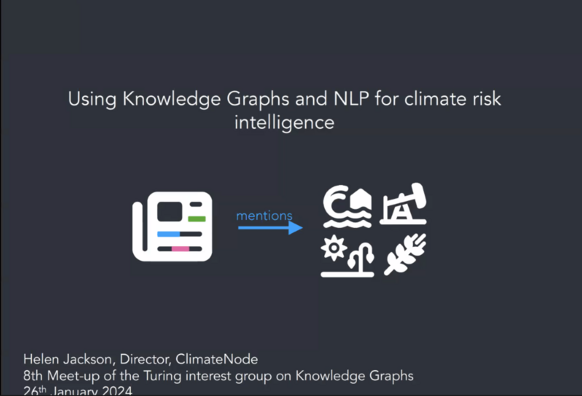
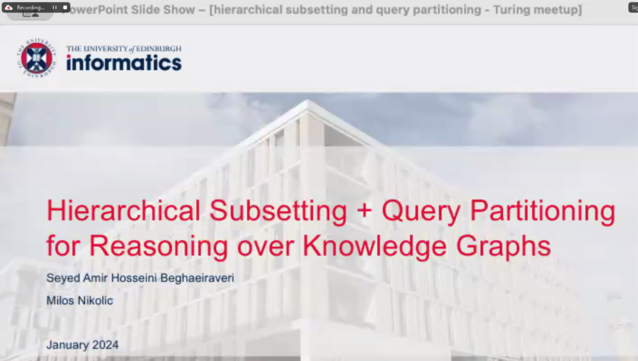
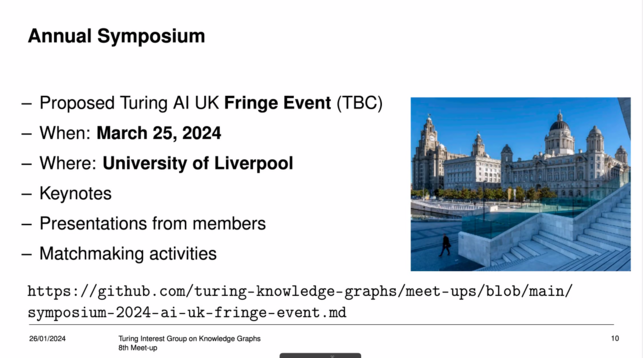
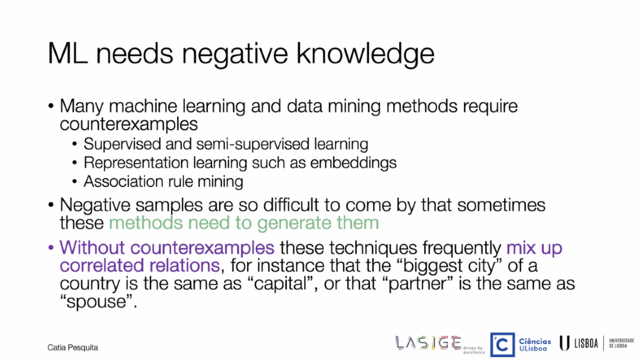
On Friday we had our 8th meet-up of the Alan Turing Institute Interest Group on #KnowledgeGraphs. Featuring
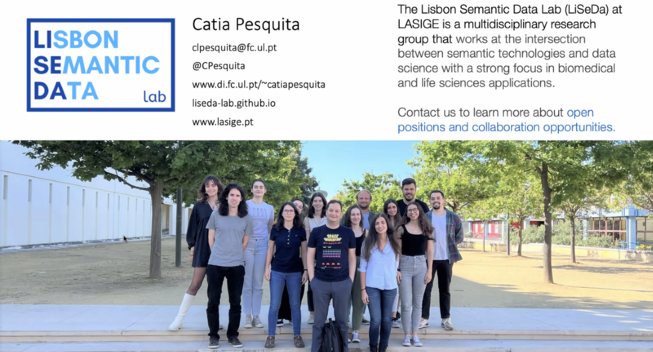
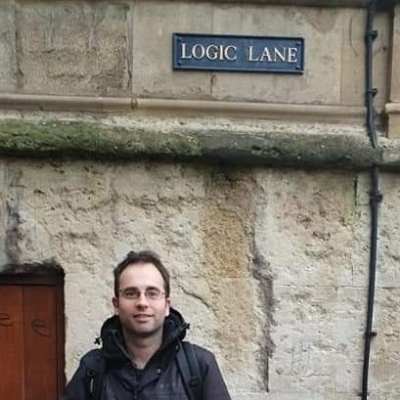
Catia Pesquita as keynote on "The impact of negative knowledge in biomedical #AI"
Agenda and recordings:
https://github.com/turing-knowledge-graphs/meet-ups
See you in March in Liverpool!
Knowledge Graphs for the Life Sciences: Recent Developments, Challenges and Opportunities
Jiaoyan Chen, Hang Dong, Janna Hastings, Ernesto Jiménez-Ruiz, Vanessa Lopez, Pierre Monnin, Catia Pesquita, Petr Škoda, Valentina Tamma
https://arXiv.org/abs/2309.17255 https://arXiv.org/pdf/2309.17255
The term life sciences refers to the disciplines that study living organisms and life processes, and include chemistry, biology, medicine, and a range of other related disciplines. Research efforts in life sciences are heavily data-driven, as they produce and consume vast amounts of scientific data, much of which is intrinsically relational and graph-structured. The volume of data and the complexity of scientific concepts and relations referred to therein promote the application of advanced knowledge-driven technologies for managing and interpreting data, with the ultimate aim to advance scientific discovery. In this survey and position paper, we discuss recent developments and advances in the use of graph-based technologies in life sciences and set out a vision for how these technologies will impact these fields into the future. We focus on three broad topics: the construction and management of Knowledge Graphs (KGs), the use of KGs and associated technologies in the discovery of new knowledge, and the use of KGs in artificial intelligence applications to support explanations (explainable AI). We select a few exemplary use cases for each topic, discuss the challenges and open research questions within these topics, and conclude with a perspective and outlook that summarizes the overarching challenges and their potential solutions as a guide for future research.
What can knowledge graph alignment gain with Neuro-Symbolic learning approaches?
Pedro Giesteira Cotovio, Ernesto Jimenez-Ruiz, Catia Pesquita
https://arXiv.org/abs/2310.07417 https://arXiv.org/pdf/2310.07417
Knowledge Graphs (KG) are the backbone of many data-intensive applications since they can represent data coupled with its meaning and context. Aligning KGs across different domains and providers is necessary to afford a fuller and integrated representation. A severe limitation of current KG alignment (KGA) algorithms is that they fail to articulate logical thinking and reasoning with lexical, structural, and semantic data learning. Deep learning models are increasingly popular for KGA inspired by their good performance in other tasks, but they suffer from limitations in explainability, reasoning, and data efficiency. Hybrid neurosymbolic learning models hold the promise of integrating logical and data perspectives to produce high-quality alignments that are explainable and support validation through human-centric approaches. This paper examines the current state of the art in KGA and explores the potential for neurosymbolic integration, highlighting promising research directions for combining these fields.