Event Horizon Telescope

@ehtelescope
1,005 Followers
41 Following
51 Posts
We are the Event Horizon Telescope (EHT) - the worldwide collaboration that captured humanity’s first image of a black hole.

Watch one of the telescopes behind the M87 MOVIE campaign in action - the IRAM 30-meter telescope near Pico Veleta in the Sierra Nevada, Spain.

Perched at nearly 3,000 meters (10,000 feet), this snowy peak is one of the many remote sites currently helping capture a movie of a black hole.

📸 Credit: Manuel Castillo
#M87Movie
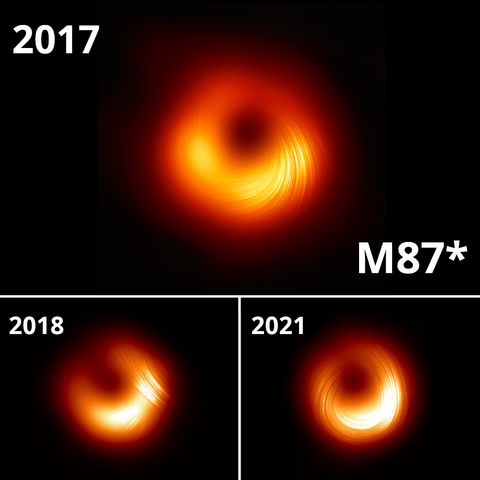
Five years ago this week, we released the first polarized image of the black hole in M87*, revealing the structure of magnetic fields at the edge of a black hole.

Just six months ago, new results from 2018 and 2021 showed something incredible- the environment around M87* is evolving.

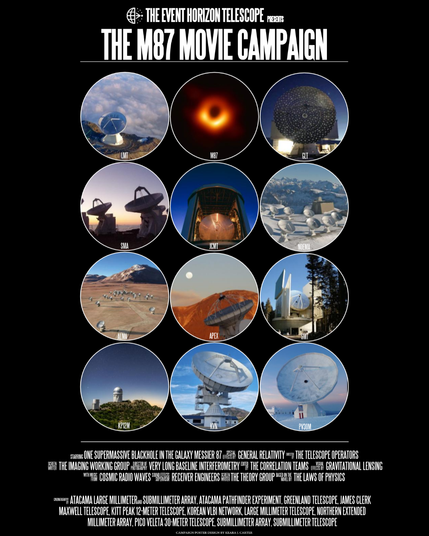
Eleven telescopes.
Countless scientists, engineers, and operators.
One goal: a movie of the black hole in M87.

The M87 MOVIE campaign is now underway.

Over the coming weeks we’ll share the teams, observatories, and behind-the-scenes work that make this global observing effort possible.

Participating telescopes:
ALMA • APEX • GLT • JCMT• KP12M • KVN • LMT • NOEMA • PV30M • SMA • SMT

Follow along as the campaign unfolds.
#M87Movie

EHT scientists Sera Markoff & Vincent Fish were recently interviewed on Quirks & Quarks, a Canadian science story broadcast. Listen to the conversation to learn how the EHT is working toward creating videos of black holes!

https://www.cbc.ca/radio/quirks/black-hole-video-astronomy-space-science-9.7117478

Astronomers are capturing video of a black hole for the first time | CBC Radio

Astronomers are working to capture the first-ever video of a black hole — a groundbreaking effort that could shed light on how these enigmatic cosmic objects behave and offer clues about the origins of our universe.

CBC

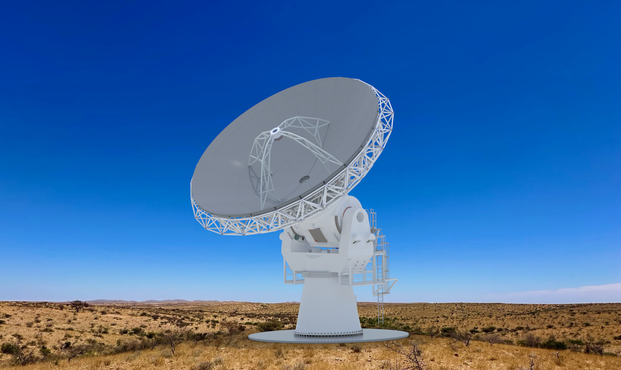
We're happy to announce a newly signed agreement for the construction of the Africa Millimeter Telescope (AMT). This will open great possibilities for astronomy on the African continent and make black hole images even sharper!

The AMT will be situated in Namibia and will be both the first millimeter telescope in Africa and will fill a major gap in the EHT network.

This image shows a digital rendering of the planned antenna design.

Read more here: https://eventhorizontelescope.org/news/2026/03/africa-millimetre-telescope-bring-black-holes-sharper-focus-movies

🔤 EHT A-Z
We’re breaking down the science behind the Event Horizon Telescope - one letter at a time.

📡 X is for X-ray Emission
Sgr A*, the supermassive black hole at our galaxy’s center, emits X-rays. Astronomers often observe X-ray flares when the emission suddenly brightens.

Learn more in this video from the Chandra Observatory: https://www.youtube.com/watch?v=jHPWq4x92vI

🔤 EHT A-Z
We’re breaking down the science behind the Event Horizon Telescope - one letter at a time.

📡 W is for Water Vapor
While Earth's atmosphere is crucial for our survival, water vapor within it absorbs some of the signal we want to analyze from black holes.

That’s why we build our radio telescopes in high, dry places- typically on tall mountains where the air is thin and the skies are clear.

🔤 EHT A-Z
We’re breaking down the science behind the Event Horizon Telescope - one letter at a time.

📡 V is for VLBI
VLBI stands for Very Long Baseline Interferometry, connecting radio telescopes around the world to create one Earth-sized telescope.

Our favorite observational technique, this enables us to resolve the shadow of a black hole.

🔤 EHT A-Z
We’re breaking down the science behind the Event Horizon Telescope - one letter at a time.

📡 U is for Universe
The observable universe contains trillions of galaxies, most thought to host a supermassive black hole.

Only a few are accessible to the EHT. So far, Sagittarius A* and M87* are the only black holes where we’ve resolved the shadow itself.

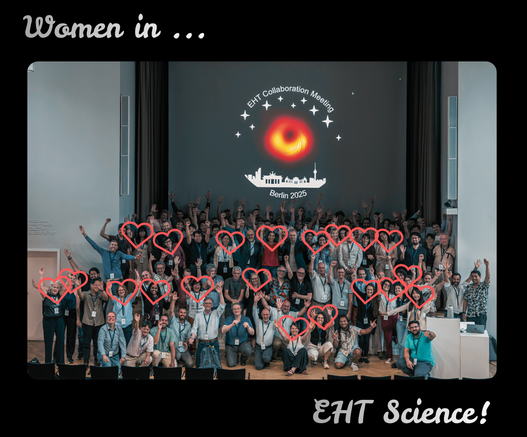
Today we mark the International Day of Women and Girls in Science by acknowledging the invaluable work of the many women in the EHT - some of them highlighted in this recent conference photo.

Contributions cover all aspects needed to advance our understanding of black holes - from instrumentation and observations to data processing, theory, and analysis.

#WomenInSTEM