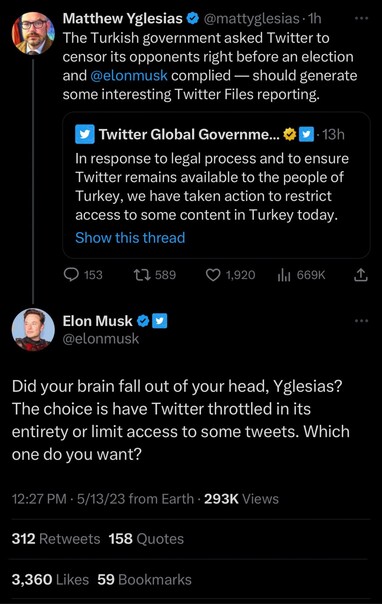
 Robert McNees
The free speech absolutist has logged on.
Shot and chaser:


| website | https://eecue.com |
| Github | https://eecue.github.io |
> **_NOTE:_** This post is part of my [Machine Learning Series](#) where I discuss how AI/ML works and how it has evolved over the last few decades. Autoencoders are a type of neural network architecture used for tasks such as dimensionality reduction, feature extraction, and data denoising. With their ability to learn efficient representations of data, autoencoders have found applications in various fields, from image processing to anomaly detection. In this post, we'll explore the structure and functionality of autoencoders and delve into their use cases. 
> **_NOTE:_** This post is part of my [Machine Learning Series](https://eecue.com/blog/machine-learning-series---exploring-the-world-of-ai-ml) where I discuss how AI/ML works and how it has evolved over the last few decades. Recurrent Neural Networks (RNNs) are a class of neural networks designed to handle sequential data. Whether it's analyzing time series, understanding natural language, or predicting stock prices, RNNs are powerful tools for capturing temporal dependencies in data. In this post, we'll delve into the structure of RNNs, how they process sequences, and their practical applications. 
> **_NOTE:_** This post is part of my [Machine Learning Series](https://eecue.com/blog/machine-learning-series---exploring-the-world-of-ai-ml) where I discuss how AI/ML works and how it has evolved over the last few decades. Convolutional Neural Networks (CNNs) have become the go-to architecture for image recognition and computer vision tasks. CNNs excel at identifying patterns in images, such as edges, textures, and shapes, making them a key player in applications like image classification, object detection, and facial recognition. In this post, we'll explore the key components of CNNs, how they operate on images, and their use cases. 
> **_NOTE:_** This post is part of my [Machine Learning Series](https://eecue.com/blog/machine-learning-series---exploring-the-world-of-ai-ml) where I’m discussing how AI/ML works and how it has evolved over the last few decades. Feedforward Neural Networks (FNNs), also known as Multi-Layer Perceptrons (MLPs), are one of the most fundamental and widely-used neural network architectures in machine learning. FNNs have been employed for a variety of tasks, including classification, regression, and feature extraction. In this post, we'll explore the architecture, training process, and applications of FNNs. 
Neural networks are the foundation of many artificial intelligence and machine learning applications. There are several types of neural networks, each designed to address specific types of problems. In this post, we'll explore the most common types of neural networks and their applications. 
One of the most transformative developments in the field of artificial intelligence and machine learning was the advent of **neural networks**. These computational models are designed to mimic the way the human brain processes information and are capable of performing complex tasks such as image recognition, natural language processing, and more. In this blog post, we'll explore what neural networks are, their components, and why specialized hardware like GPUs (Graphics Processing Units) and TPUs (Tensor Processing Units) are highly effective for training and deploying neural networks. 
Computer vision, the field of AI that enables computers to interpret and understand visual information from the world, has undergone significant advancements over the past decade. The ability to analyze images and videos, recognize objects, and understand visual scenes has opened up a multitude of applications in fields such as healthcare, autonomous vehicles, and security. In this blog post, we will explore the key milestones and breakthroughs that have shaped the evolution of computer vision over the last ten years. 
Machine learning has become an integral part of our lives, powering applications from voice assistants to self-driving cars. However, the field has a rich history that spans over five decades, with foundational ideas that date back even further. In this blog post, we'll explore the key milestones and breakthroughs in the history of machine learning over the last 50 years and how they've shaped the field as we know it today. 
Machine learning is an exciting and rapidly evolving field that has the potential to transform virtually every industry. From natural language processing to computer vision, machine learning models are becoming an integral part of our daily lives, enabling new levels of automation and understanding. To explore the fascinating world of machine learning and share insights with a broader audience, I am launching a blog series on AI/ML. In this post, I will discuss the topics I will be covering and what you can expect from the upcoming blog series.