Douglas McRae

384 Followers
232 Following
29 Posts
Historian of #Brazil, #LatinAmerica, urban environments. Postdoc research fellow/education+outreach for #Tropy (tropy.org) at Roy Rosenzweig Center for History and New Media, George Mason University. Will only be logged on Mon-Fri.
Websitehttps://tropy.org
Professionalhttps://rrchnm.org/
Twitterhttps://twitter.com/dv_mcrae

Are you an environmental historian who uses Tropy? How does Tropy help you organize/analyze your sources? I will be presenting Tropy to a group of environmental historians next month and I'd be interested in hearing about your particular experience! PM me or reply, I look forward to hearing from you!

#tropy #envhist #digitalhumanities #environment #envhistodons #digitalhistory

@jeremy

Thank you for forwarding to your colleagues! They can DM me if they are on Mastodon. I will also DM you the emails for the outreach team.

Another option is to post on our forums--users typically post troubleshooting or features requests, but an #Omeka #Tropy integration use case would be welcome:

https://forums.tropy.org/

forums.tropy.org

Public discussion forum for Tropy, free open-source software that allows you to organize and describe photographs of research material.

forums.tropy.org

#histodons is there anyone out there using #tropy and #omeka at the same time?

If so, the Tropy team would like to hear your experience.

Oh by the way...did you know Tropy has a plugin that makes it very easy to export your Tropy project items to Omeka S?

https://github.com/tropy/tropy-plugin-omeka

(If you’re working on public history projects and planning online exhibits it might be handy for you.)

GitHub - tropy/tropy-plugin-omeka: Tropy plugin for exporting items into Omeka

Tropy plugin for exporting items into Omeka. Contribute to tropy/tropy-plugin-omeka development by creating an account on GitHub.

GitHub

Will you be at #AHA2023 in Philly and are you interested in learning more about #Tropy ? Let's find a time to connect this weekend!

I will be in Philly along with a host of impressive panels and presentations from the people at the Roy Rosenzweig Center for History and New Media.

https://rrchnm.org/news/connect-with-rrchnm-at-aha23/#

Connect with RRCHNM at AHA23 – Roy Rosenzweig Center for History and New Media

Are you interested in learning more about #Tropy? The Tropy team has two dedicated outreach postdocs who frequently hold virtual and in-person demonstration sessions and workshops.

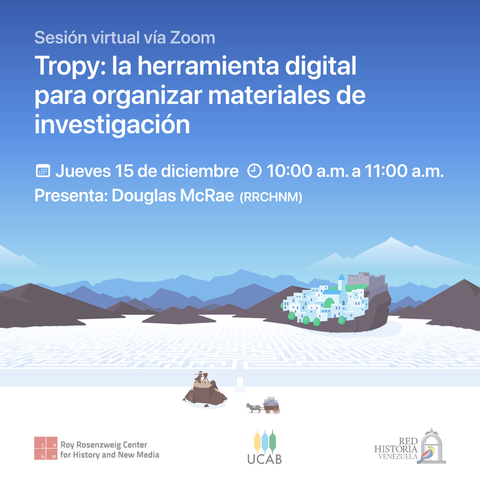
In the upcoming week we will lead sessions at Universidad Católica Andres Bello (Caracas, Venezuela--see attached image), Arquivo Público Estadual de São Paulo (Brazil) and the Univrsidade Federal de Sergipe (also Brazil).

Contact us if you'd like to set up a Tropy session at your institution!

@dh
@histodons

@natalie @dvmcrae @alucchesi Stating the obvious but--if you make each letter its own item, you can put date and author and other metadata by item and treat it as a corpus.

I'm doing this with a huge 1000+ document probate file and it really helps to understand the correspondence flows.

@dvmcrae For the past hour, since @whanley sent this link, I've been sitting here with my mouth open as I explore the possibilities of Tropy. This looks great and so promising. Just looking at how the whole thing might work together with Omeka S. It just looks fantastic. Excited to learn more. Thank you!

@alucchesi

@whanley @natalie @dh I would second second that #Tropy is a good tool for this. You can add metadata and tags to selections within documents.

One tip: Make sure that when you import the manuscript into Tropy in PDF form that you set the default density so that the document is legible--at least 144 ppi. To change this setting, go to Tropy>Preferences and select Settings.

Feel free to reach out here or on our support forums if you have questions cc: @alucchesi

@natalie @dh As a general purpose annotation tool for a multipage manuscript, #tropy is pretty good. (It's even better if you have multiple multipage manuscripts in the same project.) A combination of annotation boxes and controlled tag vocabulary could work well for you. https://tropy.org/
Explore your research photos

Tropy is free open-source software that allows you to organize and describe photographs of research material.

Tropy
If you do research (or have fun with!) large collections of images, whether of your own taking or institutionally provided ones, #Tropy is a life saver and I cannot recommend it highly enough. I've been using it since early days and am delighted with it https://tropy.org/
Explore your research photos

Tropy is free open-source software that allows you to organize and describe photographs of research material.

Tropy