
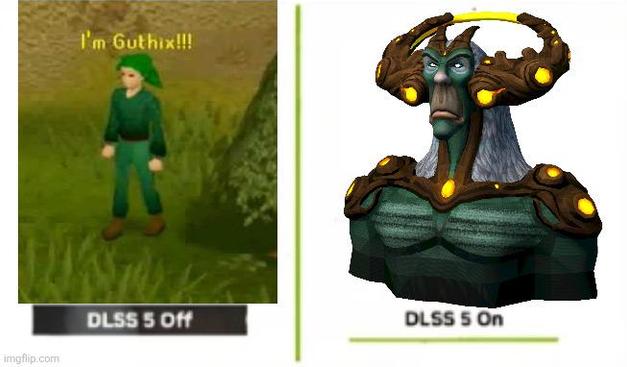
Guthix with/without DLSS 5
Beastmaster ranger
You magically summon a primal beast, which draws strength from your bond with nature. Choose its stat block: Beast of the Land, Beast of the Sea, or Beast of the Sky. You also determine the kind of animal it is, choosing a kind appropriate for the stat block. Whatever beast you choose, it bears primal markings indicating its supernatural origin.
Druid familiar summon
You gain the service of a familiar, a spirit that takes an animal form you choose: Bat, Cat, Frog, Hawk, Lizard, Octopus, Owl, Rat, Raven, Spider, Weasel, or another Beast that has a Challenge Rating of 0. Appearing in an unoccupied space within range, the familiar has the statistics of the chosen form, though it is a Celestial, Fey, or Fiend (your choice) instead of a Beast. Your familiar acts independently of you, but it obeys your commands.
Summon beast
You call forth a bestial spirit. It manifests in an unoccupied space that you can see within range and uses the Bestial Spirit stat block. When you cast the spell, choose an environment: Air, Land, or Water. The creature resembles an animal of your choice that is native to the chosen environment, which determines certain details in its stat block. The creature disappears when it drops to 0 Hit Points or when the spell ends.
It’s a weird pick, but I recommend bloom.host.
They’re gaming-focused, but their Ryzen vps boxes are really performant. Very helpful and competent support, great uptime and comms, solid tooling and monitoring.
You can pay with a virtual card no problem.
I work in biomed R&D, and specifically spent many years in Radiology.
Industry consensus is that CAD occasionally picks up anomalies that a radiologist would have missed, but the false positives it picks up are noisy enough to largely offset that benefit. It’s fine if used as a second pass to catch areas a human missed, but doesn’t actually perform “better than a doctor” in a vacuum, precisely because it’s not thinking for itself and e.g. cross referencing the imaging against clinical history.
Why are you making up quotes I didn’t say and don’t reflect my opinion in the slightest?
From the outside, it sure looks like you’re trying to flame and stir drama to address your own emotional state, rather than make any sort of coherent argument to persuade people to your line of thinking.
This is a project released for free by volunteers we’re talking about, not a commercial service pushing hostile crap on users.
I think the dev in question is shitty for treating Lutris as their own fiefdom, but the mob are looking a gift horse in the mouth by attacking volunteers when they’re not willing to step up and contribute non-AI code themselves.
Your link doesn’t support what you’re saying in the slightest. Have whatever opinion you want, but don’t shovel up transparent bullshit to push your narrative.
TFA is about a a copyright on a work made by a purely autonomous device, and SCOTUS declining to hear a case doesn’t “settle” jack-shit.
Quoting further:
Thaler submitted an application to the US Copyright Office to register copyright in “A Recent Entrance to Paradise,” explicitly identifying the AI system as the author and stating the work was created without human intervention.
For now, businesses and creators using AI should continue to rely on the longstanding human authorship requirement. Under current law, works made solely by autonomous AI are not eligible for copyright protection in the United States. Ongoing cases also consider the amount of human input, including prompting or post-generation editing, required to register copyright in an AI-generated work.[12]
Companies should ensure a human contributes creatively and is named as the author in any copyright applications for AI-assisted works. To maximize protection, organizations should review their creative workflows and document human involvement in AI-assisted projects, particularly for commercial content. Organizations should continue to document the timing and scope of the use of AI in copyrightable works, for example by retaining prompts provided by the author. Internal policies should clarify attribution, ownership, the nature of creative input, and documentation requirements to avoid denied copyright applications.
Iteratively working on a codebase by guiding an LLMs design choices and feeding it bug reports is fundamentally different from this case you’re citing.
