 blackle mori
never change, the onion, never change


@jensimmons It’s crazy that people still try to claim that Safari is extremely far behind other browsers. When the reality is a privacy focused browser from the foundation has to be done correctly not quickly.
Congratulations to the entire Safari team for being the first browser to support this tho. 🎉
I can't remember the last time a new HTML element came along. Yesterday, <search> shipped in Safari 17.0 (the first browser with support).
You can start using it to build websites TODAY, even when most of your users still don't have support. We explain why & how at the beginning of this article: https://webkit.org/blog/14445/webkit-features-in-safari-17-0/
```
<search role="search">
<form action="/search">
<p><input type="search" name="q"> <input type="submit" value="Search!"></p>
</form>
</search>
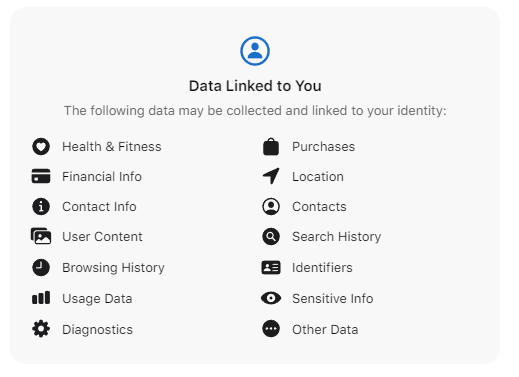
If you're thinking of using Facebook/Instagram's Twitter clone, here's a reminder of just how invasive it will be of your privacy:
h/t @nelson
There was a paper to fix this. https://wg21.link/p0145
If you see in the last version of that paper (r3, http://wg21.link takes you to last revision), they had to leave open the potential for not doing left-to-right eval, because one set of vendors fought the authors.
The history of this is fascinating, because if you go to a few of the CppCon and C++Now panels with Standards Experts, you can hear them -- on video -- laughing at the guy working on Clang for Windows for asking why they didn't standardize the eval order for parameters in calls.
(Sidenote: I'll never forget this shit because it was pre my involvement in the C++ Committee. I remember hearing that Clang for Windows guy get up there, ask, and then have everybody sitting up there imply you're a dumbass for relying on the order of evaluation.
I felt stupid, myself.)
Fast forward to the publication of this paper, all of the C++ experts that were up there shitting on the Clang for Windows dev had egg on their face because common idiomatic code had unspecified evaluation order and things were genuinely fucked up between compilers!
So, these folks write a paper to fix it, because that's actually kind of fucking embarrassing and stupid. If you read the revisions r0 through r2, you'll see they included left-to-right evaluation for Function Calls as part of the deal.
But it didn't make it.
What happened?
See, the people writing the paper knew it was a steep slope. Old compiler dev traditions die hard; unevaluated order is best so they can swizzle things and Do Cool Optimizations™ or whatever the hell they were saying.
So they made some benchmarks and tests, then put that data in the paper.
Turns out, eval order didn't matter as much as your optimizer just not being dumb as bricks. You could change the ordering and even when you weren't trying it was basically noise which direction it went in: +/-2% either way just by doing left-to-right eval, without cluing the optimizer in to the change of the evaluation order. This was pretty solid evidence that if people actually gave a damn and tried, left-to-right enforced eval would have no performance impact, and the Old Compiler Dev traditions was actually just that:
boring, dead tradition!
Alas, despite this paper first showing up in 2015 and having time for others to validate their claims, rather than present counter-data, do you know what the detractors of this paper did? They just complained.
"You're taking away my implementation freedom!" (Not a direct quote, but that's the gist of it.) And, you know what?
It worked.
By the time this paper was settled for C++17, they chose the most batshit option which is:
A clownshoes resolution, but on-brand for C++.

Hey all, It's been an amazing run thanks to all of you. Eight years ago, I posted in the Apple subreddit [about a Reddit app I was looking for...
Announced at WWDC23, Vision Pro is the beginning of a spatial computing, and the moment when AR/VR reaches the masses. Let's not discuss how useful or creepy that is, but appreciate for a moment how well-thought-out this ecosystem is from the get-go.
I just watched "Create Accessible Spatial Experiences" and I am impressed by how well this platform addresses all accessibility aspects. The platform is designed to be inclusive from the ground up.
 Charlie Fish
 Jen Simmons
 David Nelson
 Taylor Lorenz
 Dan Gillmor
 Björkus "No time_t to Die" Dorkus
 Christian Selig
 Paweł Grzybek