Daniel Laurison

@daniel_laurison@sciences.social
1.3K Followers
781 Following
384 Posts
Sociologist interested in class, inequality, politics. Author of Producing Politics & co-author of The Class Ceiling. Carnegie Fellow. Trans man. Dad.
Bookbit.ly/ProducingPolitics
Websitedaniellaurison.com
Google Scholarhttps://scholar.google.com/citations?user=4FJPz8YAAAAJ&hl=en
Editor-in-Chiefhttps://onlinelibrary.wiley.com/journal/14684446
I really enjoyed this conversation with Matthew Sheffield - we discussed my new report (https://www.swarthmore.edu/understanding-political-disconnect), the benefits of qualitative research, and why Democrats are not doin enough to bring low-income & working-class people into politics.
https://plus.flux.community/p/financially-struggling-americans
My mom - an atheist - sent the picture to *her* mom, a fundamentalist Christian. My mom hoped a picture of a pastor with her grandkid would make my grandma happy. Grandma Hazel instead told her we didn't have to keep going to protests, she would just pray for the South Africans.
My Reverend Jesse Jackson recollection: my mom was a big supporter of his & the Rainbow Coalition. And I met him once, kind of - he came to the weekly protest we went to at the South African consulate's house in Seattle, and there's a picture of him holding my brother.

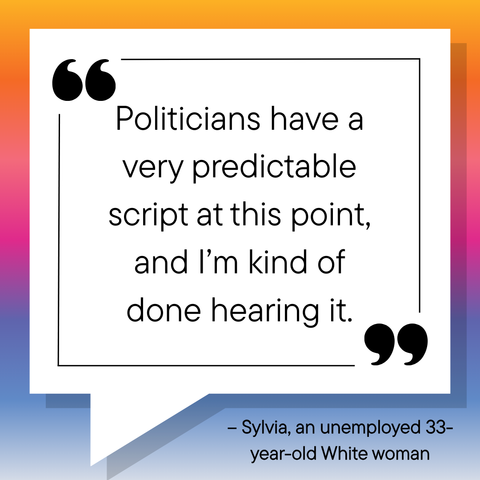
And they also didn't believe that politicians or electoral politics were likely to make real changes in their lives; many told us they did not important differences between the parties.

(That's not how I see it; but this is about how what our respondents said.)

The people we spoke with were not ignorant, and they weren't apathetic.

For lots of very good reasons, many poor & working-class people we interviewed don't believe politicians understand or care about their concerns or their communities, or are interested in learning.

Note - many opinion polls and most campaign polls exclude people who are not registered or unlikely to vote, and in general nonvoters are less likely to respond to most polls & surveys, so in a very real sense people who aren't voting have their views discounted/ignored.

Almost all of the people we spoke with see politics as something by, for, and about rich people (and often also white people & men).

That makes for a vicious cycle - they stay home, so politicians don't try to reach them, so they don't see why they should vote.

Last week, I published a report - the "Political Disconnect" -based on interviews with 144 low-income & working-class people, across racial groups, who don't usually vote. They are the experts on why, and today I want to share their words.
https://www.swarthmore.edu/understanding-political-disconnect
Today I'm releasing probably the most important scholarly thing I've ever worked on - a report based on talking with 144 people about why they don't vote or only vote regularly, and on what needs to be done to build a democracy that can include everyone.
https://www.swarthmore.edu/understanding-political-disconnect
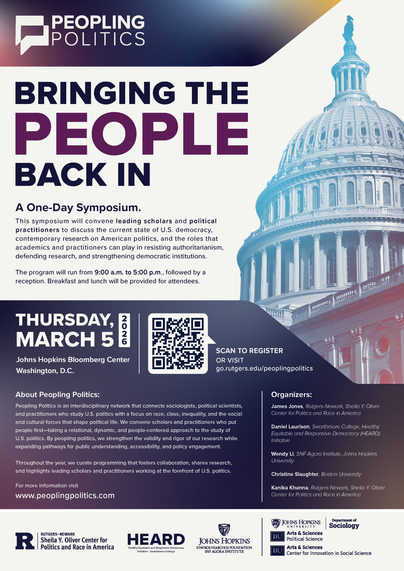
We have an amazing line-up of speakers for "Bringing the People Back In: Race Class & Inequality in US Politics." Scholars & people who work in politics will be in conversation throughout the day. Sign up at https://www.eventbrite.com/e/bringing-the-people-back-in-race-class-inequality-in-us-politics-tickets-1980385632738?aff=oddtdtcreator