Cornor Reed

@cornorreed
0 Followers
0 Following
11 Posts

Author of Ordering.

Ordering Papers Series on failure cost, decision drop, and institutional memory.

Book + Papers + Notes + Archive
https://read-ordering.netlify.app/

Zenodo Archive
https://zenodo.org/communities/ordering-papers/records

OSF Project
https://osf.io/q7kzw/

Substack Notes
https://notesonordering.substack.com

Book + Papers + Notes + Archivehttps://read-ordering.netlify.app/
Zenodo Archivezenodo.org/communities/ordering-papers/records
OSF Projecthttps://osf.io/q7kzw/
Substack Noteshttps://notesonordering.substack.com/
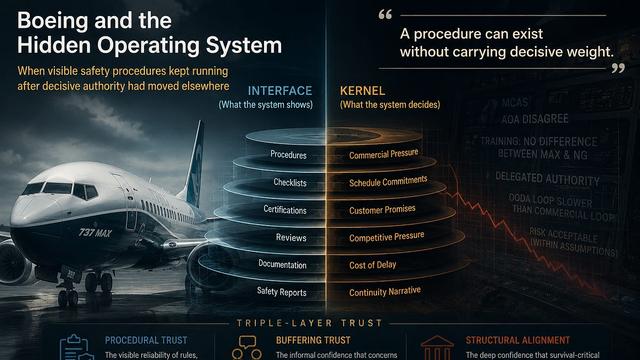
Boeing and the Hidden Operating System

When visible safety procedures kept running after decisive authority had moved elsewhere

Ordering

Ordering Case Notes · No. 01 is ready.

Boeing and the Hidden Operating System

When visible safety procedures kept running after decisive authority had moved elsewhere.

Full article coming through Notes on Ordering.

Cornor Reed (@cornorreed)

What Comes Next: Cases, Tools, and Concepts The archive is now in place. The first sequence of the Ordering Papers Series has been released, and the downloadable guide now connects the book, the papers, and the project archive. The next stage of this Substack will move from archive-building to applied reading. Going forward, three recurring formats will organize the work here. 1. Ordering Case Notes Ordering Case Notes will apply the Ordering framework to real cases: corporate failures, regulatory transformations, platform crises, data-governance conflicts, energy-dependence shocks, capital allocation errors, long-cycle institutional behavior, and geopolitical pressure fields. These essays will not treat cases as ordinary commentary. They will ask what the visible explanation misses. Where did decision weight move? What was the system really pricing? Which layer carried the decisive force? When did compliance stop explaining the outcome? What should practitioners learn from the pattern? The first case note will examine Boeing and the hidden operating system: how visible safety procedures continued to operate after decisive authority had already moved elsewhere. 2. Ordering Diagnostics & Tools Ordering Diagnostics & Tools will focus on practical use. The book Ordering: How Systems Reprice When Failure Becomes Expensive develops diagnostic tools, pressure calibrations, cold tools, and structural reading protocols. This series will introduce selected tools in a shorter and more usable format. These pieces will ask questions such as: How do you know when compliance has stopped explaining the decision? How do you detect failure-cost repricing before it becomes visible? How do you tell whether a partner has become a managed variable? How do you recognize when the interface is still speaking but the kernel has moved? How do you know when a system is preserving inefficiency because it is carrying stored failure cost? The article shows the symptom. The book gives the diagnostic instrument. 3. Ordering Concepts Ordering Concepts will offer shorter explanations of the framework’s core terms. These pieces will clarify concepts such as failure cost, decision weight, interface and kernel, managed variable, decision drop, structural repricing, institutional memory, deep time, and civilizational memory. They are designed to build fluency in the language of Ordering. Concepts matter because language determines what a system can see. Without a name for decision weight, one may keep arguing with the visible process after the decision has moved elsewhere. Without a name for stored failure cost, one may mistake institutional memory for mere inertia. Without a name for managed variable, one may continue treating a relationship as trust-based after the system has already reclassified it. Publication Rhythm The two main formats — Ordering Case Notes and Ordering Diagnostics & Tools — will run in an alternating weekly rhythm. One week will focus on a real case. The next week will focus on a diagnostic tool. Ordering Concepts will appear between them as shorter explanatory pieces, especially when a term needs to be clarified before or after a case analysis. The structure is simple: Case Notes show what the framework can read. Diagnostics & Tools show how readers can use it. Concepts build the language needed to think with it. The papers develop the mechanisms. The book develops judgment. The next phase begins now.

Substack

The archive is now in place.

The framework now moves into the field.

Download the guide:

The Architecture of Systemic Repricing — A guide to Ordering, the book, and the first five papers in the Ordering Papers Series

Zenodo:

https://doi.org/10.5281/zenodo.20485150

The Architecture of Systemic Repricing: A guide to Ordering, the book, and the first five papers in the Ordering Papers Serie

This guide introduces the Ordering framework and explains the relationship between the book Ordering: How Systems Reprice When Failure Becomes Expensive and the first five papers in the Ordering Papers Series. It serves as a reader guide, series overview, and conceptual entry point linking the book, working papers, notes, and archive into a single reading path.

Zenodo
The Architecture of Systemic Repricing: When Compliance Stops Explaining Decisions

How failure cost moves from rules to structure, from crisis to memory, and from visible compliance to institutional firmware.

Ordering

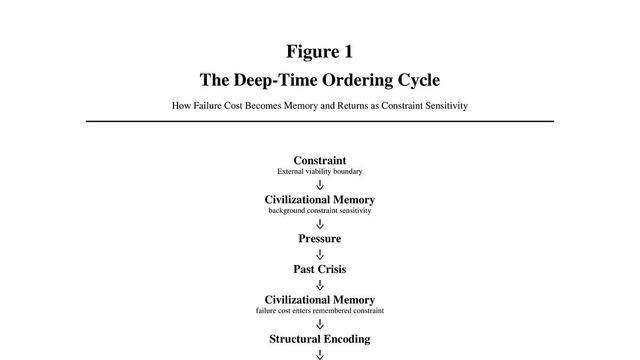
Ordering Papers Series, No. 05: Deep Time and Institutional Memory: Why Systems Preserve Inefficiency After the Original Crisis Has Passed

DOI 10.5281/zenodo.20462295
https://doi.org/10.5281/zenodo.20485150

The Architecture of Systemic Repricing: A guide to Ordering, the book, and the first five papers in the Ordering Papers Serie

This guide introduces the Ordering framework and explains the relationship between the book Ordering: How Systems Reprice When Failure Becomes Expensive and the first five papers in the Ordering Papers Series. It serves as a reader guide, series overview, and conceptual entry point linking the book, working papers, notes, and archive into a single reading path.

Zenodo

Ordering Papers Series, No. 04

Decision Drop

This paper examines how visible procedures may remain active while decision weight shifts across layers under failure cost.

DOI archive:
https://doi.org/10.5281/zenodo.20422168

Ordering Papers Series, No. 04: Decision Drop: How Layer Weights Shift Under Failure Cost

This working paper develops the concept of decision drop to explain why visible decision procedures may remain active while losing decisive weight under high failure cost. Decision drop does not mean that decisions are made by a single hidden layer. In layered systems, all layers continue to calculate. The shift occurs when the visible interface loses relative weight inside a parallel weighted calculation, while deeper layers of exposure, reversibility, dependency, memory, and survivability gain greater weight. The paper extends the Ordering Papers Series by linking compliance loss, structural repricing, structurally encoded failure cost, and the redistribution of decision weight across system layers.

Zenodo

Ordering Papers Series, No. 03

From Partner to Managed Variable

This paper examines how valuable external actors may remain useful and compliant while being reclassified from trusted partners into managed variables under systemic pressure.

DOI archive:
https://doi.org/10.5281/zenodo.20402495

Ordering Papers Series, No. 03: From Partner to Managed Variable: How External Actors Are Reclassified Under Failure Cost

This working paper examines how valuable external actors are reclassified under systemic pressure. It argues that partners, suppliers, platforms, investors, experts, and institutions may remain useful, compliant, and formally acceptable while their operational status changes from partner to managed variable. The paper develops the concept of the managed variable to explain how systems shift cooperation from trust-carried structures to containment-carried structures when an external actor’s failure burden becomes harder to carry. It shows why access narrows, discretion declines, communication becomes routed, redundancy increases, and alternative actors are cultivated even when cooperation formally continues. As part of the Ordering Papers Series, this paper extends the failure-cost mechanism to external-actor relationships and explains how systems reclassify actors when trust is no longer the cheapest way to contain failure.

Zenodo

Ordering Papers Series, No. 02

Failure Cost as an Ordering Mechanism

This paper examines why systems may stop optimizing for performance and begin protecting viability when failure becomes expensive.

DOI archive:
https://doi.org/10.5281/zenodo.20402394

Ordering Papers Series, No. 02: Failure Cost as an Ordering Mechanism: Why Systems Stop Ranking by Efficiency When Failure Becomes Expensive

This working paper develops failure cost as an ordering mechanism. It argues that when failure becomes expensive, systems stop ranking behavior primarily by efficiency, performance, or optimization value. Instead, they begin ranking possible paths by what can still be carried without threatening systemic viability. The paper explains how rising failure cost shifts authority from optimization logic to viability protection. It shows why systems preserve redundancy, delay efficient actions, narrow discretion, and reselect feasible paths when local failure can become system-level exposure. As part of the Ordering Papers Series, this paper provides the core mechanism through which systems reprice behavior under pressure.

Zenodo

Ordering Papers Series, No. 01

When Compliance Stops Explaining Decisions

This paper examines how formal compliance can remain visible after losing ordering authority under systemic pressure.

DOI archive:
https://doi.org/10.5281/zenodo.20402113

Ordering Papers Series, No. 01: When Compliance Stops Explaining Decisions: Why Formal Validity Loses Causal Authority Under Systemic Pressure

This working paper examines why formal compliance can lose causal authority under systemic pressure. It argues that when failure cost rises, systems no longer rank objects, actors, or decisions only by visible correctness. Instead, they reprice them according to the burden their failure may impose on the broader system. The paper develops compliance loss as an ordering problem, showing how formally acceptable objects can become exposure-bearing objects when systems shift from rule validation to viability protection. It contributes to the Ordering Papers Series by explaining how compliance can remain valid while no longer explaining institutional decisions.

Zenodo