CliMA

@climatemachine
18 Followers
18 Following
15 Posts
We are a coalition of scientists, engineers, and applied mathematicians from Caltech, MIT, and NASA’s Jet Propulsion Laboratory. We are building a new Earth system model that leverages recent advances in the computational and data sciences to learn directly from a wealth of Earth observations from space and the ground.
websitehttp://clima.caltech.edu
githubhttps://github.com/CliMA
Blueskyhttps://bsky.app/profile/climatemachine.bsky.social
LinkedInhttps://www.linkedin.com/company/climate-modeling-alliance/

SURF interns contribute to CliMA Science at Caltech

Over a 10-week summer period, the CliMA project welcomed three Summer Undergraduate Research Fellowship (SURF) interns. These undergraduate students were mentored by CliMA project scientists and software engineers on individual research projects that contributed to our model development. Thanhthanh Noel Nguyen, a second-year Caltech undergraduate, collaborated with Software Engineer Julia Sloan and the Land team. Her…

https://clima.caltech.edu/2025/10/07/surf-interns-contribute-to-clima-science-at-caltech/

SURF interns contribute to CliMA Science at Caltech

Over a 10-week summer period, the CliMA project welcomed three Summer Undergraduate Research Fellowship (SURF) interns. These undergraduate students were mentored by CliMA project scientists and so…

CliMA

Rethinking Vegetation Optics in Climate Models

By Renato Braghiere Vegetation plays a critical role in regulating Earth’s climate by absorbing sunlight, exchanging moisture with the atmosphere, and sequestering carbon. Yet, how vegetation is represented in climate models has remained surprisingly static for decades. Most climate models use a simplified classification called plant functional types (PFTs) — broad categories like “tropical trees” or “grasses” — and assign…

https://clima.caltech.edu/2025/07/03/rethinking-vegetation-optics-in-climate-models/

Rethinking Vegetation Optics in Climate Models

By Renato Braghiere Vegetation plays a critical role in regulating Earth’s climate by absorbing sunlight, exchanging moisture with the atmosphere, and sequestering carbon. Yet, how vegetation is re…

CliMA

Constraining 21st century ocean circulation changes

The ocean contains a system of currents that connects different ocean basins. A significant feature of this system is found in the Atlantic Ocean basin and often referred to as the Atlantic meridional overturning circulation (AMOC). The AMOC is crucial because it transports warm water northward and helps circulate water between the deep ocean and the surface. As a result, the AMOC plays a vital role in regulating both…

https://clima.caltech.edu/2025/06/02/constraining-21st-century-ocean-circulation-changes/

Constraining 21st century ocean circulation changes

The ocean contains a system of currents that connects different ocean basins. A significant feature of this system is found in the Atlantic Ocean basin and often referred to as the Atlantic meridio…

CliMA

High-level, high-resolution ocean modeling at all scales with Oceananigans

https://clima.caltech.edu/2025/04/30/high-level-high-resolution-ocean-modeling-at-all-scales-with-oceananigans/

High-level, high-resolution ocean modeling at all scales with Oceananigans

CliMA
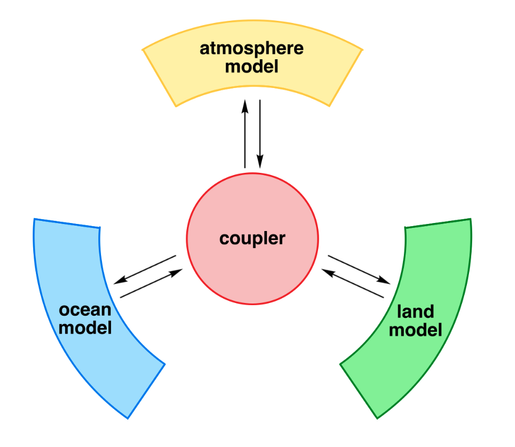
🌍 CliMA is developing an #ESM with independent atmosphere, ocean, and land components. Each can be run alone for focused studies or together for global climate predictions. ClimaCoupler.jl links these models, facilitating data exchange and comprehensive analysis. Read blog about it: http://bit.ly/3W7FWiD
ClimaCoupler.jl: A modular, efficient ESM coupler in Julia

CliMA
Dive into the world of ocean modeling revolutionized by GPU technology! 🌊 Our latest blog post explores how CliMA's cutting-edge model achieves unprecedented speed and accuracy, unlocking insights into Earth's climate dynamics. Discover how GPUs are transforming climate science and powering future climate scenario exploration. ClimateScience #GPU #OceanModeling Read the fresh blog! https://clima.caltech.edu/2024/04/15/the-worlds-fastest-ocean-model/
The world’s fastest ocean model

CliMA
🌊 Discover the journey from a gentle breeze to turbulent waves! Gregory Wagner et al. explore using simplified simulations. They highlight the crucial role of surface wave amplitude in wind-drift layer evolution, emphasizing the need for accurate predictive models. #FluidDynamics #WaveScience 🌀 Read more in the Journal of Fluid Dynamics: https://doi.org/10.1017/jfm.2023.920
Transition to turbulence in wind-drift layers | Journal of Fluid Mechanics | Cambridge Core

Transition to turbulence in wind-drift layers - Volume 976

Cambridge Core
🌫 See our new blog post on enhancing bulk cloud microphysics modeling by incorporating super droplet simulations. Learn how these simulations offer a more accurate representation of cloud processes, contributing to better climate predictions. #CloudPhysics #ClimateScience https://clima.caltech.edu/2024/04/04/improving-bulk-cloud-microphysics-modeling-the-role-of-super-droplet-simulations/
Improving bulk cloud microphysics modeling: the role of super-droplet simulations

CliMA
Our latest research article now in Chaos journal. Ensemble Fokker–Planck Filter (EnFPF): a novel approach to filtering dynamical systems with noisy observations of evolving densities. EnFPF proves effective in correcting ensemble statistics and accelerating convergence in various scenarios. Potential applications include climate ensembles and turbulence modeling. 🌐🔍 https://doi.org/10.1063/5.0171827
Filtering dynamical systems using observations of statistics

We consider the problem of filtering dynamical systems, possibly stochastic, using observations of statistics. Thus, the computational task is to estimate a tim

AIP Publishing
The US is facing increasing demands for resilient, secure, and thriving services amidst environmental challenges. 🌿🔍 In a new AGU Earth's Future article, a Keck Institute for Space Studies (KISS) Continuity Study team proposes solutions such as establish a robust coordination framework to prioritize sustained Earth observations, navigate evolving tech, and ensure comprehensive data stewardship. See their new article at https://doi.org/10.1029/2023EF003757