
Christopher Patton

141 Followers
102 Following
150 Posts
Cryptography at Cloudflare Research

People working on post-quantum-proofing vulnerable encryption protocols (and curious onlookers) can find lots of value in this new post from Cloudflare. It discusses the herculean engineering challenges of revamping anonymous credentials that will be broken by a quantum computer. There's a growing need for this kind of privacy (for instance to make digital drivers licenses privacy preserving), which allows individuals to prove specific facts, like they have had a drivers license for more than 3 years, without divulging personal information like their birthday or place of birth. The long and short of of the challeng is that engineers can't simply drop quantum-resistant algorithms into AC protocols that currently use vulnerable ones. Instead, engineers will need to collaborate with standards bodies that build entirely new protocols, largely from scratch. The post goes on to name a few of the most promising approaches.

https://blog.cloudflare.com/pq-anonymous-credentials/

Policy, privacy and post-quantum: anonymous credentials for everyone

The world is adopting anonymous credentials for digital privacy, but these systems are vulnerable to quantum computers. This post explores the cryptographic challenges and promising research paths toward building new, quantum-resistant credentials from the ground up.

The Cloudflare Blog

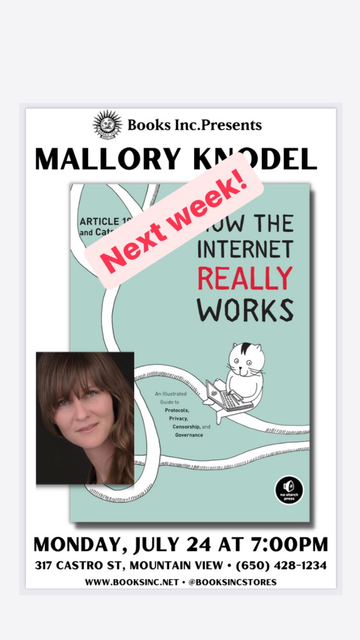
DATE CHANGE: Now on Tuesday July 25th!

Talking about the internet with cats next week. Books Inc in Mountain View is kindly hosting a book talk for How the Internet Really Works @nostarch

knuckle tats: fiat-crypto
He's just Ken

The (very early stage) draft of Merkle Tree Certificates is worth a read if you haven't already: https://www.ietf.org/id/draft-davidben-tls-merkle-tree-certs-00.html

The idea is to store domain name<->public key bindings in a Merkle tree, mirrored by browser vendors or other designated entities to clients and other interested parties. TLS servers are authenticated via a proof of membership in one of these Merkle trees, instead of via a bunch of signatures in an X.509 certificate chain -- which are huge in a postquantum world. This new form of authentication only works for certain types of clients and certain types of situations, so the whole thing falls back to traditional X.509 certificate chains otherwise. You can think of it as a PKI designed from scratch, with CAs and CT smooshed into one system, as an optimization layer on top of today's web PKI.

The main motivation is postquantum cryptography; PQ signatures are huge and this scheme allows a client to verify a domain name <-> public key association with 0 signatures. The Merkle tree proof is no bigger in a PQ world. There are lots of other interesting properties that MTCs lets us explore too, like being able to negotiate trust anchors -- that is, a client can signal which CAs it supports and the server can authenticate itself in a way that works with those supported CAs. In contrast today a server has to configure a single certificate to work with all clients it wants to support. This part isn't fully fleshed out yet but it's exciting. It's a great time to give feedback on the draft.

All credit to my colleagues David Benjamin and Devon O'Brien!

Merkle Tree Certificates for TLS

This document describes Merkle Tree certificates, a new certificate type for use with TLS. A relying party that regularly fetches information from a transparency service can use this certificate type as a size optimization over more conventional mechanisms with post-quantum signatures. Merkle Tree certificates integrate the roles of X.509 and Certificate Transparency, achieving comparable security properties with a smaller message size, at the cost of more limited applicability.

**BREAKING NEWS TOMORROW**

-----BEGIN AGE ENCRYPTED FILE-----
YWdlLWVuY3J5cHRpb24ub3JnL3YxCi0+IHRsb2NrIDEyNjc2MjEgZGJkNTA2ZDZl
Zjc2ZTVmMzg2ZjQxYzY1MWRjYjgwOGM1YmNiZDc1NDcxY2M0ZWFmYTNmNGRmN2Fk
NGU0YzQ5MwpvNUN5UkpLcWpVQ1pSR0hHTGtpdFJ0cCtOSi9ER2p5VlpLRExYOTlH
aUdqd3dtbUR3TjBPSXZjU1BaVkY4TUVpCkVFNFlrNmZmbHljcXFVWUNPcFlHM3Zs
UnkzRlVRdElHcmJ0VEtVSHpueThqbEkzYlJDN3hUd0xZQ3pBM09ZN0QKaW1kOGZ4
WnVEWGJPb0JIbHVnWXlzcnZsMm41c08yUVRPSlJCa2NYQTdIRQotLS0gOTg5NmVv
b1ZkZ2p1WnNTRkUvZXdjZWtISzNQRmxtcXQ0ZTdSVGVZcDBKOApXCVBzeM1r6FgE
Jd8YtcjJqMC60waCEn0bJzvJ4XlmbViL83Y/UcWk0svUJdQ=
-----END AGE ENCRYPTED FILE-----

https://timevault.drand.love/

Timevault

I actually went through this process three times and sent the three candidates to the RFC editor on March 24 for them to pick.

The other two topics that ChatGPT picked were:
* The AI Self-Awareness Protocol: Towards Conscious Machines
* AI-Generated Pranks Protocol (AIPP)

In case folks are interested, I've put the Markdown for all three on GitHub:

https://github.com/bifurcation/rfc9405

8/n

GitHub - bifurcation/rfc9405: A ChatGPT-generated April 1 RFC

A ChatGPT-generated April 1 RFC. Contribute to bifurcation/rfc9405 development by creating an account on GitHub.

GitHub
is the danger zone near the neutral zone
MPC sorting is a cool looking problem.
It's good to think a little beyond your formal model. Cryptography can and should provide defense-in-depth.