@caseiokey

20 Followers
20 Following
1,079 Posts
What’s under the paint (click on TOP! Fantasy colors added by me.)
Decoding Hieronymus Bosch riddles. Late-Medieval, Early-Renaissance and religious art & culture.
For better visibility, images may have been enhanced.
DAILY SERVICE NOT ALWAYS POSSIBLE

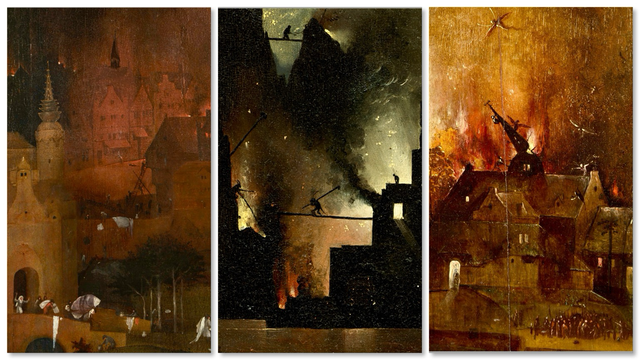
FIRES 🔥
Hieronymus Bosch often painted large fires. Likely, as a ~13y boy Joen saw the Den Bosch City Fire 1463.

Fires are in several situations:
*as city fire, on the Wilgefortis work. Bax explains that depicted St.Anthony was seen as protector
*in Purgatory/Hell
*by demons, to harass St.Anthony.

=> See ALT for locations.
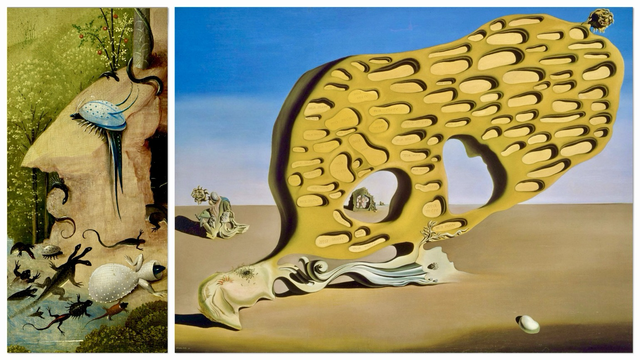
Salvador Dali’s “The Enigma of My Desire” (1929) was according to him one of his most important works.
The painting has a reference to Hieronymus Bosch’s triptych The Garden of Earthly Delights (ca.1500), like many other of Dali’s works.

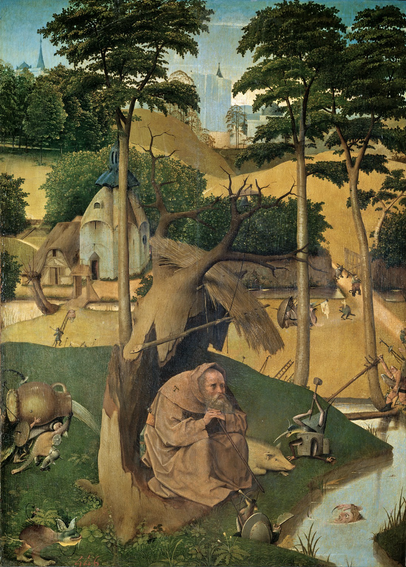
THE TEMPTATION OF ST.ANTHONY
can also be found at the Prado, in a quite different version. The museum attributes it to Hieronymus Bosch 1510-15, on several characteristics.

The Bosch Conservation and Research Project was not yet given permission to document or examine the painting in situ.

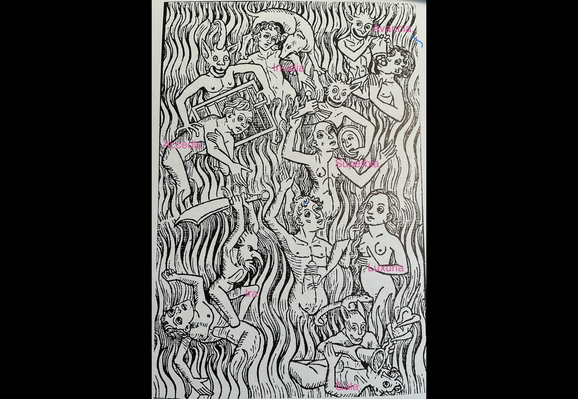
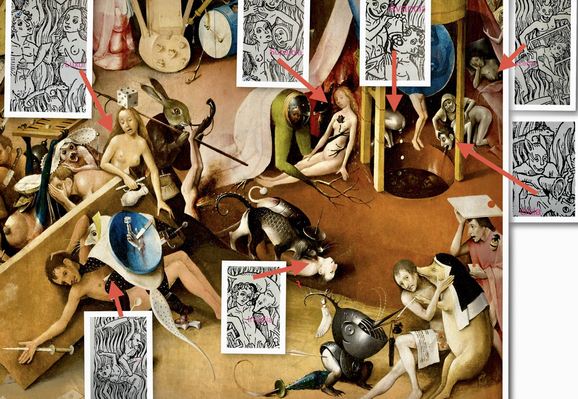
“The punishments for the seven deadly sins in hell”, a Seelenwurzgarten woodcut (Ulm 1482) is here compared with Hieronymus Bosch’s Afterlife (“Hell”) of ~1500. SLIDE to see!

I have put the names of the PRESUMABLE sins next to the appropriate scene, and placed the scenes on the Bosch painting.

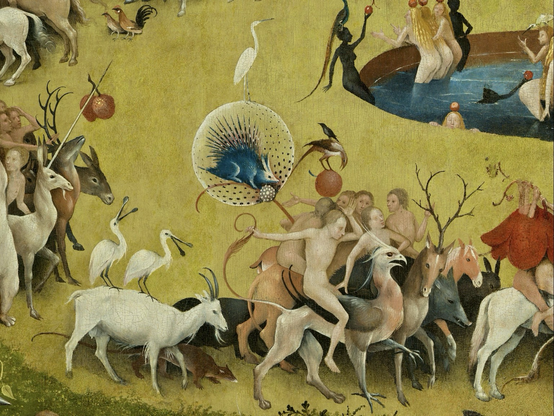
PORCUPINE IN SPHERE
Bax(1956) describes the round object as “(a stem to which)
a TRANSLUCENT BULBOUS FRUIT is attached with a porcupine in it.”

There are many such fruit(/skins) on Bosch’s painting. This is the only time a porcupine is inside:
Keeping sharp needles apart?
Or hinting at prickly sin?

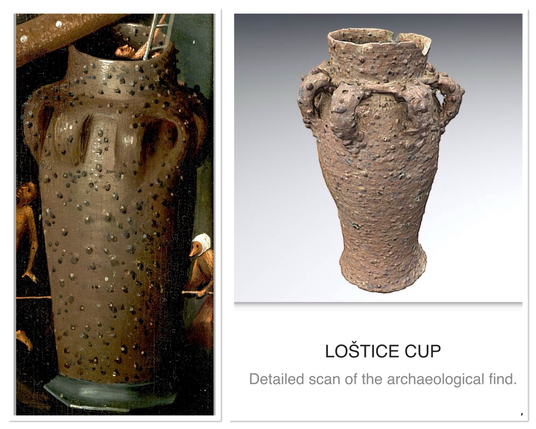
‘PRUNTED’ JUG IDENTIFIED.
It’s a Loštice Cup from N.Moravia, Czech Rep.
A unique pottery w. clay surface nodules. The goblets originally had 8 handles.
They have been a highly prized trading good, found in many castles of C-Europe.
Made since end 14c or early 15c and ceased to be manufactured sometime in the early 16c.
The jug is painted by Hieronymus Bosch on the far right side of the triptych The Garden of Earthly Delights of ~1500AD.

Why it is in the Afterlife (“Hell”) is the next thing/>ALT

Salvador Dali’s “The Enigma of My Desire” (1929) was according to him one of his most important works.
The painting has a reference to Hieronymus Bosch’s triptych The Garden of Earthly Delights (ca.1500), like many other of Dali’s works.

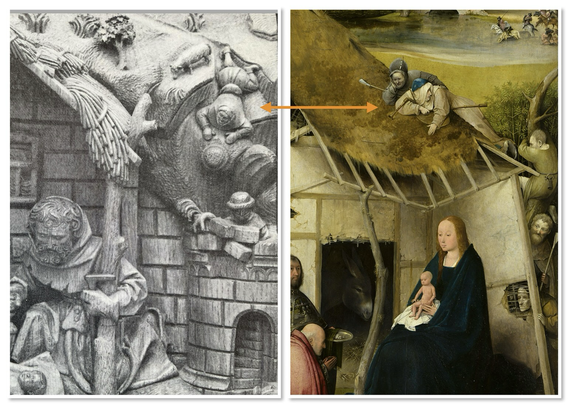
SIMILARITY IN ART: SPECTATING SHEPHERD(S)
on the roof of Nativity’s Stable.
A funny detail in religious art was copied from earlier examples.
Here wood-artisan Dries Holthuys of ca.1500AD (private collection) and painter Hieronymus Bosch use similar scenes of shepherd(s) watching newly born Baby Jesus.

The Bosch detail is from the Magi Adoration triptych at the Prado museum. Ca.1500 AD.

Other sins also come in mind, especiallyx
*Sloth (the man is rather lethargic!)
*Greed (Avaricia)

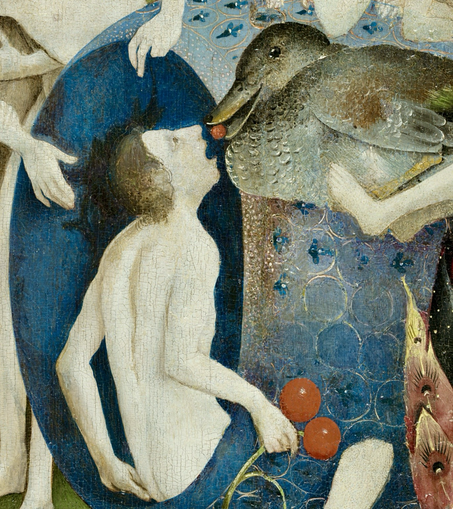
A LITTLE DETAIL
can mean more.
A man opens his mouth for, and is being fed a cherry by the duck -
do notice that he already holds a pair of cherries himself!
=> Into view here is a.o. the capital sin: GLUTTONY.

(From the Garden triptych by Hieronymus Bosch, ~1500AD.
At the Prado museum.
Text based on Johanna Klein, 2nd printing, 2016.)