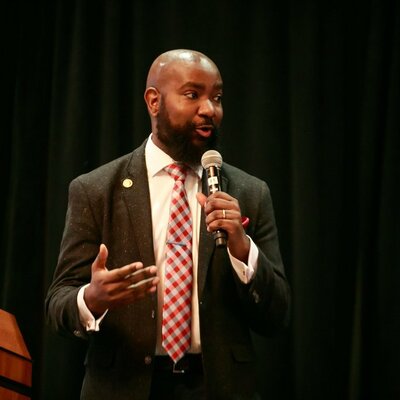
Bret Staudt Willet (he/him)

83 Followers
102 Following
52 Posts
Assistant Professor, Instructional Systems & Learning Technologies at Florida State University. I study self-directed learning through social media.
Websitehttps://bretsw.com
Research Grouphttps://erso-group.org
ORCiDhttps://orcid.org/my-orcid?orcid=0000-0002-6984-416X
tidytags R packagehttps://docs.ropensci.org/tidytags/

Just saw a TikTok from a woman explaining how when she was 12 she learned HTML so she could make Neopets websites and then (legitimately not realizing that this might be bad) creating a fake login page to trick people into giving her their account passwords. She says she had no idea why this was wrong until her dad caught her.

This is the best example I've ever heard of the "you can do a lot of damage with a little bit of code" re: why ethics should be part of learning intro programming.

New article in Learning, Media & Technology:

"Teachers without borders: professional learning spanning social media, place, and time"

https://doi.org/10.1080/17439884.2023.2209326

Have you ever thought about why there aren't AI tax prep companies coming out of the woodwork? Perfect application: drudgery! Legible rules! Expensive human experts!

It's because they (rightly) expect that enough of their customers would get in trouble from bad advice that they'd be sued out of existence, if not indicted themselves.

That's how it should be with all AI apps. Be accountable for what you claim your model does, or don't ship it.

Got a bit of fantastic news this morning as the recipient of the Early Career Scholar award from the AERA Technology as an Agent of Change in Teaching and Learning (TACTL) SIG. I’ve been so happy to learn and grow with this group over the years and feel incredibly honored by this recognition.
It's been a busy but lovely time seeing so many great people this week at AERA (https://www.aera.net/) in Chicago. In addition to all the great conversations, I've had a few different presentations too: https://bretsw.com/post/aera-2023/
American Educational Research Association > Home

As I think about how to design assessments that are not readily answered by large language models, I find myself coming back to something I’ve been interested in for a while: rewarding students for understanding and honestly conveying their degree of certainty in their answers.

This is something that ChatGPT and the likes are notoriously bad at in their current instantiations.

In its simplest form, this might mean taking more points off for wrong answers than for questions left blank.

tidyverse 2.0.0 is out now! https://www.tidyverse.org/blog/2023/03/tidyverse-2-0-0/ — main change in this release is that lubridate is (finally!) part of the core tidyverse and is thus automatically loaded #rstats
tidyverse 2.0.0

Now including lubridate!

I was deeply skeptical of the idea but I was very wrong. My school hosted a regional conference yesterday during the school day. Sessions were held in classrooms while various teachers had their prep periods. Attendees got to drop in on classrooms, interact with students, and see some of the people who were presenters in action. The closing session was a student panel about what they want more and less of in the classroom.

More k-12 conferences should be done this way.

Here is your must-read article for the day, a profile of @emilymbender, and her efforts to deflate the ridiculous hype around large language models such as ChatGPT.

It's also about the people who are behind that hype, and about what their way of thinking has the potential to do to us.

It's worth reading all the way to the end.

https://nymag.com/intelligencer/article/ai-artificial-intelligence-chatbots-emily-m-bender.html

Happy to share some recent work that is open access in the journal Professional Development in Education:

"Early career teachers’ expansion of professional learning networks with social media"

https://www.tandfonline.com/doi/full/10.1080/19415257.2023.2178481

Although the focus is on how new teachers navigate challenges as they enter their careers, many of the recommendations are broadly applicable to anyone starting a new job.

Early career teachers’ expansion of professional learning networks with social media

Early career teachers (ECTs) face numerous challenges during their transition from preparation programmes into professional employment contexts. Social media platforms have created many new opportu...

Taylor & Francis