 Datagraver.com
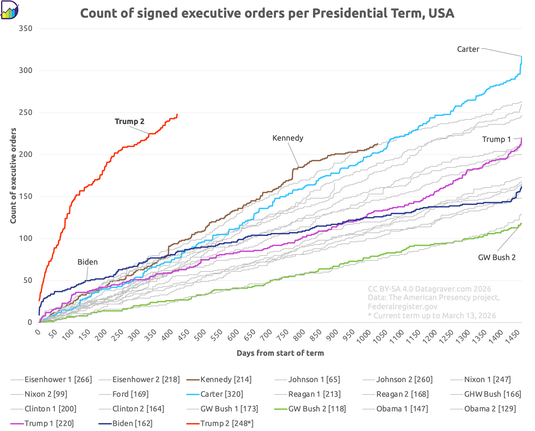
USA: Executive orders signed, days since start Presidential term, post-WWII.


Martin Fowler coined one of my favorite phrases while on a panel at the XP 2000 Conference regarding change and if your employer isn't willing to change: If you can't change your organization, change your organization! I don't think much of eXtreme Programming but I think the phrase itself applies

I feel “baby bonds” are one of the weakest and least effective policy interventions imaginable. They also have a lot of negatives:
It says in no uncertain terms “we don’t trust you parents, we only trust your baby”.. if you even have one? I prefer to start from a position of trust instead of undermining that trust, so why not give people the basic monthly economic security they need first and let THEM decide if they are ready to introduce a new child to the world?
It says “you only have value if you procreate”, whereas I feel all humans have intrinsic value, even if they choose not to have children. So the incentive is now to have lots of babies for the money.. pay to play? Is that want we want?
It ties up a sum of money for 18-23 years so only banks benefit from sitting on that money, which is meanwhile doing absolutely nothing to help anyone, or make the world better, for two decades.
The “lottery effect” of suddenly dumping a sizable sum of money on a young adult doesn’t tend to work well, compared to the safety of having a reliable, regular, consistent monthly income for a reasonable period of time, so the parents have time to raise their child with love and affection, and guide their child without having to work 4 different jobs at once.
Having a child is exactly the time you would need extra financial support… not in 18-23 years, but RIGHT NOW, when the baby arrives, when the need is most urgent -- not “one and done” but regular consistent monthly safety knowing you can have at least a year of reliable income, a predictable future where you can do more than be in constant survival mode.
Why would a policy that mostly benefits banks and “funds” be something that people want to support rather than disbursing the money now to those most in need of it? The incentives seem perverse.
Not only do baby bonds not trust the parents, they don’t even trust the babies — the funds at age 18+ can only be used for certain “correct” things, well who exactly determines that? How does this “program” know their lives better than they do?
What are the upsides of Baby Bonds because I’m having a tough time seeing it.
Minnesota is an anathema to the Trump administration.
“He’s attacking Minnesota because of Minnesota’s virtue,” said Keith Ellison, the state’s attorney general
It’s a midwestern state that hasn’t voted for a Republican presidential candidate since 1972,
including the three times it voted against Donald Trump.
A strong and growing
Scandinavian-style social safety net
and welcoming culture to immigrants
has attracted populations from around the world over the last few generations, including the largest Somali population outside Somalia.
The state is a refuge for trans people and abortion access.
It has high levels of civic engagement,
regularly ranking at or near the top for voter turnout.
It is a donor state, sending more money to the federal government than it receives.
It has higher organized labor participation rates than the national average.
Minneapolis, its largest city, ignited the nationwide 2020 protests over police brutality and racism after a police officer killed George Floyd.
When the polls are so bad that you don’t want the orange guy to come after you so you get out of the polling business. 😬
https://newrepublic.com/post/206495/gallup-ends-presidential-approval-polls-trump
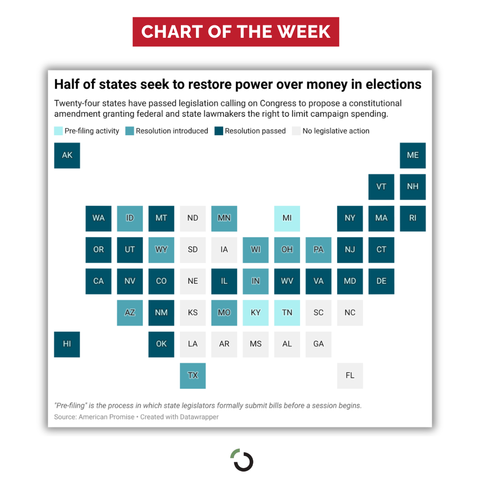
Many political scientists and constitutional scholars now describe the U.S. Constitution as "constructively unamendable." This means that while it is legally possible to change it, the political reality makes it functionally impossible.
Because the amendment process is broken, the energy for changing the "rules of the game" has shifted to the Supreme Court. Since the Constitution cannot be easily changed by the people, political groups fight to appoint judges who will "interpret" the Constitution to mean what they want:
...
Scholars refer to this as 'constitutional calcification.' The U.S. has the hardest constitution to amend in the democratic world. Until the partisan divide softens or one party achieves a massive, generational dominance, the U.S. is likely stuck with the Constitution exactly as it is.
 OpenSecrets
 M❍n❍t❍ne❍fBill™
 Jeff Atwood
 Alice McFlurry
 Chuck Darwin
 Dare Obasanjo