RT @TwistBioscience
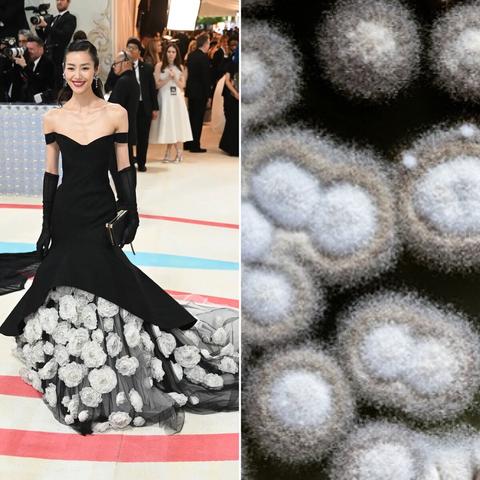
Met Gala as things seen around the lab…
First up: Liu Wen as mold colonies
RT @TwistBioscience
Met Gala as things seen around the lab…
First up: Liu Wen as mold colonies

Characterization of the myotis bat morbillivirus shows that infection in human cells is restricted by innate immune responses in vitro and cross-neutralization by sera from measles, mumps and rubella vaccinees.

Monitoring the diversity of viruses infecting animals is important for assessing zoonotic risk. Here, the authors use metatranscriptomics to characterise the viromes of small mammals, pangolins, and zoo animals in China to identify potentially zoonotic viruses.
RT @patdebrun
So much for defending free speech.
Latest data reveals that @Twitter complied with *every single* government censorship request - no matter how repressive or arbitrary - since @elonmusk took over.
Compliance rates previously hovered around 50%.
https://restofworld.org/2023/elon-musk-twitter-government-orders/

Author summary In 2020, MARV was first detected in fruit bats in Sierra Leone (West Africa). One year later, first outbreak of MARV in West Africa was registered in the neighboring Guinea after a man’s death in the Temessadou M’bokét village. The source of the outbreak has not been identified. It is known, that the reservoir animal of MARV is the cave-dwelling bat Rousettus aegyptiacus, and typically, MARV disease outbreaks emerge after a visit of the index patient to a cave or mine. In our work, we studied bats in the vicinity of this village for the presence of the MARV. A cave hosting a colony of R. aegyptiacus was found close to the Temessadou M’bokét village (~4.5 km). Sampling and PCR screening of the bats from the colony identified three MARV-positive bats. The cave is inaccessible to humans; therefore, the index patient could not have been infected upon visit. We assume that the patient was infected outside the cave after direct or indirect contact with an infected bat of the same colony. These results provide the basis for preventive measures against new MARV outbreaks in Guinea.

Background Coevolution between pathogens and their hosts decreases host morbidity and mortality. Bats host and can tolerate viruses which can be lethal to other vertebrate orders, including humans. Bat adaptations to infection include localized immune response, early pathogen sensing, high interferon expression without pathogen stimulation, and regulated inflammatory response. The immune reaction is costly, and bats suppress high-cost metabolism during torpor. In the temperate zone, bats hibernate in winter, utilizing a specific behavioural adaptation to survive detrimental environmental conditions and lack of energy resources. Hibernation torpor involves major physiological changes that pose an additional challenge to bat-pathogen coexistence. Here, we compared bat cellular reaction to viral challenge under conditions simulating hibernation, evaluating the changes between torpor and euthermia. Results We infected the olfactory nerve-derived cell culture of Myotis myotis with an endemic bat pathogen, European bat lyssavirus 1 (EBLV-1). After infection, the bat cells were cultivated at two different temperatures, 37 °C and 5 °C, to examine the cell response during conditions simulating euthermia and torpor, respectively. The mRNA isolated from the cells was sequenced and analysed for differential gene expression attributable to the temperature and/or infection treatment. In conditions simulating euthermia, infected bat cells produce an excess signalling by multitude of pathways involved in apoptosis and immune regulation influencing proliferation of regulatory cell types which can, in synergy with other produced cytokines, contribute to viral tolerance. We found no up- or down-regulated genes expressed in infected cells cultivated at conditions simulating torpor compared to non-infected cells cultivated under the same conditions. When studying the reaction of uninfected cells to the temperature treatment, bat cells show an increased production of heat shock proteins (HSPs) with chaperone activity, improving the bat’s ability to repair molecular structures damaged due to the stress related to the temperature change. Conclusions The lack of bat cell reaction to infection in conditions simulating hibernation may contribute to the virus tolerance or persistence in bats. Together with the cell damage repair mechanisms induced in response to hibernation, the immune regulation may promote bats’ ability to act as reservoirs of zoonotic viruses such as lyssaviruses.

We are organizing an online Bat1K meeting, aka "Batellite", scheduled for April 27th, @16.00 CEST / 10:00 EDT / 09:00 CDT / 09:00 ECT / 11:00 BRT / 07:00 PDT / 15:00 BST / 08:00 CST / 16:00 SAST /17:00 EAT / 22:00 CST As a community, we would like to further discuss and develop the methodologies, concepts and scientific exploration of the 50+ bat genomes that have been generated at Bat1K. There will be multiple scientific papers stemming from these genomes exploring the amazing biology of bats and we need input, involvement, and commitment from all that are interested in analyzing these data to maximize the output and use of these assemblies. We propose to pitch a package of scientific papers to Science/Nature and their companion journals exploring bat genomics and we are now looking for additional champions of topics and themes. We would like to assess key topics, key players, data sharing, data analyses, and community engagement and together envision our plans moving forward. So what would you do with >50 bat genomes? Are there questions you would like to address? If you have an idea, please bring it to the table at this Batellite
RT @themenacherylab
N679K in boosters may mean much less spike protein than expected. In the context of the bivalent vaccines, WT to Omicron spike ratios may shift from an expected 1:1 to possibly ~5:1. These could explain only modest improvement with the omicron targeted boosters.
(9/N)