Josh Kovach

117 Followers
131 Following
112 Posts

My Latest: M45 - Pleiades / Subaru

Also known as the Seven Sisters, this is one of the closest star clusters to Earth, surrounded by a reflection nebula illuminated by the stars in the cluster.

Total integration time: 25 h 15 min

Click for details: https://app.astrobin.com/i/6r2umd

#astrophotography

AstroBin

I was inspired to shoot this target to figure out what was cut off in my original photo of the Great Lacerta Nebula. The lower right of the photo is be head of LBN432, which looks to me like a dragon with smoke emitting from its nostrils. https://app.astrobin.com/i/335vs5?r=D

It was pretty cool to see that there were, indeed, dragons hiding there.

The Great Lacerta Nebula - AstroBin

This is a two-panel mosaic of the Great Lacerta Nebula, also known as Sh2-126. [list] [*]Pane 1: 608 x 150s (25 h 20 min) ISO800 bin 1x1 [*]Pane 2: 541 x 150s (22 h 32 min 30 s) ISO800 bin 1x1 [/list]...

Presenting my latest: The Bright Nebulae of Southern Lacerta.

This is a 6-panel mosaic taken between August through October of 2024 under Bortle 7 skies. Panel integration time varies between 12-25 hours.

Click for more high res and full details: https://app.astrobin.com/i/wvb931

This was pretty much the only target I shot all summer in 2024. Over half of my subframes had to be rejected for various reasons, but I was trying to take only the best ones to ensure I got as much detail as possible.

Southern Lacerta - 6-Panel Mosaic - AstroBin

This is pretty much the only target I shot in all of summer 2024. I've had to throw away probably at least half of the sub-frames across the six panels. Six panels at 2x drizzle is probably too much. ...

Thanks so much, SCOTUS traitors.

Over the last 70 years, astronomers have charted the disappearance of hundreds of massive stars from the night sky. These kinds of stars should be detonating as supernovae, but instead, they've just vanished. The evidence is growing that some of these stars are imploding into black holes without a peep. A new paper charts the behavior of the star VFTS 243, a main sequence star with a black hole companion that probably suffered a complete collapse.

https://journals.aps.org/prl/abstract/10.1103/PhysRevLett.132.191403

Constraints on Neutrino Natal Kicks from Black-Hole Binary VFTS 243

The recently reported observation of VFTS 243 is the first example of a massive black-hole binary system with negligible binary interaction following black-hole formation. The black-hole mass ($\ensuremath{\approx}10{M}_{\ensuremath{\bigodot}}$) and near-circular orbit ($e\ensuremath{\approx}0.02$) of VFTS 243 suggest that the progenitor star experienced complete collapse, with energy-momentum being lost predominantly through neutrinos. VFTS 243 enables us to constrain the natal kick and neutrino-emission asymmetry during black-hole formation. At 68% confidence level, the natal kick velocity (mass decrement) is $\ensuremath{\lesssim}10\text{ }\text{ }\mathrm{km}/\mathrm{s}$ ($\ensuremath{\lesssim}1.0{M}_{\ensuremath{\bigodot}}$), with a full probability distribution that peaks when $\ensuremath{\approx}0.3{M}_{\ensuremath{\bigodot}}$ were ejected, presumably in neutrinos, and the black hole experienced a natal kick of $4\text{ }\text{ }\mathrm{km}/\mathrm{s}$. The neutrino-emission asymmetry is $\ensuremath{\lesssim}4%$, with best fit values of $\ensuremath{\sim}0--0.2%$. Such a small neutrino natal kick accompanying black-hole formation is in agreement with theoretical predictions.

Physical Review Letters

Two new images of Jupiter from NASA's Juno spacecraft are spectacular, as usual. Its Great Red Spot is down at the lower left. If you look carefully, you'll see a tiny dot in one spot that isn't in the other. That's Jupiter's tiny moon, Amalthea, a potato-like object that measures just 84 kilometers across. It's the reddest object in the Solar System and releases more heat than it receives from the Sun, probably because of its interaction with Jupiter's magnetic field.

https://www.nasa.gov/image-article/nasas-juno-mission-spots-jupiters-tiny-moon-amalthea/

NASA’s Juno Mission Spots Jupiter’s Tiny Moon Amalthea - NASA

NASA’s Juno mission captured these views of Jupiter during its 59th close flyby of the giant planet on March 7, 2024. They provide a good look at Jupiter’s

NASA

NASA's Advanced Concepts program (NIAC) chooses several advanced technology ideas to study to see how they could benefit science and space exploration. The most successful ideas are funded for Phase II, allowing researchers to flesh them out more fully. NASA announced six ideas that received Phase II funding, including a lunar railway system, fluid-based telescopes, pulsed plasma rockets, low-frequency space telescopes, new space power, and quantum dot solar sails.

https://www.nasa.gov/directorates/stmd/nasa-doubles-down-advances-six-innovative-tech-concepts-to-new-phase/

NASA Doubles Down, Advances Six Innovative Tech Concepts to New Phase - NASA

NASA’s Innovative Advanced Concepts program (NIAC) has selected six visionary concept studies for additional funding and development. Each study has already

NASA

The atmosphere of the modern Earth results from 4.5 billion years of geological and biological evolution. But if you had observed our planet billions of years ago, it would have contained different chemical signatures. A new paper looks at different epochs in Earth's history, exploring how the interplay between geology and biology would impact our planet. This will give astronomers hints about searching for life in other worlds.

https://arxiv.org/abs/2404.15432

The early Earth as an analogue for exoplanetary biogeochemistry

Planet Earth has evolved from an entirely anoxic planet with possibly a different tectonic regime to the oxygenated world with horizontal plate tectonics that we know today. For most of this time, Earth has been inhabited by a purely microbial biosphere albeit with seemingly increasing complexity over time. A rich record of this geobiological evolution over most of Earth's history provides insights into the remote detectability of microbial life under a variety of planetary conditions. We leverage Earth's geobiological record with the aim of a) illustrating the current state of knowledge and key knowledge gaps about the early Earth as a reference point in exoplanet science research; b) compiling biotic and abiotic mechanisms that controlled the evolution of the atmosphere over time; and c) reviewing current constraints on the detectability of Earth's early biosphere with state-of-the-art telescope technology. We highlight that life may have originated on a planet with a different tectonic regime and strong hydrothermal activity, and under these conditions, biogenic CH$_4$ gas was perhaps the most detectable atmospheric biosignature. Oxygenic photosynthesis, which is responsible for essentially all O$_2$ gas in the modern atmosphere, appears to have emerged concurrently with the establishment of modern plate tectonics and the continental crust, but O$_2$ accumulation to modern levels only occurred late in Earth's history, perhaps tied to the rise of land plants. Nutrient limitation in anoxic oceans, promoted by hydrothermal Fe = fluxes, may have limited biological productivity and O$_2$ production. N$_2$O is an alternative biosignature that was perhaps significant on the redox-stratified Proterozoic Earth. We conclude that the detectability of atmospheric biosignatures on Earth was not only dependent on biological evolution but also strongly controlled by the evolving tectonic context.

arXiv.org
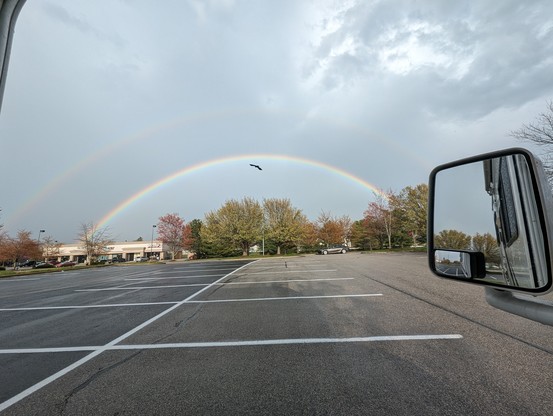
Double rainbow crow on the eve of the eclipse.

SpaceX completed Thursday's third test of the Starship/Superheavy launch system. The full stack blasted off from Boca Chica, Texas, at 9:25 a.m. ET separated successfully a few minutes into the flight. Superheavy crashlanded in the Atlantic Ocean off the coast of Texas while Starship proceeded to orbit. Once in orbit, it tested its payload doors and reoriented for re-entry. The video cut off as Starship was plunging into the atmosphere, so we don't know when it was lost.

https://www.cnn.com/world/live-news/spacex-starship-launch-scn-03-14-24/index.html

Live updates: SpaceX Starship third test launch

The massive Starship rocket from Elon Musk's SpaceX launched for the third time Thursday. It achieved multiple milestones before likely breaking apart. Follow live updates.

CNN