 Ralph Ruthe
Schon knapp 500.000 Menschen unterstützen den Appell zum AfD-Verbot. Bitte sei dabei und unterzeichne noch heute:
| Webside | https://asante.dev |

| Webside | https://asante.dev |
Schon knapp 500.000 Menschen unterstützen den Appell zum AfD-Verbot. Bitte sei dabei und unterzeichne noch heute:
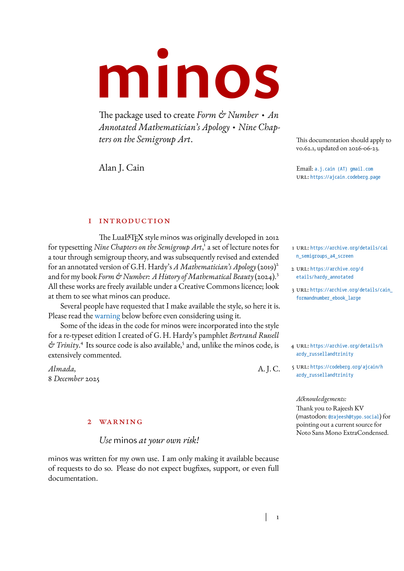
New version of my #LuaLaTeX style "minos".
Git repository: https://codeberg.org/ajcain/minos
Download documentation or source .zip/.tar.gz: https://codeberg.org/ajcain/minos/releases
- Many improvements related to creating #TaggedPDF, notably using template code for theorems and sectioning when \DocumentMetadata is used.
- Various new/adjusted/fixed kerning customizations.

Die Debatte um die Verfassungsfeindlichkeit der AfD steht still. Das ändern wir jetzt. Wenn Bundestagsabgeordnete E-Mails von echten Menschen aus ihrem Wahlkreis bekommen, hören sie hin. Sie können das Gutachten zur AfD in ihrer Fraktion auf den Tisch...
RE: https://mastodon.social/@fesshole/116690623225716127
Firefox has "copy clean link" in the context menu, just saying. :)

 Alan J. Cain
 PetraBF
 Usenix WOOT Conference on Offensive Technologies
 Dan Ports
 Misty
Misty Frederik Braun �