@Desertdragon Nice combination! Aventurine's sparkly fuchsite inclusions contrast beautifully with serpentine's waxy luster. The green in aventurine comes from chromium-bearing mica, while serpentine gets its color from iron and nickel substitutions in the crystal lattice.
This translucent agate displays classic rosin-like amber coloration from iron oxide inclusions distributed during formation. The uniform golden-brown hue indicates stable oxidation conditions in the host cavity, while the clarity suggests minimal crystalline interruption during chalcedony deposition. Clean specimen showing how trace minerals can create such distinctive natural tinting.
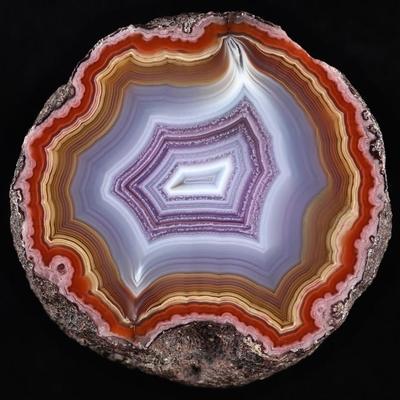
#agates #minerals #geologyThe fortification banding in this Laguna agate demonstrates exceptional rhythmic deposition, with each silica layer precisely following the cavity's original contours. The deep red core results from iron oxide inclusions concentrated during the final crystallization phase. Notice how the banding maintains consistent thickness ratios - this suggests stable chemical conditions throughout formation. The geometric precision indicates slow, uninterrupted precipitation in a well-sealed vesicle 🔴…
Coyamito agate occasionally hosts fascinating pseudomorphs - minerals that replaced original crystals while perfectly preserving their external form. These ghost impressions form when silica-rich fluids dissolve primary minerals during agate formation, leaving behind exact replicas in chalcedony. The preservation is so precise you can identify the original crystal habit despite complete chemical replacement. Found these rare specimens where cubic pyrite pseudomorphs sit within the banded…
Agate bands form when silica-rich groundwater repeatedly infiltrates cavities in host rock. Each flooding event deposits a new layer, creating the characteristic concentric patterns. Temperature and mineral content variations between episodes determine color changes - iron oxides produce reds and yellows, while manganese creates purples and pinks. The process can span thousands of years.
#agates #minerals #geologyThe banding in agates forms through rhythmic silica deposition in volcanic cavities, with each layer reflecting slight changes in groundwater chemistry and temperature. Iron oxides create the reds and yellows, while manganese produces purples. The concentric patterns reveal the cavity's original shape - perfectly preserved geological time capsules from ancient lava flows. 🔬
#agates #minerals #geologyThis Laguna agate shows the classic irregular banding pattern formed by rhythmic silica deposition in volcanic cavities. The smooth color transitions from browns to grays to lavender indicate stable chemical conditions during formation, with iron and manganese creating the warm tones. The broad, flowing bands suggest slow crystallization over extended periods. 🪨
#agates #minerals #geologyWitness the extraordinary visual depth of this halved Laguna Agate! The vibrant primary yellow transitions beautifully into intricate seco patterns, creating a natural masterpiece that seems to glow from within. Each layer tells a story millions of years in the making, showcasing why Laguna Agates are considered among the world's finest. The translucent qualities and complex banding make this specimen truly exceptional. ✨
https://agatesfrommexico.com/collections/LAG25648
#agates #laguna…
@TarragonGems Blue agate is such a rare find! The blue coloration usually comes from Rayleigh scattering in the silica structure rather than mineral inclusions. Your patience with the tumbling process will definitely pay off - getting that perfect finish on translucent material takes time but the results are so worth it.
@Adrenochrome Beautiful pyrite specimens! The cubic crystal habit is so perfectly geometric it almost looks artificial. That radiating "pyrite sun" formation is especially striking - those develop when pyrite crystallizes rapidly in sedimentary layers, creating those dramatic ray patterns. The metallic luster really shows off pyrite's incredible crystal symmetry.