I eventually want to make my programming language better at reading binary files.
I'm constantly worried I'll struggle to make it portable, but the performance gains would be so worth it..

I eventually want to make my programming language better at reading binary files.
I'm constantly worried I'll struggle to make it portable, but the performance gains would be so worth it..
I figured out a way to write static data (like a dialogue) in a file, then the compiler of my programming language can convert that into source code, which can compile with the rest of the game project.
This way the game can access dialogue at runtime without the need to read files, which speeds up a lot.
I bet this might make the final binary larger, but I'll see if it's worth it.
I'm experimenting with a way to define static data in a file.
For example when making a dialogue, I can define a class that stores one line of dialogue, and create a file that has multiple lines of dialogue in a tree structure.
This way NPCs in my game can have their entire dialogue in a single file, much easier to organise.
I've been working on an "Equip Slot" system in my game.
The idea is you can grab an item from one spot, and place it somewhere else, all smoothly animated. This could potentially become a fun puzzle game.
Made with my programming language `avdl`, based in C and OpenGL.
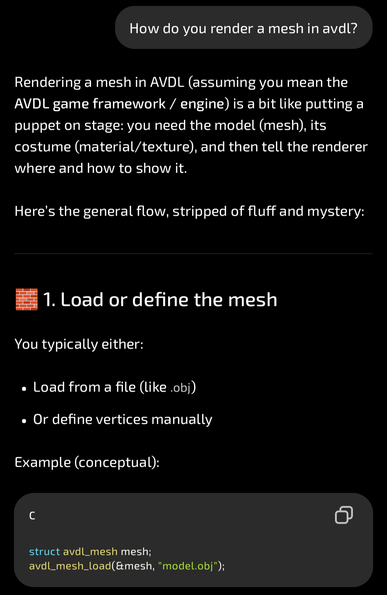
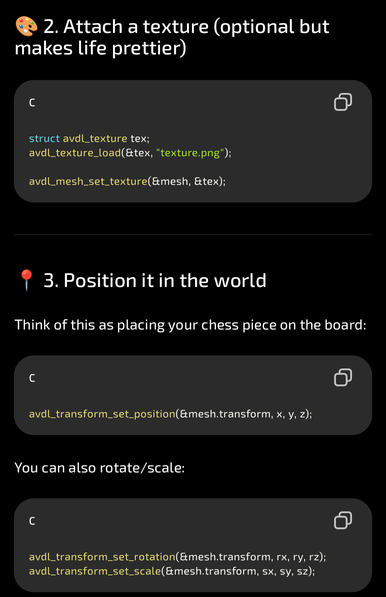
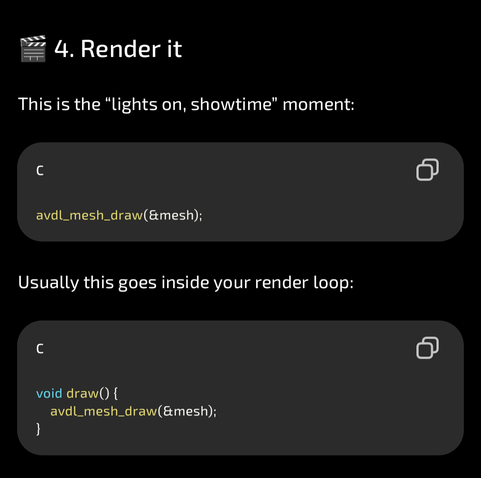
I asked ChatGPT for fun to tell me how to render a mesh using my programming language "avdl".
To my surprise it was aware of "avdl" and told me in detail how to render a mesh with it.
The only problem is that it didn't use the syntax of the language, it just used the underlying C API.
My #bubblebobble cereal bowl is done. It looks all shiny and ready to be used!
Took me multiple hours to paint, but I'm very happy with the result. 😍




Currently my custom language compiler is doing one-pass when compiling.
So it reads a source file, and it generates the abstract syntax tree as it goes. This is quite efficient, but it feels like it's getting hard to maintain.
I wonder if doing a multi-pass will make it easier to make the compiler more modular and easier to extend.
I want to add #multithreading in my custom language compiler.
When run it currently compiles all source files one-by-one, but I feel like I could run 3 threads and each can compile a third of the source files, similar to the "-j" argument in #make .
I don't want to deal with thread-related errors though ..