| Website | https://abhimat.net |
| Github | https://github.com/abhimat |

Abhimat Gautam
@abhimat
- 46 Followers
- 410 Following
- 159 Posts
अभिमत कृष्ण गौतम • Astrophysics researcher at UCLA who likes starry nights, social justice, progressive policy, long runs, and good typography • he/him/his


Hind Rajab, 6, found dead in Gaza days after phone calls for help
https://www.bbc.com/news/world-middle-east-68261286
https://www.bbc.com/news/world-middle-east-68261286


Full details about our results and methods are in the paper, including lots of gory details about all the binary simulations I needed to run in order to derive our results!
https://arxiv.org/abs/2401.12555
https://arxiv.org/abs/2401.12555
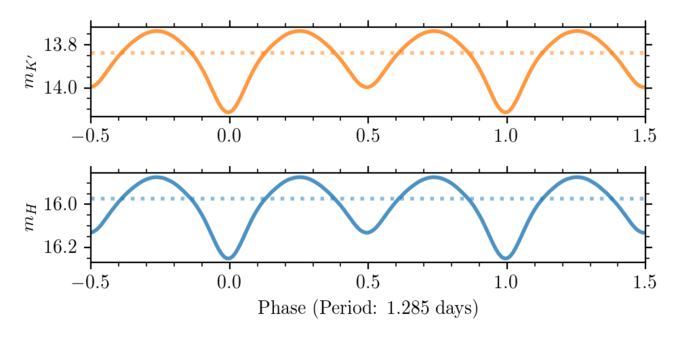

An Estimate of the Binary Star Fraction Among Young Stars at the Galactic Center: Possible Evidence of a Radial Dependence
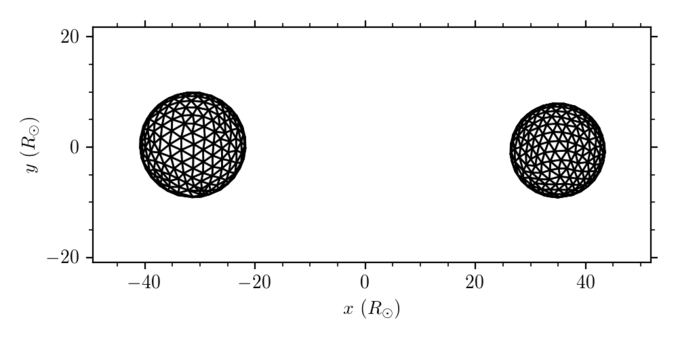
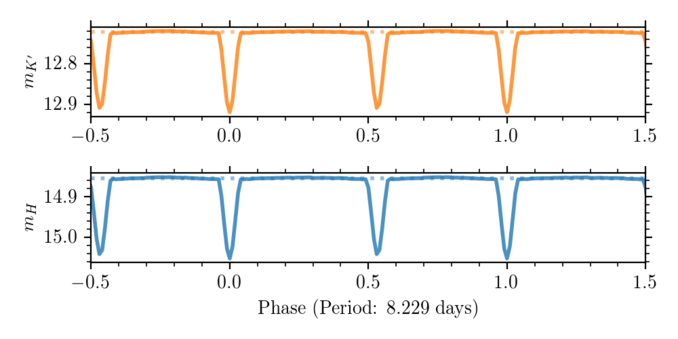
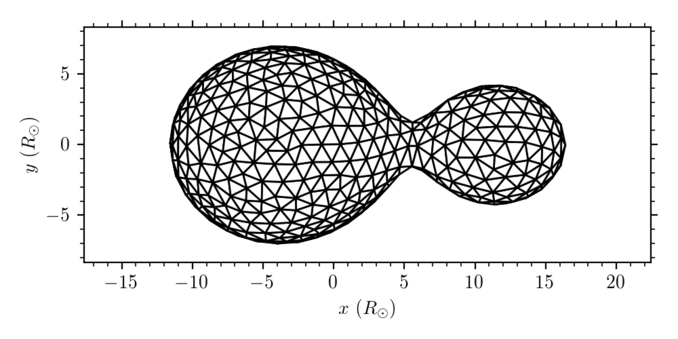
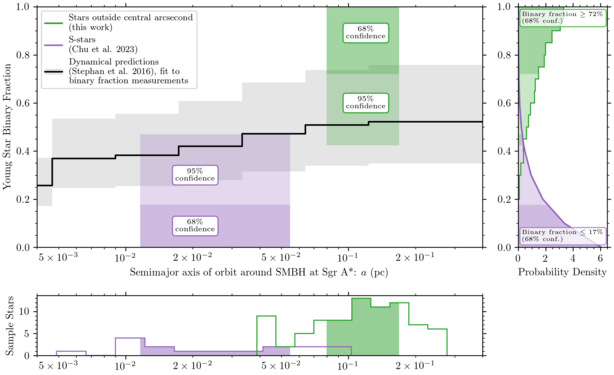
We present the first estimate of the intrinsic binary fraction of young stars across the central $\approx$ 0.4 pc surrounding the supermassive black hole (SMBH) at the Milky Way Galactic center (GC). This experiment searched for photometric variability in 102 young stars, using 119 nights of 10"-wide adaptive optics imaging observations taken at Keck Observatory over 16 years in the K'- and H-bands. We photometrically detected three binary stars, all of which are situated more than 1" (0.04 pc) from the SMBH and one of which, S2-36, is newly reported here with spectroscopic confirmation. To convert the observed binary fraction into an estimate of the underlying binary fraction, we determined experiment sensitivity through detailed light curve simulations, incorporating photometric effects of eclipses, irradiation, and tidal distortion in binaries. The simulations assumed a population of young binaries, with stellar ages (4 Myr) and masses matched to the most probable values measured for the GC young star population and underlying binary system parameters similar to those of local massive stars. The detections and simulations imply young, massive stars in the GC have a stellar binary fraction $\geq$ 71% (68% confidence), or $\geq$ 42% (95% confidence). This inferred GC young star binary fraction is consistent with that typically seen in young stellar populations in the solar neighborhood. Furthermore, our measured binary fraction is significantly higher than that recently reported by Chu et al. (2023) based on RV measurements of young stars <~1" of the SMBH. Constrained with these two studies, the probability that the same underlying young binary fraction extends across the entire region is <1.4%. This tension provides support for a radial dependence of the binary star fraction and, therefore, for the dynamical predictions of binary merger and evaporation events close to the SMBH.
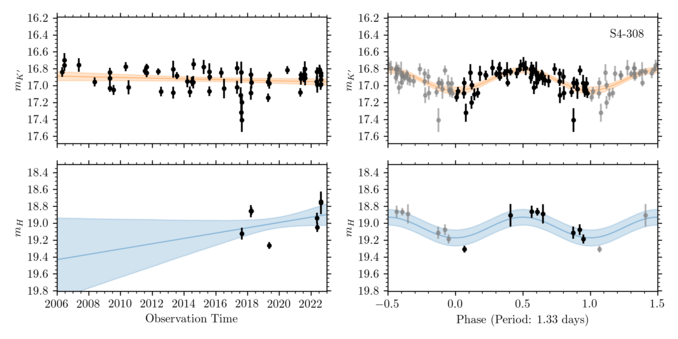
And we have another new candidate binary discovery, S4-308, that is *just a little too faint* to obtain spectroscopic confirmation from current ground based telescopes. But JWST can get its spectrum, so hopefully we can confirm soon if it is indeed a binary star!
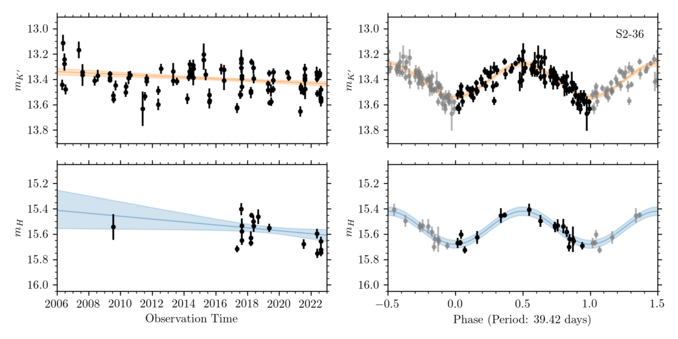
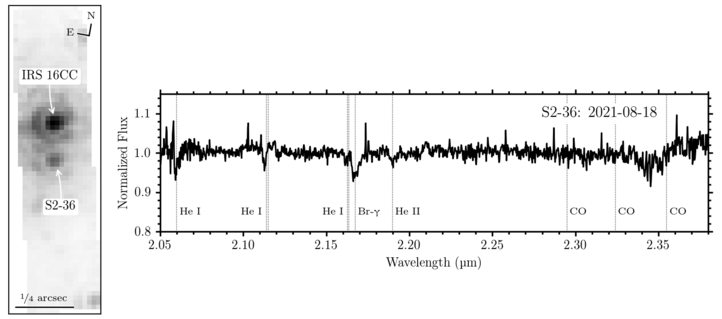
One of the binaries, S2-36, is a new discovery, only about 0.1 pc (0.3 ly) from the galactic center supermassive black hole! We've spectroscopically confirmed it for the first time. It’s pretty unique and interesting in its own right, and we hope to have some exciting details about its story soon!
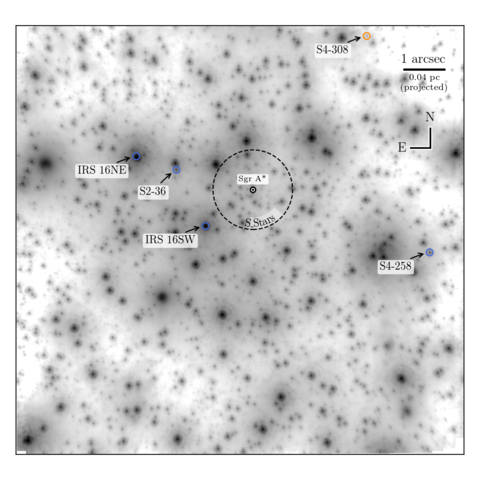
The other super exciting result from this paper is that we confirm for the first time that the fraction of young stars in binaries drops as we get close to the central supermassive black hole! It’s something that’s been predicted by many dynamical models, but we can now confirm it with observations!
Some models predict if the disk is being heated (maybe from an active central black hole 😉), you end up with high binarity in the resulting stellar population! Our results support this scenario, but we need higher fidelity simulations and more precise future binary fraction measurements!
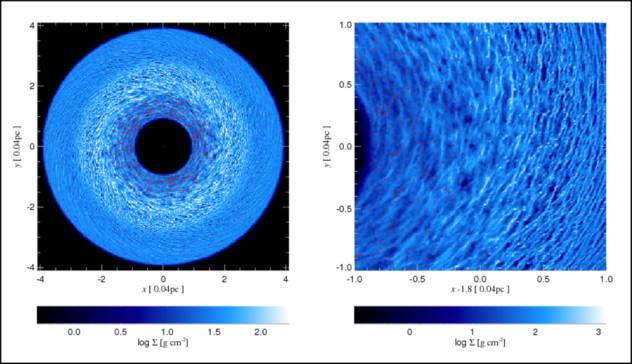
A leading idea of star formation at the center of the Galaxy is that young stars formed in over dense regions of an accretion disk that previously surrounded the supermassive black hole. (Picture from star formation simulations in an accretion disk by Nayakshin+, 2007)
So why is a high binary fraction at the center of the galaxy interesting / useful? Binarity is a consequence of star formation, and explaining how the young stars we see at the center of the Galaxy formed next to the supermassive black hole is still an open challenge.