 Vidyut
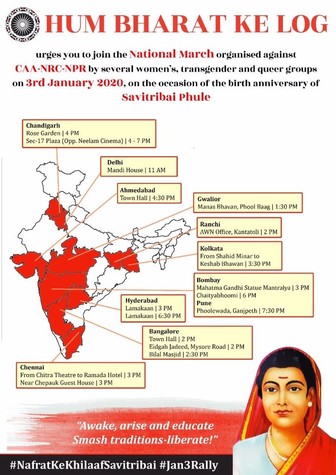
Hum Bharat ke Log 3 Jan - https://aamjanata.com/event/hum-bharat-ke-log-3-jan/?utm_source=TW&utm_medium=Twitter+-+Vidyut&utm_campaign=SNAP%2Bfrom%2BAamJanata+-+Intellectual+Anarchy%21

Ye kya drama hai?
UK PM Johnson Vows to Partner With PM Modi to Build ‘New India’
Senior Advocate Rajeev Dhavan, who led the arguments for the Muslim side in the Ayodhya Case alleged that he has been sacked from the Case.In his Facebook post Dr Dhavan wrote;'Just been sacked from...
New Zealand's draft law will forbid any donation of>$50 by a foreigner to political parties/candidates, tighten disclosure rules on political advertising & ensure parties know the source of donations. This is how u cleanse the system @[email protected] ! @[email protected] https://www.ft.com/content/3a660d3c-1579-11ea-9ee4-11f260415385
🐦🔗: https://twitter.com/ramanmann1974/status/1201841859485523969
When a community hopes it loses, just to able to live another day, you know the republic is deeply out of order, writes Vidya Subrahmaniam
https://www.thehinducentre.com/the-arena/current-issues/article30024468.ece
It was common knowledge that the Supreme Court would deliver its judgment in the Ramjanmabhoomi-Babri Masjid title suit before the Chief Justice of India, Ranjan Gogoi, retired on November 17, 2019. As the hour drew close, however, there was panic in Muslim homes, particularly in the Hindi belt. Parents wanted their wards to be safe and preferably among Muslims. Many fervently prayed for the judgment not to be in favour of the mosque because the consequences of that would impact Muslims more than any joy they felt at winning back the mosque. But losing the case, which they did, crushed their spirit, more so because the court had accepted almost all the claims of the Muslim plaintiffs. In contrast, the court rejected the central plank of the Hindu side that the Babri Masjid had been built by demolishing a pre-existing Ram temple. The court also accepted that the Masjid had been desecrated in 1949 by the surreptitious placement of idols and was illegally demolished by Hindutva vandals on the fateful day of December 6,1992. How then was the site handed over to the Hindu side?Following the Allahabad High Court’s three-way partitioning of the site in 2010, Vidya Subrahmaniam, Senior Fellow at The Hindu Centre for Politics and Public Policy had spoken to a cross-section of young Muslims. She recalls that at the time, they expressed no despair, and were confident about moving on with their lives, leaving behind the bitter past of the Mandir-Masjid conflict. She spoke to another set of younger generation Muslims after the Supreme Court verdict and this time, as she notes in this essay, the finding was a disturbing one: In majoritarian India, young Muslims had to reconcile to being second-class citizens.
"I am no more an IAS. And I don’t want to serve a government that has scant respect for fundamental rights of people and even do not mind stripping citizenship away from them for political gains."
~Kannan Gopinathan ( @naukarshah )
When people look back in later years, they may conclude that the worst thing the Court did was not even any particular judgment that it handed down, but that it let this anti-democratic electoral bond scheme stand for election cycle after election cycle without striking it down. https://twitter.com/SushantSin/status/1197669875172413440
🐦🔗: https://twitter.com/gautambhatia88/status/1197674219208880128
 Musafir
 LiveLaw
 nitin sethi
 Sridhar V
 Dhanada
 Nilim Dutta
 stux⚡️