Systems Approach

1.3K Followers
229 Following
1,091 Posts
Larry Peterson and Bruce Davie write books and newsletters about the Internet and related computer systems topics.
websitehttps://www.systemsapproach.org/books/
newsletterhttps://systemsapproach.org/newsletter
GitHubhttps://github.com/SystemsApproach
tech raghttps://www.theregister.com/Tag/Systems%20Approach
The India-born tech writer Om Malik has died. He was one of the founders of the South Asian Journalists Association. Om had numerous ups and downs in his 59 years. I first noticed his writing in Red Herring and he became a trailblazer in Silicon Valley. https://om.co/2026/06/24/1966-2026/

This is a good piece from @emilymbender on how to use language to push back on “AI” (or “probabilistic automation” as she suggests) and stop anthropomorphising the synthetic text extruders.

https://buttondown.com/maiht3k/archive/how-to-talk-about-ai-without-adding-to-the/

How to talk about "AI" without adding to the anthropomorphization

Emily M. Bender and Nanna Inie In our op-ed for Tech Policy Press ("We Need to Talk About How We Talk About 'AI'"), we made the case against the...

Mystery AI Hype Theater 3000: The Newsletter
happy winter Solstice to all who celebrate
My CC-licensed book, "Don't Get Hacked", is available in hardcopy, if you prefer, at https://www.lulu.com/shop/steven-bellovin/dont-get-hacked/paperback/product-gj4mq5w.html. The PDF, ePub, and .mobi versions remain available for free at https://www.cs.columbia.edu/~smb/homesec/.
Don't Get Hacked!

We all want to keep our computer systems secure, but how? Too much of the advice we see is wrong (“Don’t click on suspicious links”—how are you to know if it’s suspicious, or where it really goes?) or outdated (“Use strong passwords and never write them down”—notions that date to 1979, when the technology world was very different). In Don’t Get Hacked!, Steven Bellovin gives practical, real-world, up-to-date advice, without jargon. He explains the threats and what to do about them, and why—and what threats you probably don’t have to worry about. From backups to two-factor authentication to AI, you learn what the real issues are, such as why your email account is probably your most important and why it needs the most protection. You also learn where security is not all-or-nothing—while upgrading your hardware when necessary is a good idea, Don’t Get Hacked!, shows what to do if you can’t.

Lulu

When we were deciding how to cover network operations in our book, we decided to focus on gNMI rather than NETCONF (while admitting that there are still adherents to the latter). We appreciated the way gNMI leveraged an existing RPC framework rather than creating a new one. And taking the side of the cloud operators is consistent with our belief that operations need to be treated as a first class topic rather than an afterthought.

When we look at how we cover other topics in our book—such as SDN, virtual networks, datacenter networking—they all have large operational components. They depend on programmatic interfaces and centralized control to abstract away the details of managing individual devices. This focus on scalable operations feel like an important theme to highlight in a modern book on networking.

More details here:
https://systemsapproach.org/2026/06/15/internet-%E2%86%92-cloud-repeat/

/FIN

Internet → Cloud; Repeat - Systems Approach

There is a symbiotic relationship between the Internet and the cloud, and nowhere is that more obvious than in network operations

Systems Approach

Left to their own devices (no pun intended), network vendors were happy to define models for their own products, and there was no clear reason for that to change just because of a move from MIBs to YANG. But maybe it required a cloud provider to push for a vendor-agnostic unification of the models, which is a primary objective of the OpenConfig initiative. Whereas the telcos seem to have depended on vendor tooling, the cloud operators have long used open source tools and their own engineering teams to scale operations. OpenConfig, pushed by Google, is a good example of this, leveraging gRPC (an open source RPC framework) and gNMI (gRPC network management interface).

https://www.openconfig.net/

3/n

OpenConfig

If you use early editions of mainstream networking textbooks (including ours) as your archaeological “core sample”, network management is synonymous with SNMP and MIB. That’s how we’ve taught network operations for years, if we covered the topic at all. That started to change in the 2010s with the appearance of modelling languages like YANG, with NETCONF providing the RPC mechanism for interacting with such models.

2/n

This week we've been working on our chapter on network operations, historically a backwater for networking, which we aim to bring to the foreground in our next edition. One of the challenges is that there is no one "right answer" - every network has their own operational practices. But one thing we notice is how much the operations of large clouds has come to influence practices in network operations, and mostly for the better. We cover this line of thought in this week's newsletter:

https://systemsapproach.org/2026/06/15/internet-%E2%86%92-cloud-repeat/

🧵 1/n

Internet → Cloud; Repeat - Systems Approach

There is a symbiotic relationship between the Internet and the cloud, and nowhere is that more obvious than in network operations

Systems Approach

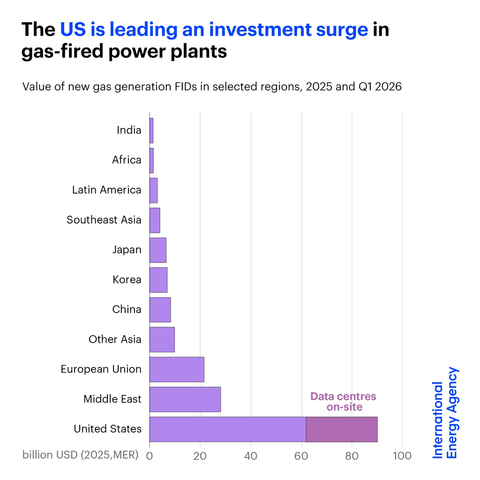
The planned gas-fired capacity **JUST FOR DATA CENTRE ON-SITE USE** in the US is the same as *all* planned gas capacity in India, Africa, Latin America, Southeast Asia, Japan, Korea and China *combined*.

But sure, 'ChatGPT is just like 10 seconds of watching Netflix' 🫠 🫠 🫠 🫠 🫠 🫠 🫠 🫠 🫠 🫠 🫠 🫠 🫠 🫠 🫠 🫠 🫠 🫠 🫠 🫠 🫠 🫠 🫠 🫠 🫠 🫠

https://www.iea.org/reports/world-energy-investment-2026

SIGCOMM is soliciting proposals to improve the way we run the conference. We will create an “incubator” for community-driven innovation through a multi-year effort to discover, test, and integrate new ideas into the fabric of SIGCOMM events. Funding is available to support concrete proposals. Full details here:
https://sites.google.com/view/sigcomm-consultation/home
The future of sigcomm

In 2023, SIGCOMM, together with many members of our community, launched a “Call for Change” in response to both longstanding challenges and new pressures arising during and after the global pandemic. That effort led to a broad set of community-driven proposals, followed by discussion, voting, and