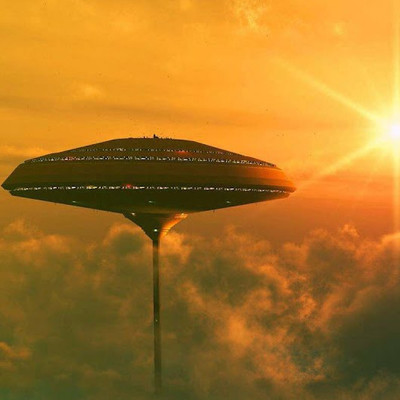
You've probably heard the Oasis song Black Dwarf Supernova - but did you know that was a real thing?
More precisely, none exist *now*, but they may be among the last really exciting events in our universe. As a star the size of our Sun dies, it eventually shrink downs to a white dwarf, very hot and dense but held up by 'electron degeneracy pressure'. That's because electrons can't be in the same quantum state.
As a white dwarf cools, we expect it will dim and eventually become a 'black dwarf'. This hasn't happened yet. While there are already plenty of white dwarfs, they take a long time to cool down. The coldest white dwarfs found are about 12 billion years old, and they're still 3,600 °C. We expect that for a white dwarf to get *really* cold, like 5 °C above absolute zero, would take about a quadrillion years!
But eventually, it could explode.
The reason is that as it cools, its electron degeneracy pressure gets smaller and it shrinks. For white dwarfs heavier than 1.2 times the mass of our Sun, this may actually tip them over into collapsing entirely, becoming black holes. But just as with heavy stars today, this collapse should also liberate a huge amount of energy, shooting off the star's outer layers in a SUPERNOVA!
Stars that could do this account for just 1% of all stars in the observable universe. But that's 10²¹ stars - nothing to sneeze at.
These black hole supernovae may go off around 10¹¹⁰⁰ years from now, long after most other processes have settled down. However, it's possible that the protons in these stars will decay first. Protons could be stable, but we only know for sure that their half-life exceeds 10³² years.
In the far future long after star formation has ceased the universe will be populated by sparse degenerate remnants, mostly white dwarfs, though their ultimate fate is an open question. These white dwarfs will cool and freeze solid into black dwarfs while pycnonuclear fusion will slowly process their composition to iron-56. However, due to the declining electron fraction the Chandrasekhar limit of these stars will be decreasing and will eventually be below that of the most massive black dwarfs. As such, isolated dwarf stars with masses greater than $\sim 1.2 M_\odot$ will collapse in the far future due to the slow accumulation of iron-56 in their cores. If proton decay does not occur then this is the ultimate fate of about $10^{21}$ stars, approximately one percent of all stars in the observable universe. We present calculations of the internal structure of black dwarfs with iron cores as a model for progenitors. From pycnonuclear fusion rates we estimate their lifetime and thus delay time to be $10^{1100}$ years. We speculate that high mass black dwarf supernovae resemble accretion induced collapse of O/Ne/Mg white dwarfs while later low mass transients will be similar to stripped-envelope core-collapse supernova, and may be the last interesting astrophysical transients to occur prior to heat death.
@[email protected] - in the shorter term, red dwarf stars considerably smaller than our sun keep going for 100 trillion years and have earth-like planets which we might maneuver into the habitable zone. Right now many have annoying flares, but as they age they probably settle down. I've advertised them here: https://johncarlosbaez.wordpress.com/2015/02/14/earth-like-planets-near-red-dwarfs/ White dwarfs last longer, though!
On this SISKO DAY, being every May 22 as the day Benjamin Sisko took command of Deep Space Nine...
Be vulnerable
Seek help
Engage with the wisdom of others
Move the station
Heal
“Microsoft has simply given us no other option,” Signal says as it blocks Windows Recall
Signal Messenger is warning the users of its Windows Desktop version that the privacy of their messages is under threat by Recall, the AI tool rolling out in Windows 11 that will screenshot, index, and store almost everything a user does every three seconds.