SecurityPrivacyMag

90 Followers
0 Following
198 Posts
IEEE Security & Privacy magazine provides research articles, case studies, tutorials, and columns for the information security industry.

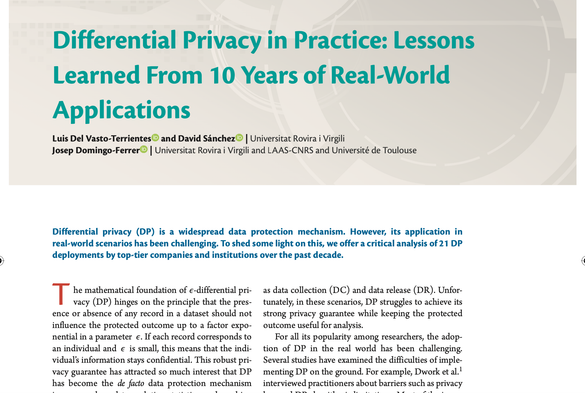
In the Jan/Feb '26 edition of S&P, read about a critical analysis of 21 large-scale differential privacy (DP) deployments by top-tier companies and institutions over the past 10 years. Authors characterize the data utility & privacy budgets of such DP deployments, examine commonly-found issues across “DP in practice” versus theoretical expectations of DP ideal usage, and discuss how alternatives adjacent-to-DP can be used alongside DP to align intention with technique utility maximization.

Read on and more here at S&P: https://www.computer.org/csdl/magazine/sp/2026/01

and be on the look out for the Mar/April '26 S&P soon!
Jump into the new year with the Jan/Feb 2026 issue of Security & Privacy! Our new Editor-in-Chief for 2026-2027 Jeffrey Voas discusses the vision for S&P in 2026 – emphasizing S&P’s importance as a timely assessment of threat landscapes, noting how content diversification to be both technical & novel may attract larger audiences, and reviews how the increasing presence of artificial intelligence-focused work impacts future security & privacy fields.

Read here at S&P: https://www.computer.org/csdl/magazine/sp/2026/01

and look out for the Mar/April '26 S&P soon!

The Heilmeier Catechism has guided research and engineering projects for decades, prompting teams to think systematically about objectives, risks, and impact. This article revisits the framework for the age of security and privacy design, adding a critical new question: “Who is left out?” Read more in S&P: https://www.computer.org/csdl/magazine/sp/2025/03
AI is set to redefine global power structures, with autonomous decision making, unpredictable errors, and low barriers to misuse creating risks that outpace those of past technologies. From destabilizing markets to large-scale influence operations, its integration into critical infrastructure heightens both opportunity and vulnerability. Read more in S&P: https://www.computer.org/csdl/magazine/sp/2025/03
From speculative execution leaks to microcode bugs, examples reveal how attackers exploit both what defenders overlook and the abstractions used in secure-by-design approaches. Security is framed not as a binary state but as an empirical property to be strengthened over time. Read on here: https://www.computer.org/csdl/magazine/sp/2025/03
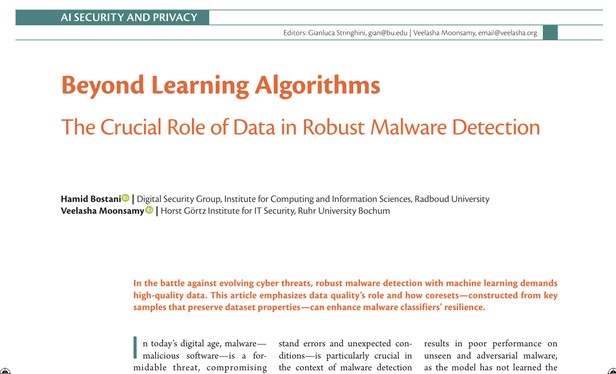
In this issue of S&P, Bostani and Moonsamy explore how data quality directly impacts the robustness of ML-based malware detection. More data is not always better — biased, noisy, or mislabeled samples can make classifiers brittle and vulnerable to evasion. Read more in S&P: https://www.computer.org/csdl/magazine/sp/2025/03
In this issue of S&P, Hawkes et al. demonstrate how generative AI can be used to invert perceptual hashes, reconstructing sensitive images from values used in image-based sexual abuse (IBSA) removal tools. Their findings show that multiple widely used hash functions, including those in major platforms, are vulnerable even with consumer-grade hardware. More at S&P: https://www.computer.org/csdl/magazine/sp/2025/03
In this issue of S&P, Franceschini et al. use the February 2023 earthquakes in Türkiye as a case study to examine how natural disasters can expose and amplify cyberrisks. Their analysis maps threats across the predisaster, disaster, and postdisaster phases, showing how disruptions to critical infrastructure can undermine confidentiality, integrity, and availability. Read more in S&P: https://www.computer.org/csdl/magazine/sp/2025/03
In this issue of S&P, authors Awais Rashid, Corinne May-Chahal, and Claudia Peersman critique proposals in the U.K. and EU to weaken end-to-end encryption (E2EE) for monitoring online child sexual abuse. They argue that such measures fail to address root causes, risk mass surveillance, and undermine the very privacy protections that can safeguard victims. Read more in S&P: https://www.computer.org/csdl/magazine/sp/2025/03
In this issue of S&P, authors Zubair Baig, Sri Harsha Mekala, Adnan Anwar, Naeem Syed, and Sherali Zeadally examine how digital forensic processes must adapt to the Industrial Internet of Things (IIoT). They detail the technical, legal, and jurisdictional challenges of collecting and preserving evidence in complex, heterogeneous, and often critical industrial environments. Read more in S&P: https://www.computer.org/csdl/magazine/sp/2025/03