Why are the Silver Arrows so fast?
Why are the Silver Arrows so fast? - Lemmy.World
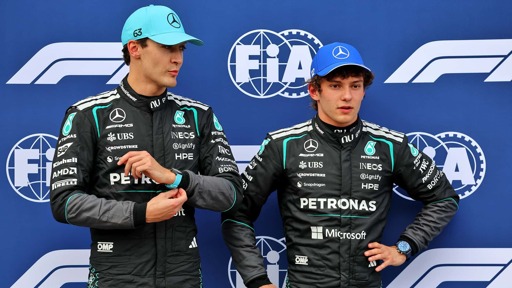
English translation Mercedes shocked the competition with a one-two victory in qualifying for the Australian Grand Prix. Even worse was their huge lead of eight tenths of a second over the rest of the field. Ferrari, Red Bull and McLaren offered different explanations. The truth is that Mercedes has the best energy management. This is what Formula 1 feared most. One team is entering the new season with a huge advantage. Just like in 2014 at the start of the first hybrid era. Then, as now, Mercedes thrashed the competition. George Russell and Andrea Kimi Antonelli seemingly effortlessly placed their Silver Arrows on the front row of the grid in qualifying for the Australian Grand Prix (7 March). Antonelli was driving a car that had been a write-off just three hours earlier. Everyone pitched in to patch up the Mercedes with start number 12 after a 170 km/h crash in turn 2 so that it could qualify. Optimising the setup was out of the question. So George Russell was the sole benchmark for the competition. ‘He was driving in another world,’ marvelled Ferrari team boss Frédéric Vasseur. The Englishman’s time advantages underlined this impression. Russell was 0.785 seconds faster than Red Bull, 0.809 seconds faster than Ferrari and 0.862 seconds faster than McLaren. It is little consolation that the chasing pack is as close as it was last year. ‘Russell can already be congratulated on the title,’ was the frustrated sentiment in the paddock. Red Bull believes it can catch up When asked why the Silver Arrows are so dominant, everyone had their own answer. McLaren blames energy management, where it still lags far behind the factory team. Ferrari blames the Mercedes engine, which operates with more compression than all other engines. Red Bull says it loses time evenly distributed across the course. Isack Hadjar surprised friends and foes alike in his first race for Red Bull with the third-fastest qualifying time. Red Bull’s technical director Pierre Waché remains optimistic despite the significant time gap: ‘The battle is not over yet. The gap can be closed.’ The Frenchman bases his theory on the fact that Max Verstappen was only three tenths of a second off the fastest time. But the Dutchman ended up in the gravel trap at the first corner just 300 metres into his first qualifying session. He fell victim to the new technology. Red Bull’s energy management system was apparently programmed to recover too much energy when braking. This caused the rear wheels to lock up. Interestingly, Waché does not see the engine as the area most in need of improvement. ‘We have more scope with the chassis.’ Ferrari loses more time with its engine Ferrari sees its disadvantage in the engine. ‘In the corners, we were sometimes faster than the Mercedes,’ analysed Vasseur. According to its opponents, the Mercedes V6 turbo is superior because it runs with more compression than the other engines. The competition expects a loss of up to 15 hp. That is why the FIA was forced to measure compression in cold and hot conditions from 1 June onwards. This will not make much difference because Mercedes will continue to achieve the permitted compression ratio of 16:1, but its opponents will not. Red Bull is likely to lose the least and is therefore holding back on its actionism. However, those who are lagging behind with their engines still have another opportunity to catch up. After six races, the FIA will investigate the extent to which individual engines are responsible for the loss of time. If this exceeds a certain limit, manufacturers will be allowed to retrofit. There will be more test bench time and exemptions from the budget allowance. Ferrari was beaten below its true value. The red cars performed well over long stretches of the practice days. And when Lewis Hamilton set the second-fastest time in Q1 on medium tyres, Ferrari was firmly expected to be Mercedes’ main rival. But then Vasseur once again struggled with the tyre preparation. ‘We tried one warm-up lap, then two, but didn’t get it right at the crucial moment. There was more in it.’ McLaren in the learning phase McLaren cannot blame the engine. Like the factory team, the defending champion has a Mercedes V6 turbo in the rear. It must be identical in terms of its specification and characteristic maps. However, customers are free to set the parameters for energy management. Team boss Andrea Stella therefore takes responsibility. ‘We still have some shortcomings in how we use the engine and energy to achieve the best possible lap time. If we had used the engine better, third and fourth places would have been possible.’ McLaren is still in a learning phase, says Stella, and is using GPS measurements to look very closely at how and where Mercedes stores and retrieves its energy. This is not quite as trivial as it sounds. ‘There are three ways to charge your battery: when braking, with super clipping when coasting, and when the driver takes his foot off the accelerator. The speed at the exit of the corner shows us how much power the individual teams are drawing when accelerating.’ Stella admits that the factory team is starting the season with a knowledge advantage when it comes to operating its engine. When designing the power unit, he naturally already had in mind how best to use the energy. ‘We have a steep learning curve ahead of us to do just as well. This also applies to the drivers, who have a major influence on energy management.’ However, the Italian also admits: ‘Mercedes was faster than us in most of the corners.’ The first major upgrade is still a long way off. Its deployment depends on whether or not the races in Bahrain and Saudi Arabia are cancelled. Russell slow at all measuring points The difference factor remains energy management. This is also shown by the speed measurements. George Russell was at best midfield at the four measuring points. At the finish line, he was only in 15th place with 301.3 km/h. Liam Lawson in the Racing Bulls was 17 km/h faster there. Red Bull, Ferrari and McLaren also outpaced the Mercedes at the finish line. At the end of the home straight, Russell was only twelfth at 297.9 km/h. Again behind Ferrari and Red Bull, but just ahead of McLaren. This suggests that Russell’s Mercedes went into super clipping earlier. The lesson to be learned from this is that the home straight was obviously not that important to Mercedes. At the first sector boundary just before turn 4, Russell reached a speed of 273.4 km/h. That was eighth place. Isack Hadjar flew over the induction loop 15 km/h faster. Lewis Hamilton was also faster at that point. Nevertheless, Russell made up most of the time between turns 4 and 6. Mercedes obviously rationed its power at other points. This was also evident at the second sector boundary on the back straight. Russell could not get beyond 14th place with a speed of 287.8 km/h. Of his direct rivals, only Oscar Piastri was slower. Lewis Hamilton was 15 km/h faster than his former teammate. Hadjar was only slightly better. The snapshots give the wrong impression, because Russell won all sectors, albeit by a narrow margin. The competition was far from this consistency. In sector 1, Ferrari came closest to Mercedes, trailing by 0.181 seconds. In sector 2, it was Red Bull, trailing by just 0.028 seconds. McLaren came out on top as the second-fastest car in sector 3. Piastri was 0.152 seconds behind Russell in the section with the most corners. Conclusion What can we learn from this? The season isn’t over yet. Mercedes’ lead is mainly down to using energy more wisely. That’s something that can be learned. The advantage of combustion engine power is smaller than it’s made out to be. Otherwise, Mercedes’ customer teams McLaren, Williams and Alpine would be benefiting more from it. And Mercedes isn’t miles ahead in terms of chassis either. Ferrari is at least on a par with them in that respect. Translated with DeepL [https://www.deepl.com/].