RT @[email protected]
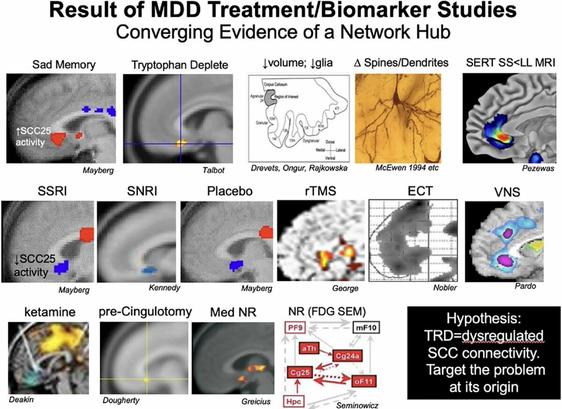
New DBS Think Tank X proceedings are out! Read about how through a series of small experiments by @[email protected], collective information built a network that identified connectivity to SCC as a critical player in treatment resistant depression. https://www.frontiersin.org/articles/10.3389/fnhum.2022.1084782/full @[email protected]
🐦🔗: https://twitter.com/MichaelOkun/status/1619089950397579268

Proceedings of the 10th annual deep brain stimulation think tank: Advances in cutting edge technologies, artificial intelligence, neuromodulation, neuroethics, interventional psychiatry, and women in neuromodulation
The deep brain stimulation (DBS) Think Tank X was held on August 17–19, 2022 in Orlando FL. The session organizers and moderators were all women with the theme women in neuromodulation. Dr. Helen Mayberg from Mt. Sinai, NY was the keynote speaker. She discussed milestones and her experiences in developing depression DBS. The DBS Think Tank was founded in 2012 and provides an open platform where clinicians, engineers and researchers (from industry and academia) can freely discuss current and emerging DBS technologies as well as the logistical and ethical issues facing the field. The consensus among the DBS Think Tank X speakers was that DBS has continued to expand in scope however several indications have reached the “trough of disillusionment.” DBS for depression was considered as “re-emerging” and approaching a slope of enlightenment. DBS for depression will soon re-enter clinical trials. The group estimated that globally more than 244,000 DBS devices have been implanted for neurological and neuropsychiatric disorders. This year’s meeting was focused on advances in the following areas: neuromodulation in Europe, Asia, and Australia; cutting-edge technologies, closed loop DBS, DBS tele-health, neuroethics, lesion therapy, interventional psychiatry, and adaptive DBS.
RT @[email protected]
The brain is mysterious, but one part is ✨ extra ✨ mysterious - the claustrum. There's a lot of activity between it and the cortex, but its role is not completely understood. Learn how our scientists are shining a light on it - literally. ➡️ https://alleninstitute.org/news-press/articles/scishots-illuminating-mysterious-brain-structure
🐦🔗: https://twitter.com/AllenInstitute/status/1618771168391036928

SciShots: Illuminating a mysterious brain structure
Neuroscientists are shedding literal light on the mouse claustrum, a tiny part of the brain with an outsized number of connections
RT @[email protected]
Brain connectomics: time for a molecular imaging perspective? | http://tinyurl.com/MCWGTrends
The 1st paper of the Molecular Connectivity Working Group is out now in @[email protected]!
We discuss the use of molecular imaging to advance brain connectomics, in an integrative perspective
🐦🔗: https://twitter.com/ConnectivityPet/status/1618960541661396992
RT @[email protected]
Job alert 🚨: We will recruit a new Ph.D. student in May 2023. The project will focus on developing innovative clinical interventions using non-invasive vagus nerve stimulation.
If you are interested, please get in touch: https://neuromadlab.com/en/research/jobs/
🐦🔗: https://twitter.com/cornu_copiae/status/1617513175003406336
Come work with us - neuroMADLAB
Are you looking for a job? At neuroMADLAB, we are always keen to recruit passionate and determined neuroscientists to join our growing team.
RT @[email protected]
What do you guess #Neurotwitter – lingering issue a couple months after surgical resection of this dorsal anterior cingulate \ “salience” node?
A.New-onset insomnia
B.Fatigue \ excessive sleep
C.New-onset gambling addiction
D.Depressed mood
🐦🔗: https://twitter.com/boeslab/status/1616455632948957185

Aaron Boes on Twitter
“What do you guess #Neurotwitter – lingering issue a couple months after surgical resection of this dorsal anterior cingulate \ “salience” node?
A.New-onset insomnia
B.Fatigue \ excessive sleep
C.New-onset gambling addiction
D.Depressed mood”
RT @[email protected]
Our new network meta-analysis of ~500 neuroimaging studies investigates how brain changes overlap and differ between 17 different psychiatric disorders is out now in @[email protected]
https://www.nature.com/articles/s44220-022-00010-y
1/n
🐦🔗: https://twitter.com/rob_mccutcheon/status/1616419948229971969

Shared and separate patterns in brain morphometry across transdiagnostic dimensions - Nature Mental Health
In this network and pairwise meta-analysis of 498 brain imaging studies, McCutcheon et al. demonstrate patterns of distinct and overlapping brain volume changes across psychiatric disorders.
RT @[email protected]
Reward is not Necessary: How to Create a Compositional Self-Preserving Agent for Life-Long Learning https://arxiv.org/abs/2211.10851 - super interesting framework, from Thomas Ringstrom @[email protected]
🐦🔗: https://twitter.com/WiringTheBrain/status/1615669692894482432


Reward is not Necessary: How to Create a Modular & Compositional Self-Preserving Agent for Life-Long Learning
Reinforcement Learning views the maximization of rewards and avoidance of punishments as central to explaining goal-directed behavior. However, over a life, organisms will need to learn about many different aspects of the world's structure: the states of the world and state-vector transition dynamics. The number of combinations of states grows exponentially as an agent incorporates new knowledge, and there is no obvious weighted combination of pre-existing rewards or costs defined for a given combination of states, as such a weighting would need to encode information about good and bad combinations prior to an agent's experience in the world. Therefore, we must develop more naturalistic accounts of behavior and motivation in large state-spaces. We show that it is possible to use only the intrinsic motivation metric of empowerment, which measures the agent's capacity to realize many possible futures under a transition operator. We propose to scale empowerment to hierarchical state-spaces by using Operator Bellman Equations. These equations produce state-time feasibility functions, which are compositional hierarchical state-time transition operators that map an initial state and time when an agent begins a policy to the final states and times of completing a goal. Because these functions are hierarchical operators we can define hierarchical empowerment measures on them. An agent can then optimize plans to distant states and times to maximize its hierarchical empowerment-gain, allowing it to discover goals that bring about a more favorable coupling of its internal structure (physiological states) to its external environment (world structure & spatial state). Life-long agents could therefore be primarily animated by principles of compositionality and empowerment, exhibiting self-concern for the growth & maintenance of their own structural integrity without recourse to reward-maximization.

Comparative Anatomy of the Locus Coeruleus in Humans and Non-Human Primates
The locus coeruleus (LC) is a dense cluster of neurons that projects axons throughout the neuroaxis and is located in the rostral pontine tegmentum extending from the level of the inferior colliculus to the motor nucleus of the trigeminal nerve. LC neurons ...
RT @[email protected]
Interesting paper by Jinke Liu & @[email protected] in @[email protected]. Applying "distance-of-distance" transformation to the pairwise distance matrix of high-dim data separates signal from noise, making all noise points (grey) cluster together. Impressive!
https://journals.plos.org/ploscompbiol/article?id=10.1371/journal.pcbi.1010764
🐦🔗: https://twitter.com/hippopedoid/status/1613096715963211776


Improved visualization of high-dimensional data using the distance-of-distance transformation
Author summary Biological datasets are often high-dimensional, e.g. the genetic profile of cells or the firing pattern of neural populations. Dimensionality reduction methods like t-SNE are commonly used to represent the high-dimensional data in a low-dimensional embedding space. The visualization helps us to identify the underlying clustering patterns and shed light on the information hidden within the data. We show that in situations where there exist scattering noise points, clustering patterns in the data tend to be heavily distorted. Here, we show that using a distance-of-distance (DoD) transformation of the dissimilarity matrix between data points, the influence of scattering noise is effectively removed. This neighborhood-based transformation is most effective when the dimensionality of the dataset is high. We show that this technique improves low-dimensional embedding for several high-dimensional datasets, such as the convolutional neural network representation of natural images or the neuronal population representation of visual stimuli.
RT @[email protected]
The Lead-DBS v3 paper is out @[email protected]!
Writing effort led by @[email protected] et al., development effort by @[email protected], @[email protected], @[email protected], K. Butenko, @[email protected], @[email protected], @[email protected], @[email protected], @[email protected], @[email protected] …
https://www.sciencedirect.com/science/article/pii/S1053811923000113
🐦🔗: https://twitter.com/leaddbs/status/1611085404098396160
