Non Linear Narrative

64 Followers
18 Following
126 Posts
MA Non Linear Narrative at Royal Academy of Art, The Hague (KABK), merges investigative methods of journalism & forensics with technologies of computer science & visual arts into a contemporary progressive design approach: non-linear storytelling.
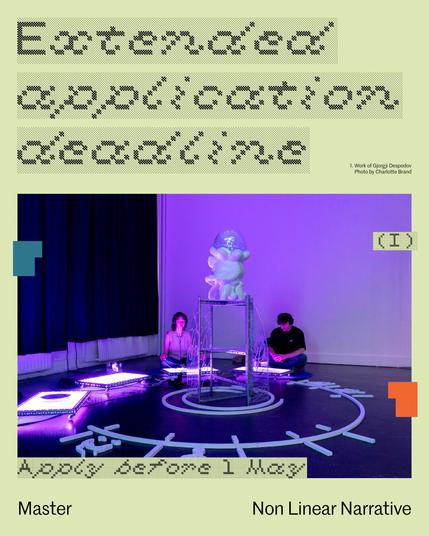
💫 Extended Application Deadline - 1st May 2026 💫

Did you miss out on applying to join the MA Non Linear Narrative before the deadline of 2nd March? We're still welcoming late applications before an extended deadline of 1st May, if you would still like to apply to join us this September.
Please note that offers will only be made if spaces remain available following the current round of applications.
Apply now: https://www.kabk.nl/en/programmes/master/non-linear-narrative

For clarity, reviews are already underway for those who applied before last week's priority deadline, and we will inform you of the next steps by the end of this month.

If you have any questions about the programme or applying, don't hesitate to drop us an email!

Photo: Gjorgji Despodov, MA Non Linear Narrative Graduation Show 2025, by Charlotte Brand.
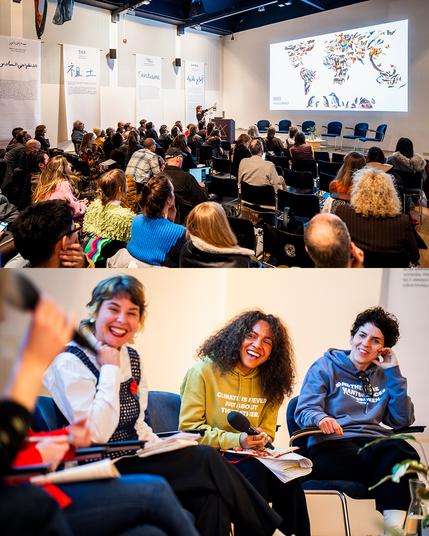
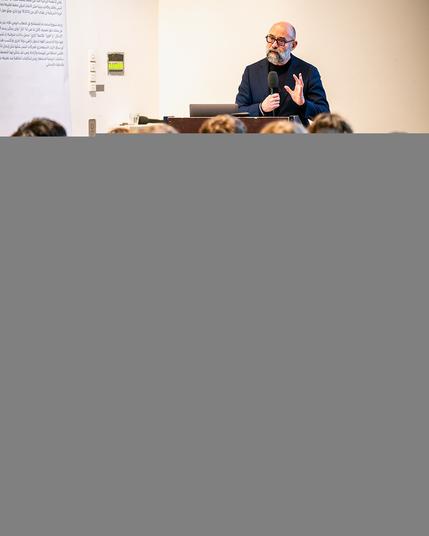
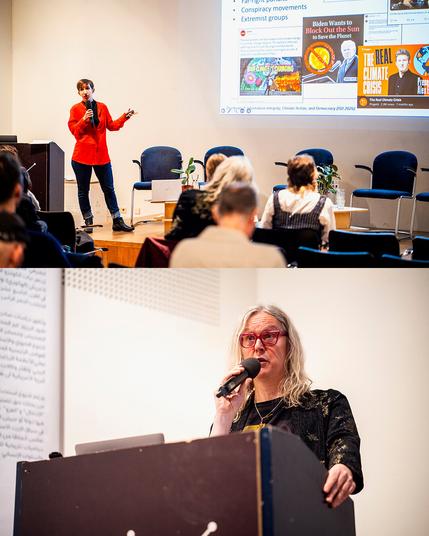
A big thank you to everyone who joined us last week for the symposium ‘Tempers and Temperatures: The Rising Heat of Digital Ecologies’. It was an inspiring and thought-provoking day dedicated to exploring climate change disinformation and its impact on democracy and public trust.

We are especially grateful to our speakers Gabriele Colombo, Mijke van der Drift, Sophie Dyer, Joey Grostern, Jennie King, Sabine Niederer, and Sorab Roustayar for sharing their expertise, insights, and critical perspectives. Their contributions sparked meaningful discussions about how misinformation shapes public debate, influences policy, and affects the way societies respond to climate challenges. The first session explored how climate narratives are shaped by power, ethics, and disinformation, while the second session focused on how climate data enters the public domain through journalism, media, and artificial intelligence. The final session examined how to foster resilience and cultivate shared imaginaries for climate action.

We value the participation of everyone who joined the discussions, asked questions, and contributed throughout the day. Your engagement made the symposium a vibrant space for exchange and reflection. A heartfelt thank you also to the Erasmus+ partners from Barcelona, London, Reykjavík, Sarajevo, Tallinn and Vilnius, and to all our brilliant NLN students, whose dedication made this event possible.

Photos by Roel Backaert

#tempersandtemperatures #symposium #digitalecologies #kabk #nonlinearnarrative
THREE WEEKS LEFT TO APPLY! 🧡

Are you interested in joining the MA Non Linear Narrative from September 2026? Make sure to submit your application by 2nd March to be reviewed as a priority!

Non Linear Narrative is a two-year master’s programme that merges investigative methods of journalism and forensics with processing technologies of computer science and visual arts into a contemporary progressive design approach: non-linear storytelling.

It takes the entanglement of relations in the global information society as a starting point, in order to identify and interrogate complex socio-political issues and communicate them to a broad audience. The programme repositions the graphic design discipline in the changing professional landscape and extends it with new responsibilities towards society.

You can find more info about what you need to do to apply via our website (link in bio). Please contact us by email if you have any questions!

Image: TogetherTogether Collective, Non Linear Narrative graduation show, 2025 by Eric de Vries

#nonlinearnarrative #kabk #royalacademyofart #masterprogram #graphicdesign #masterprogramme
Register now! Tempers and Temperatures: The Rising Heat of Digital Ecologies - Symposium, 03 March 2026, 10:00-17:30

On Tuesday, 3 March 2026, the Master Non Linear Narrative at the Royal Academy of Art, The Hague, organizes a comprehensive symposium on the topic of climate change and digital democracy.

Tempers and Temperatures: The Rising Heat of Digital Ecologies is part of the Erasmus+ Cooperation Partnership ‘Climate Truth Crisis’, which investigates how climate change skepticism impacts democracy and public trust. The research project brings together staff and students from seven art and design academies in The Hague, Reykjavík, Barcelona, London, Vilnius, Tallinn, and Sarajevo to critically evaluate climate-related news and engage in democratic processes.

Tempers and Temperatures aims to examine the relationship between climate change denial and the rising trend toward autocracy. It addresses questions related to collective trust, truth-telling, climate data, and future imaginaries, asking, are climate change denial and increased autocracy symptoms of the broader trend toward shirking political responsibility for humanity’s impact on the environment? Or is the distrust of democratic institutions a logical consequence of climate skepticism? Or perhaps even more so, is this lack of initiative merely a consequence of any given society’s tendency to blame their representatives for their own inability to act?

The one-day program is divided into three thematic sessions, each with two speakers. Students of the Master Non Linear Narrative will respond to the presentations through discussions and interactive sessions.

Moderated by Victoria McKenzie, Niels Schrader, and Füsun Türetken.

Presentations by Mijke van der Drift, Sophie Dyer, Joey Grostern, Jennie King, Sabine Niederer, and Sorab Roustayar.

Participation in the symposium is free of charge, and registration is required.
More info and register: https://www.kabk.nl/agenda/symposium-tempers-and-temperatures
PORTFOLIO REVIEWS!
Are you interested in applying to join the MA Non Linear Narrative in September 2026? We're offering the opportunity to have one-on-one talks to review and give advice on your portfolio before you submit your application.
On 27th January and 10th February, you can sign up for a 15 minute online slot to discuss your portfolio with two of our excellent NLN alums, who will guide you through some of the expectations and give advice on how you might want to adapt your portfolio for us. Sign up for a slot via the KABK website, but be quick - places are limited!
Register here: https://www.kabk.nl/en/events/1-on-1-portfolio-advice-master-non-linear-narrative
Interested candidates are also always welcome to reach out to us via email with any questions about application.

Pictured are our current students on a visit to the Snellius National Supercomputer in Amsterdam in September, as part of our introduction week!
Photo: Roel Backaert

#nonlinearnarrative #kabk #masterprogramme
Interested in studying with the MA Non Linear Narrative? Join us for the KABK Open Day this Saturday 29 November from 10:00-16:00. You can find out more about the programme by talking with our teachers and students. We'll also have screenings of student and graduate work, roundtable talks, and a workshop by our alum collective Together Together!
Sign up via www.kabk.nl if you want to attend!
We want to remind you that the Dutch parliamentary elections take place tomorrow, October 29th 2025, and to encourage those who can to get out and vote.

Our home of the Hague is one of the centres of European democracy, let alone the Dutch national governmental institutions - it is a key component of our programme to consider - and we see this in action around us all of the time. For that reason, we encourage everyone that is able to vote and use your voice to have your say in our national democratic processes, especially at a time when democracy is under serious threat.

Many thanks to our alum Blandine Molin for providing us with these illustrations.
A huge congratulations to our class of 2025, who received their diplomas in July after a gorgeous grad show, for which they worked extremely hard. We're super proud of this cohort, and wish them all the best for an exciting future beyond the academy!
🚀💞🥳🌟🌈🎊
Our final graduate takeover of 2025!

Julia Löffler is a designer whose work explores everyday objects and routines as entry points for critical reflection on socio-political systems.

“Soft Sabotage” is a private intervention within a public system. Presented as a spatial installation, the work engages with wastewater surveillance — a public health tool that collects biochemical residues from sewage to monitor drug use, stress levels, nutrition and other population-wide health indicators. These systems claim to protect, but they can also classify, divide, and produce visibility without consent.

The project connects this form of systemic measurement with the intimate act of washing. Collective waste — once mixed and anonymized in sewage — becomes readable data. But what if this datasoup turns into datasoap? The soap returns to the system not as evidence, but as interference: a private object moving through a public drain. It doesn’t clarify — it disturbs. It slips through the measured stream like a void, opening uncertainty between traces. Not hiding outside the data, but within it — questioning the line between source and signal.

Soap becomes a tool of soft sabotage, reimagined to interrupt the logic of observation from within the supposed privacy of the bathroom. A diluted threshold between the body and the system.

With kind support from @youwish.craft — you wish it was just soap.
NLN 2025 Graduate Takeover:
Martín Escalante is a Peruvian visual designer and researcher. His work dives into the complexities of embodying the tensions of identity. Through filmmaking, he articulates image, text and space; testing how visuals can depict, speculate or abstract meaning.

In translation, Vacíos means both empty (adj.) and void (n.), features that characterize many outdoor spaces here in the Netherlands. It addresses the in-between, spatially through areas that are somehow simultaneously indoors and outdoors; symbolically, for people who find themselves in a transitional state of shifting identities. Architecture becomes a metaphor for cultural identity.

Through fading frames of concrete and bodies, the film foregrounds the search for both identity and commonality, while in a state of being and longing. Like its title, the gap becomes an invitation: a video installation that shapes space and creates place.