Noah Whiteman

486 Followers
319 Following
39 Posts
Twitter: @NKWhiteman / Evolution Professor at University of California, Berkeley (personal account) / from http://saxzim.org / plant-animal interactions / toxins / Guggenheim Fellow and author of MOST DELICIOUS POISON at Little, Brown Spark https://www.hachettebookgroup.com/titles/noah-whiteman/most-delicious-poison/9780316386579/ 🏳️‍🌈, him, 1stgen/ www.noahwhiteman.org / ☮️ + ❤️

Interrupting your election stress scrolling with this exciting news…

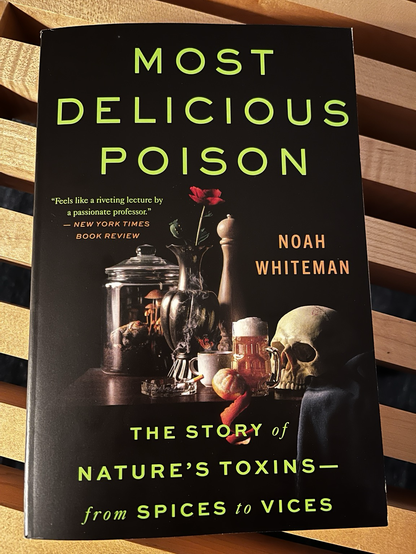
The North American paperback edition of Most Delicious Poison just shipped to a bookstore near you and will be in stores on November 18!

It printed beautifully thanks to my fabulous publisher Little, Brown & Co.
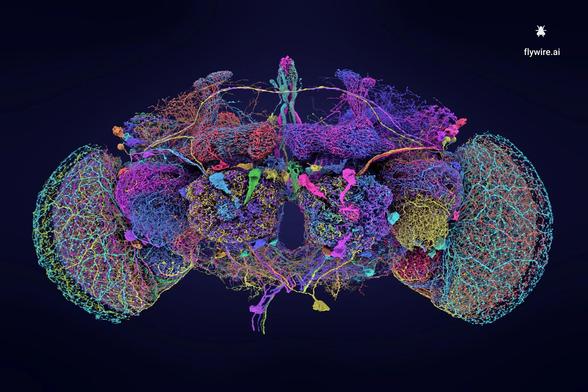
The fruit fly brain has 140,000 neurons and nearly 500 feet of wiring. Here’s my story about how scientists have drawn its map—the first complete map of any complex adult brain. Gift link: https://nyti.ms/4gR4kx0
After a Decade, Scientists Unveil Fly Brain in Stunning Detail

Scientists have mapped out how 140,000 neurons are wired in the brain of the fruit fly, Drosophila melanogaster.

The New York Times
So pleased that the UK & Commonwealth softcover edition of Most Delicious Poison has arrived! It will be published on October 3 by @OneworldNews (a wonderful team) and is available for pre-order: https://oneworld-publications.com/work/most-delicious-poison/. The North American softcover is forthcoming. Please share!
Most Delicious Poison | Oneworld

A deadly secret lurks within our kitchens, medicine cabinets and gardens. Scratch beneath the surface of a coffee bean, a red pepper flake or an apple seed, and we find a bevy of strange chemicals. We use these to greet our days (caffeine), titillate our tongues (capsaicin) and even kill our enemies (cyanide). But what is the reason plants and fungi produce such chemicals? And how did we come to use and abuse them? Based on cutting-edge science in the fields of evolution, chemistry, and neuroscience, Most Delicious Poison is the first book to reveal the origins of plant and fungal toxins, the mechanisms animals have evolved to overcome them, and how a co-evolutionary arms race made its way into the human experience. This perpetual chemical war not only drove the diversification of life on Earth, but is also intimately tied to our own successes and failures as a species.

Oneworld
Boston-area: it would be great to see you on Sept 26 @Harvard for a book talk (Most Delicious Poison) that includes a discussion with Prof. Ryan Nett, followed by signing and a reception. Tickets FREE, but sign up needed: https://www.harvard.com/event/noah_whiteman_at_harvard_science_center/ Here is the book: https://www.hachettebookgroup.com/titles/noah-whiteman/most-delicious-poison/9780316386579/. Presented by Harvard Division of Science, Harvard Library, and Harvard Book Store.
Noah Whiteman at Harvard University - Events - Harvard Book Store

Delighted to share this review in @Nature of my new book Most Delicious Poison that will publish tomorrow in North America and November 2 in UK: https://www.nature.com/articles/d41586-023-03303-z
The plant poisons that shape our daily lives

An exploration of nature’s toxins reveals complex relationships between humans and the plant chemicals we use as foods, medicines and mind-altering drugs.

Thrilled @diler and my paper with Jia Huang's lab "Convergent resistance to GABA receptor neurotoxins through plant–insect coevolution" is out: https://www.nature.com/articles/s41559-023-02127-4... Liz Pennisi also wrote a story about it: https://www.science.org/content/article/ancient-arms-race-has-helped-insects-gain-resistance-pesticides-again-and-again.... A tale of chemistry, coevolution, convergence, & CRISPR.
Convergent resistance to GABA receptor neurotoxins through plant–insect coevolution - Nature Ecology & Evolution

Antagonistic coevolution of plants and insects is hypothesized to promote biological diversity. This study shows convergent evolution of a gene that encodes the GABA receptor, a target of plant toxins, in herbivorous insects and their predators. It further demonstrates that the evolution of resistant GABA receptors is associated with insect diversification.

Nature
Prof. Nicole King and I officially became Program Directors of UC Berkeley’s Genetic Dissection of Cells and Organisms Training Program (GDTP)—the T32 predoctoral training program from NIGMS initiated and led by Profs. Iswar Hariharan and Jasper Rine. We submitted the renewal application last week and hope to be able to continue this important genetics training program for our PhD students across three departments (Molecular & Cell Biology, Integrative Biology, and Plant & Microbial Biology).
Delighted to announce the UK & Commonwealth edition of my new book MOST DELICIOUS POISON will be published on Nov. 2, 2023, by OneWorld Publications. You can preorder here: https://oneworld-publications.com/work/most-delicious-poison/. The North American edition of the book will be released a week earlier on October 24 and you can preorder that here: https://www.hachettebookgroup.com/titles/noah-whiteman/most-delicious-poison/9780316386579/. The British version has a great cover too!
Most Delicious Poison | Oneworld

A deadly secret lurks within our kitchens, medicine cabinets and gardens. Scratch beneath the surface of a coffee bean, a red pepper flake or an apple seed, and we find a bevy of strange chemicals. We use these to greet our days (caffeine), titillate our tongues (capsaicin) and even kill our enemies (cyanide). But what is the reason plants and fungi produce such chemicals? And how did we come to use and abuse them? Based on cutting-edge science in the fields of evolution, chemistry, and neuroscience, Most Delicious Poison is the first book to reveal the origins of plant and fungal toxins, the mechanisms animals have evolved to overcome them, and how a co-evolutionary arms race made its way into the human experience. This perpetual chemical war not only drove the diversification of life on Earth, but is also intimately tied to our own successes and failures as a species.

Oneworld
Thrilled to see the fruit of a wonderful collaboration led by former Ph.D. candidate Dr. Kirsten Verster (postdoc with Prof. Liz Hadly) and Dr. GyĂśngyi Cinege (Biological Research Centre, Szeged, Hungary) now out at PNAS: https://www.pnas.org/doi/10.1073/pnas.2218334120. Toxin genes from bacteria/phage moved horizontally into the genome of an ancestor of Drosophila ananassae around 20 million years ago. We knocked out the genes in this fly and found they protect it from parasitoid wasps!
My book MOST DELICIOUS POISON @lbsparkbooks will be out in Oct '23! I explore where many chemicals we use come from and how the contours of my life and the last 500 years of history were shaped by an insatiable desire for nature's toxins. Pre-order here: https://www.hachettebookgroup.com/titles/noah-whiteman/most-delicious-poison/9780316386579/
Most Delicious Poison

An evolutionary biologist tells the story of nature’s toxins and why we are attracted—and addicted—to them, in this “magisterial, fas...

Hachette Book Group