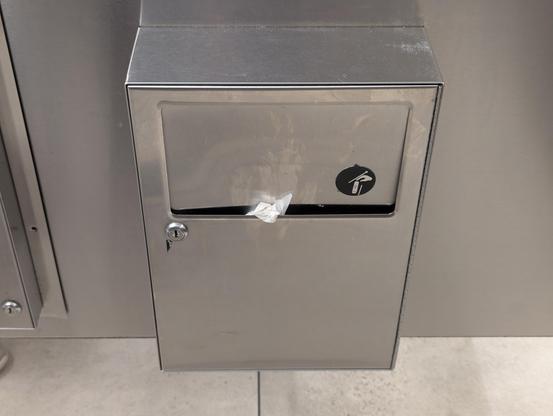
Here in the Seattle airport all the stalls in the men's bathroom have a place to dispose of your tampon ❤️
Bay Area peeps! What are you doing this weekend? Why not join me and a bunch of other amazing authors at the Bay Area Book Festival?? It's all happening in downtown Berkeley! I'll be there Saturday and Sunday! www.baybookfest.org
PLUS!! If you love science fiction, fantasy, and horror, there is a special
@Locusmag festival for the Locus Awards on Friday and Saturday during BABF, so be sure to check that out too! https://locusmag.com/2026-locus-awards-weekend/

Schedule | Buy Membership | Additional Info Join us this May in Berkeley CA to celebrate the finest in science fiction, fantasy, and horror at the Locus Awards! Locus is thrilled to announce that three of the field’s fabulously talented and award-winning authors, Tananarive Due, Stephen Graham Jones, and Nnedi Okorafor, will be headlining the 2026 Locus Awards as Guests of Honor this May. Bestselling novelists Due (The Reformatory), Jones …Read More
I’m working on an embedded database in Rust that is no_std at its core and has wear leveling built in.
Although MCU use is a core use case, it also works well under Linux. In my tests, it shows competitive performance with other embedded databases.
It is still messy and very alpha, but the results so far are exciting.
I'm incredibly pleased to announce that the microcode for the Intel 80386 has been decoded.
It was a group effort by a bunch of talented people to extract and correct the physical bits, but the major work of decoding them was done by reenigne - you may know him from such incredible PC demos as 8088 MPH and Area 5150, as well as being the person who decoded the 8088 microcode previously.
Please, check out his writeup.
https://www.reenigne.org/blog/80386-microcode-disassembled/
#retrocomputing #vintagecomputing #microcode #reverseengineering
I have made a bunch of progress in my experimental language.
https://0xa9f4.com/playground/
https://github.com/moore/langlog
The big new features are explicit state machines via the task features and the beginning of a refinement type system for the prover to use which is what the marker stuff is all about.
I have been working on a new experimental programming language. The core idea is "what if we removed all forms of runtime failure outside of algorithmic bugs". This means allocation failures, arithmetic errors, and referential integrity, bugs are all caught by the compiler.
Not all of this is implemented yet but play with what I've got so far here:
https://0xa9f4.com/playground/
The project can be found here:

 Annalee Newitz 🍜
 gloriouscow