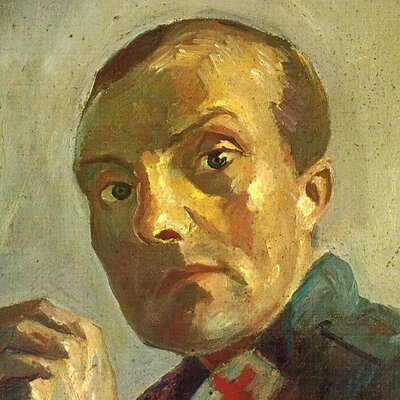
Max Beckmann, Self-Portrait, Hand to Cheek (Selbstbildnis mit aufgestützter Wange), 1916
#maxbeckmann #museumarchive http://www.moma.org/collection/works/71586
Max Beckmann. Self-Portrait, Hand to Cheek (Selbstbildnis mit aufgestützter Wange). 1916 | MoMA
Max Beckmann. Self-Portrait, Hand to Cheek (Selbstbildnis mit aufgestützter Wange). 1916. Drypoint. plate: 7 x 4 11/16" (17.8 x 11.9 cm); sheet: 14 5/16 x 10 13/16" (36.4 x 27.4 cm). unpublished. Unidentified. Gift of Mr. and Mrs. Carroll Cartwright. 591.1956. © 2023 Artists Rights Society (ARS), New York / VG Bild-Kunst, Bonn. Drawings and Prints

Hier ist Geist! (Here is Intellect!), Max Beckmann ^ Minneapolis Institute of Art

Great Scene of Agony, 1906 - Max Beckmann - WikiArt.org
‘Great Scene of Agony’ was created in 1906 by Max Beckmann in Expressionism style. Find more prominent pieces of genre painting at Wikiart.org – best visual art database.
Max Beckmann, Evening (Self-Portrait with the Battenbergs), plate 10 from..., 1916
#slam #artmuseum https://www.slam.org/collection/objects/40647/Max Beckmann, Family Scene (Beckmann Family), plate 2 from the..., 1918
#stlartmuseum #museumarchive https://www.slam.org/collection/objects/40639/Max Beckmann, The Tightrope Walkers (Die Seiltänzer) from Annual Fair (Jahrmarkt), (1921, published 1922)
#museumarchive #maxbeckmann http://www.moma.org/collection/works/70596
Max Beckmann. _The Tightrope Walkers (Die Seiltänzer) _ from Annual Fair (Jahrmarkt). (1921, published 1922) | MoMA
Max Beckmann. _The Tightrope Walkers (Die Seiltänzer) _ from Annual Fair (Jahrmarkt). (1921, published 1922). One from a portfolio of ten drypoints. plate: 10 3/16 x 10" (25.9 x 25.4 cm); sheet: 20 7/8 x 14 15/16" (53 x 37.9 cm). Marées-Gesellschaft, R. Piper & Co., Munich. Franz Hanfstaengl, Munich. Purchase. 528.1949.8. © 2023 Artists Rights Society (ARS), New York / VG Bild-Kunst, Bonn. Portfolio. Drawings and Prints

Max Beckmann. Fallen Soldiers (Gefallene Soldaten). (1914) | MoMA
Max Beckmann. Fallen Soldiers (Gefallene Soldaten). (1914). Lithograph. composition (irreg.): 11 9/16 x 10 1/2" (29.4 x 26.6 cm); sheet: 16 3/4 x 12 3/16" (42.6 x 30.9 cm). unpublished. Unidentified. Given anonymously (by exchange). 498.1954. © 2023 Artists Rights Society (ARS), New York / VG Bild-Kunst, Bonn. Drawings and Prints
Max Beckmann, Schlangendame, from "Jahrmarkt", 1921 (published 1922)
#artsmia #maxbeckmann https://collections.artsmia.org/art/106310/

Schlangendame, from "Jahrmarkt", Max Beckmann ^ Minneapolis Institute of Art
In "Jahrmarkt" ("Annual Fair"), Max Beckmann imagines the world as a traveling carnival teeming with an eclectic cast of actors, dancers, and circus entertainers who perform in the theater of life. Beckmann casts himself as a carnival barker in the series’ opening plate, ringing a small bell to announce the show, and cajoling viewers to enter the Circus Beckmann, a curious realm of outsiders and misfits. Many of the protagonists are friends and acquaintances of the artist; he even includes his wife Minna in the series, who famously appears along with Beckmann balancing on a tightrope. As the scenes of the portfolio unfold, a pageant of players takes the stage: a tall man, a sharpshooter, a snake charmer, exotic dancers, musicians, and other circus entertainers perform in succession. In one plate from the series, Beckmann presents a carousal crowded with a diverse lot of humanity, an apt metaphor for the apparent aimlessness of life. The series was inspired in part by Beckmann’s visits to the Prater, a Viennese amusement park, where he observed the performers and visitors and sketched them from life. Justly celebrated for its incisive observations on the human condition, "Jahrmarkt" is a brilliant example of Beckmann’s mature graphic style and seminal publication of German Expressionism.