John Pfaff

@Johnfpfaff
999 Followers
31 Following
59 Posts
Law professor at Fordham, author of Locked In. I'm not contrarian, the data are.

Now, this is not necessarily an argument FOR those long sentences. From almost any public policy angle (besides retribution), long sentences are hard to defend: they provide little additional deterrence, they likely over-incapacitate, they force rehab to happen in the least effective environment.

But it DOES tell us that that is where the POLITICS of long sentences have to be.

If we stay mad about long sentences for drug crimes, the resulting reforms (even in Louisiana!) would do very little.

My latest post is now up, on what those who are still in prison serving long sentences are serving those long sentences for.

The tl;dr answer? crimes of violence. In fact, for the longest-serving, a majority are in just for homicide or rape.

https://johnfpfaff.com/2023/12/12/a-final-for-now-look-at-sentence-length-those-still-serving/

A Final (For Now) Look at Sentence Length: Those Still Serving

The final look (at least for now) of long sentences: what are those who have been in prison for decades but not yet released serving time for? And the answer, as before, is “a crime of violen…

Prisons, Prosecutors, and the Politics of Punishment

My newest post, on the conviction offenses of those released from prison after serving long terms (at least 10, or maybe at least 20 years in prison).

The story is the same as the one looking at admit cohorts: those serving the longest sentences are almost all convicted of violence, often homicide.

As always, this is not necessarily an argument FOR incarceration. But it points to messiness of the politics.

https://johnfpfaff.com/2023/12/07/a-second-look-at-sentence-length-looking-at-release-cohorts/

A Second Look at Sentence Length: Looking at Release Cohorts

As part of my on-going look at what people are serving time in prison for, I look here at what crimes those who are released after decades in prison had been convicted of. It is, again, a story abo…

Prisons, Prosecutors, and the Politics of Punishment

My newest post, on the conviction offenses of those released from prison after serving long terms (at least 10, or maybe at least 20 years in prison).

The story is the same as the one looking at admit cohorts: those serving the longest sentences are almost all convicted of violence, often homicide.

As always, this is not necessarily an argument FOR incarceration. But it points to messiness of the politics.

https://johnfpfaff.com/2023/12/07/a-second-look-at-sentence-length-looking-at-release-cohorts/

A Second Look at Sentence Length: Looking at Release Cohorts

As part of my on-going look at what people are serving time in prison for, I look here at what crimes those who are released after decades in prison had been convicted of. It is, again, a story abo…

Prisons, Prosecutors, and the Politics of Punishment

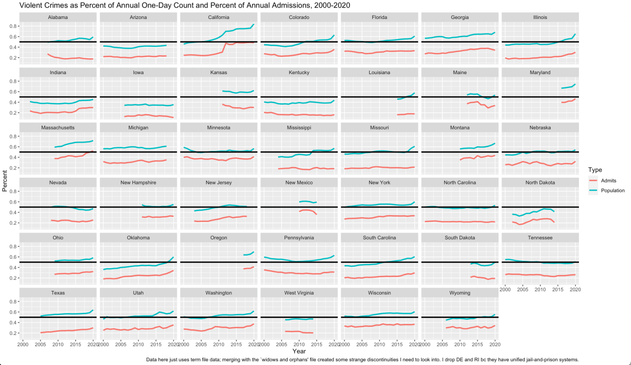
My second post on prison populations, examining the role of "churn": the extent to which looking at one-day counts may give a somewhat misleading picture of who gets admitted to prisons.

In short: while violence plays a key role in mass incarceration, those (like me!) who have argued the most about its central role may have inadvertently overstated it a bit as well:

https://johnfpfaff.com/2023/11/06/the-critical-importance-of-churn/

The Critical Importance of “Churn”

Most of our discussions of prison populations focus on the one-day count of people in prison. Looking at the types of people we admit can tell a different story, and an important one.

Prisons, Prosecutors, and the Politics of Punishment

In what may be a fairly retro move, I've decided it's time to start a blog on prisons and prosecutors.

It's easier to write out longer thoughts about the criminal legal system, and easier to post across multiple places as everything fractures.

Here's my first post, on how we've undercounted prison pops by perhaps millions of people:https://johnfpfaff.com/2023/10/30/millions-of-uncounted-people-in-prison-sort-of/

Millions of Uncounted People in Prison (Sort Of)

The not-unreasonable way we define our incarceration rate actually misses hundreds of thousands of people each year who pass through our prisons, which means we’ve undercounted the impact of …

Prisons, Prosecutors, and the Politics of Punishment

But it is also so so SO poorly understood.

In all honesty, I think local politics in general is poorly studied by academics. As best I can tell, there is about one (one!) paper on how crime impacts mayoral races, perhaps zero on prosecutors.

We are just so so SO blind.

I hope this list starts to help improve the narrative around reform prosecutors, and look forward to any and all comments!

Just assembling this list changed my perspective on the reform DA push. It's not just Foxx and Krasner and Rollins. There have been a lot of efforts--many of them successful--in places that aren't part of the standard narrative.

The movement is bigger and wider than many think.

4. There's a related challenge of how to handle multi-candidate primaries (like, Bragg wasn't the MOST prog candidate, nor the least, so is he a win? loss? both?) or two-candidate cases where both are varyingly reformy.

5. Other longer-run goals:

* I plan to add in county data on demogs, income, political ideology (% Dem vote for POTUS or something), as well as election percentages.

* A longer version of this will separate primary vs general election outcomes, have entries for each election.

3. A longer-run goal of this list is to develop some sort of metric of reform-ness, or at least some policy indicators to allow us to distinguish DAs (yes-for-declining-marijuana-cases, no-for-bail-reform, yes-for-more-treatment-diversion).

Your criticisms will help with this!