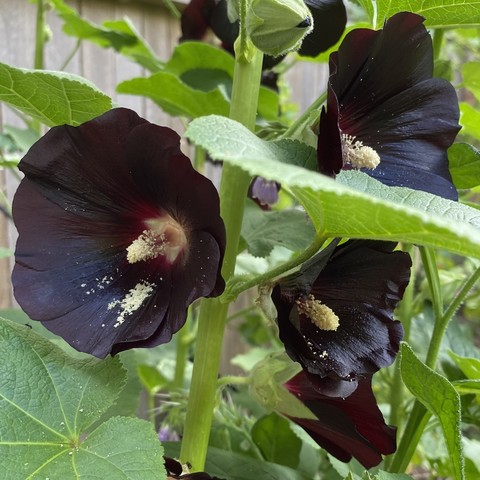
Morning visitor. Anyone recognise him/her? Location: Blue Mountains, NSW


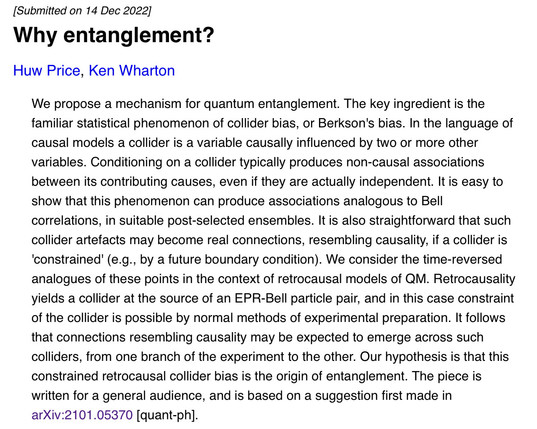

In this piece, written for a general audience, we propose a mechanism for quantum entanglement. The key ingredient is collider bias. In the language of causal models, a collider is a variable causally influenced by two or more other variables. Conditioning on a collider typically produces non-causal correlations between its contributing causes. This phenomenon can produce associations analogous to Bell correlations, in suitable post-selected ensembles. Such collider artefacts may become real connections, resembling causality, if a collider is 'constrained' (e.g., by a future boundary condition). We consider the time-reversed analogues of these points in the context of retrocausal models of QM. Retrocausality yields a collider at the source of an EPR-Bell particle pair, and in this case constraint of the collider is possible by normal methods of experimental preparation. It follows that connections resembling causality may emerge across such colliders, from one branch of the experiment to the other. Our hypothesis is that this constrained retrocausal collider bias is the origin of entanglement. This piece is based on a suggestion first made in arXiv:2101.05370v4 [quant-ph], and is an ancestor of an essay now published online in Aeon magazine [Price & Wharton 2023a]. In an updated version of the argument in arXiv:2309.10969 [quant-ph] we (i) demonstrate its application in a real Bell experiment; and (ii) show that we can do without an explicit postulate of retrocausality