RT @[email protected]
Simulation Intelligence: Towards a New Generation of Scientific Methods
SFI Pres. David Krakauer co-authored roadmap for the development
& integration of the essential algorithms necessary for a merger of scientific computing, scientific
simulation, & AI:
https://arxiv.org/abs/2112.03235
🐦🔗: https://twitter.com/sfiscience/status/1557849523459727360
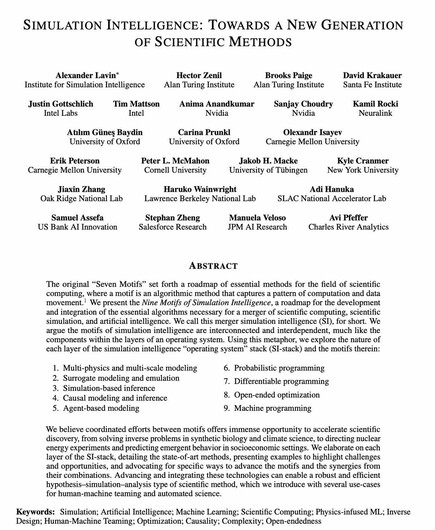
Simulation Intelligence: Towards a New Generation of Scientific Methods
The original "Seven Motifs" set forth a roadmap of essential methods for the
field of scientific computing, where a motif is an algorithmic method that
captures a pattern of computation and data movement. We present the "Nine
Motifs of Simulation Intelligence", a roadmap for the development and
integration of the essential algorithms necessary for a merger of scientific
computing, scientific simulation, and artificial intelligence. We call this
merger simulation intelligence (SI), for short. We argue the motifs of
simulation intelligence are interconnected and interdependent, much like the
components within the layers of an operating system. Using this metaphor, we
explore the nature of each layer of the simulation intelligence operating
system stack (SI-stack) and the motifs therein: (1) Multi-physics and
multi-scale modeling; (2) Surrogate modeling and emulation; (3)
Simulation-based inference; (4) Causal modeling and inference; (5) Agent-based
modeling; (6) Probabilistic programming; (7) Differentiable programming; (8)
Open-ended optimization; (9) Machine programming. We believe coordinated
efforts between motifs offers immense opportunity to accelerate scientific
discovery, from solving inverse problems in synthetic biology and climate
science, to directing nuclear energy experiments and predicting emergent
behavior in socioeconomic settings. We elaborate on each layer of the SI-stack,
detailing the state-of-art methods, presenting examples to highlight challenges
and opportunities, and advocating for specific ways to advance the motifs and
the synergies from their combinations. Advancing and integrating these
technologies can enable a robust and efficient hypothesis-simulation-analysis
type of scientific method, which we introduce with several use-cases for
human-machine teaming and automated science.
@complexsystems
RT @[email protected]
In our new paper, led by Jeremy Kazimer, in collaboration w/ Dane Taylor & the great Peter Mucha, we use changes in the entropy of network density states to learn the importance of any edge in a complex network:
https://arxiv.org/abs/2210.15148
🐦🔗: https://twitter.com/manlius84/status/1585928450472218624
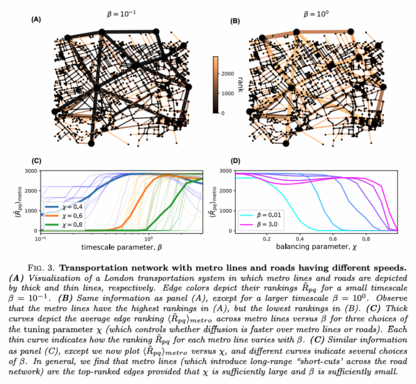
Ranking Edges by their Impact on the Spectral Complexity of Information Diffusion over Networks
Despite the numerous ways now available to quantify which parts or subsystems
of a network are most important, there remains a lack of centrality measures
that are related to the complexity of information flows and are derived
directly from entropy measures. Here, we introduce a ranking of edges based on
how each edge's removal would change a system's von Neumann entropy (VNE),
which is a spectral-entropy measure that has been adapted from quantum
information theory to quantify the complexity of information dynamics over
networks. We show that a direct calculation of such rankings is computationally
inefficient (or unfeasible) for large networks: e.g.\ the scaling is
$\mathcal{O}(N^3)$ per edge for networks with $N$ nodes. To overcome this
limitation, we employ spectral perturbation theory to estimate VNE
perturbations and derive an approximate edge-ranking algorithm that is accurate
and fast to compute, scaling as $\mathcal{O}(N)$ per edge. Focusing on a form
of VNE that is associated with a transport operator $e^{-β{ L}}$, where ${
L}$ is a graph Laplacian matrix and $β>0$ is a diffusion timescale
parameter, we apply this approach to diverse applications including a network
encoding polarized voting patterns of the 117th U.S. Senate, a multimodal
transportation system including roads and metro lines in London, and a
multiplex brain network encoding correlated human brain activity. Our
experiments highlight situations where the edges that are considered to be most
important for information diffusion complexity can dramatically change as one
considers short, intermediate and long timescales $β$ for diffusion.

AndreasStenoLarsen on Twitter
“😂😂😂”