
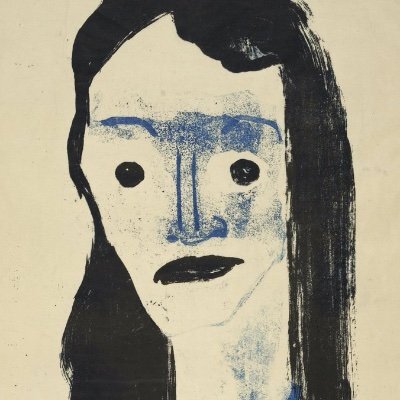
Emil Nolde
- 206 Followers
- 400 Following
- 472 Posts


Emil Nolde, Diseuse, 1910-1911 #minneapolisinstituteofart #printsanddrawings https://collections.artsmia.org/art/13194/


Diseuse, Emil Nolde (born Emil Hansen) ^ Minneapolis Institute of Art
Emil Nolde found inspiration in the decadent pleasures of urban nightlife, showing a preference for entertainers who performed in lurid artificial light. He frequented theaters, dance halls, and cabarets, recording his impressions in quick sketches that provided the basis for oil paintings and watercolors produced in his studio. The seemingly primitive treatment of this woman’s features belies the sophistication of Nolde’s watercolor technique. A marvelous balancing act of freedom, control, and chance, his handling of the brush allowed the liquid color to flow across and soak into the Japanese paper. Combining and overlapping, his wet-in-wet colors give a vivid sense of the harsh light entering from the left and casting varied shadows on the woman’s green dress. Nolde held it all together with his deft application of opaque black contours, from narrow in full light to thick in the shadows. The single stroke that separates the figure’s arm from her chest, articulating the shape and volume of both, delivers a concise statement of Nolde’s brilliance.
Emil Nolde, Farmer and Wife, 1906 #printsanddrawings #artsmia https://collections.artsmia.org/art/48859/


Figure with flowers, 1915 #nolde #emilnolde https://www.wikiart.org/en/emil-nolde/figure-with-flowers-1915


Emil Nolde, A Church by a Harbor, 1907 #artmuseum #museumarchive https://www.slam.org/collection/objects/35408/

Emil Nolde, Young Jewess II (Junge Jüdin II), (1912) #emilnolde #museumofmodernart http://www.moma.org/collection/works/65634

Emil Nolde. Young Jewess II (Junge Jüdin II). (1912) | MoMA
Emil Nolde. Young Jewess II (Junge Jüdin II). (1912). Woodcut. composition: 9 1/8 x 11 13/16" (23.2 x 30 cm); sheet (irreg.): 11 13/16 x 13 3/4" (30 x 35 cm). unpublished. Emil Nolde, Berlin, Ada Nolde, Berlin. Purchase. 268.1955. © Nolde Stiftung Seebüll, Germany. Drawings and Prints
